Saturday, March 18, 2017
Saturday Snacks for Thought: On Citizens United, Religious Fertility Wars and Some Fun
1. Jane Mayer has written an excellent and important piece about the longer-term consequences of the Citizens United Supreme Court decision which gave every dollar the same political power. Most of us could foresee what that might mean: The very rich can now legally buy almost any administration they wish and create almost any laws they want.
And Mayer shows us, very carefully, how that led to Trump and the large number of white supremacists and possibly even a Nazi or two in his administration. These shadowy super-billionaires Mayer writes about, using Mercer as her example, are the true deep "state" in the United States, our true overlords.
Granted, we still have voting for the hoi polloi, though it's more and more restricted for the black Americans every day. But if you think of voting somewhat like picking a meal in a restaurant, remember that it's people like Mercer who wrote the menu, who decided what dishes should be on it.
Friday, March 17, 2017
A Question to My Readers
What kind of posts would you like more of on this here blog? The Trump era creates an abundance of possibilities, and I find it hard to know where to focus my endeavors.
Merkel's Girl Cooties And Our Dear Leader
This is deliciously funny: Our Dear Leader had to sit down with a female leader, a woman not picked to be near her merely based on her looks or genetic kinship, and he seems to have refused to shake hands with her. It's those girl cooties. They might infect this germophobic leader!
Or it could be that Trump is following the most conservative rules about men not being allowed to shake hands with women in some interpretations of Islam, because sexual desire might then result in wanton behavior!
Just kidding. But here's a picture of the two world leaders: One the new leader of the liberal West*, the other the new leader of pre-fascist West:
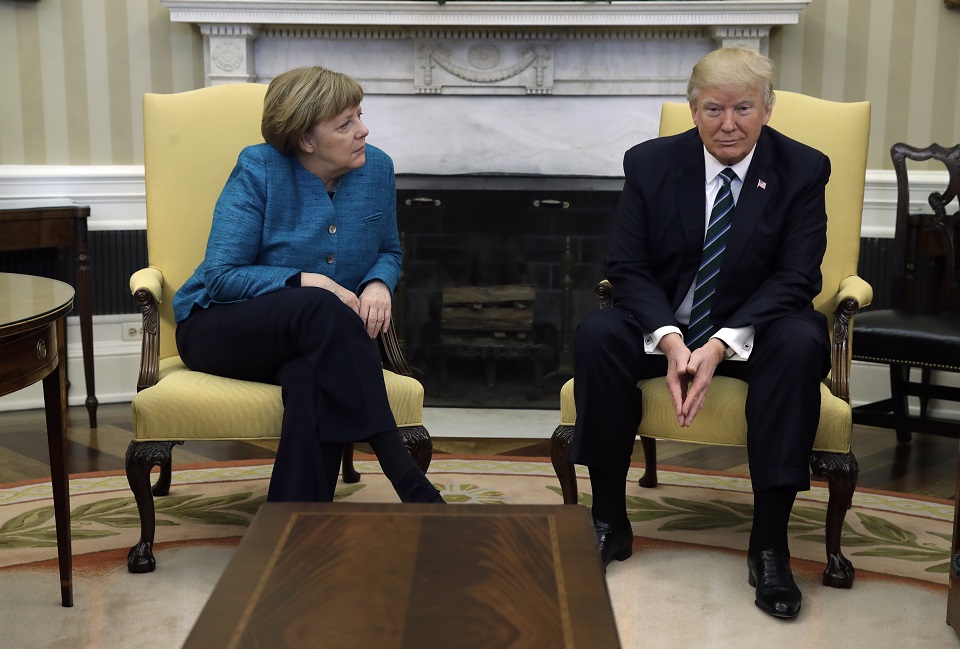
I love the body language in the picture. The way Trump tries not to connect with Merkel, the way she is turned to him while he tries to turn away and narrow his body so that there would be no possible contact. And yes, of course the picture might be those weird ones where someone is caught in mid-action and looks nothing like what actually happened.
But then there is this:
The body language was at times awkward. In an earlier photo opportunity in the White House, Mrs Merkel asked him quietly: "Do you want a handshake?" He looked forwards with his hands clasped and did not reply.
-------------
* The term "liberal" is not used here in its common American meaning. Merkel is politically fairly conservative, something like a Blue Dog Democrat in the states.
The Vetting of Sebastian Gorka
I followed the Trump campaigns and rallies fairly closely last fall, but I never saw the coming of the Breitbart reign or the direct influence of so many white male supremacists in the administration. It's as if they skittered and crawled out of the woodwork after Trump's victory, and suddenly we have the apocalyptic (in the sense of wanting one) Stephen Bannon as Trump's chief strategist.
But he is not the only extremist right-wing pseudo-Christianist white patriarch in the Trump administration. Sebastian Gorka is most likely another one, maybe even a neo-Nazi.
You can decide for yourself by reading this interesting series of articles, in the order I link to them: Begin with this one, read Gorka's answer and then the response from the author(s) of the original piece.
An Atlantic article suggests that Gorka's presence in the administration at least demonstrates poor White House vetting skills. The alternative explanation is, of course, that Gorka is exactly the kind of person Trump wants in his team. Both are troubling possibilities.
So Trump lifted a rock and all sorts critters crawled out from under it. This has echoes in the recent apparent rise in hate crimes, including the anti-Jewish and anti-Muslims threats. Or so I believe. It's as if such crimes are now more acceptable. After all, the administration itself doesn't seem to mind.
Thursday, March 16, 2017
Parsing Mulvaney on The Budget: Hard And Stupid Words
Mick Mulvaney, Trump's budget director, speaks like a manly man's man:*
“It is not a soft-power budget,” Mulvaney explained. “This is a hard-power budget, and that was done intentionally. The president very clearly wants to send a message to our allies and to our potential adversaries that this is a strong-power administration.”
STEM fields used to be called hard sciences, humanities soft. The terms were intended to be derogatory to humanities, but they also captured a gendered flavor, given that the researchers in the former were mostly men and many in the latter were women: Real men get hard! Real men do hard stuff! Girly men and girls can't get hard and can't get clear results.
Even if you don't agree with that comparison, it's exceedingly clear that Mulvaney talks war-talk. Trump wants to show the world that the US military spending is insufficient, because it only amounts to spending as much as the next seven countries put together.
That's not hard enough! Let's spend more than the rest of the whole world! Let's spend double that!
For what purpose? To protect Americans from death? The same budget tells us that Trump does not want to do that. After all, he is cutting medical research and scientific research, the kind of basic research which corporations cannot perform, the kind of basic research that might find cures for all the current killer diseases.
And he is cutting help to the poor. That those cuts would also apply to Meals On Wheels**, a program which helps some frail elderly stay longer at home and provides them with proper nutrition, is not surprising, given what Trump's health insurance plan taught us about the age of those most likely to be unable to afford insurance in it: Older individuals. But do note that this "hard-power," "strong-power" budget plans to pay for more military might by skinning the weakest, oldest and frailest among us.
Mulvaney explained how the programs and contributions to be guillotined were picked:
White House budget chief Mick Mulvaney on Thursday defended the Trump administration’s proposed deep cuts to social welfare programs such as Meals on Wheels and after-school services, saying it’s unfair to taxpayers if such programs don’t show hard results.
“Meals on Wheels sounds great,” Mulvaney said during the White House news briefing, adding that “we're not going to spend [money] on programs that cannot show that they actually deliver the promises that we’ve made to people.”
Did this man's brains leak out without him noticing? And notice that "hard" word again: Programs must show hard results.
How has the Meals on Wheels program failed to deliver? Do the volunteers who transport the meals leave them somewhere en route? Do they smear them on the walls or poison them with arsenic or what?
What are the hard results Mulvaney expects from a program such as after-school services or Meals on Wheels? Should an elderly person sip the hot soup, suddenly rise up and do thirty pushups? Should an after-school service produce PhDs from eight-year old children? What is sufficiently hard or erect to qualify?
And if we use hard results to determine the budgetary allocations, it might be worth pointing*** that the military made a mess out of Iraq, that it lost the Vietnam war and that the US forces are still in Afghanistan which has not turned into a progressive paradise of equal rights for all.
This budget proposal is not going to be the final budget. But it tells us what Trump has in his mind. And that, my friends, is frightening.
---------
* Among the white supremacists and misogynists, men who are viewed as not dominant and insufficiently oppressing are called cucks or beta males. I'm sure the Alt Right and Bannon love this budget proposal.
** The actual cut in federal aid are a fairly small percentage of the total funding of this nonprofit program and would not kill the program. But clearly Trump's budget-makers never even noticed that the budget condoned the faster killing of frail elderly homebound individuals.
*** The blame belongs to those who make the decisions, of course. My point is that the way Mulvaney explains what is to be cut could not explain why military spending is to be increased so much. In a rational reality, that is.
The Trump Budget: Good News For All Sadists!
Now this budget is fun if you are a sadist. It drowns the military in money so as to enable it to kill more people and it also withdraws money from those who are the weakest, frailest and the poorest among us.
It slashes the budget of the Environmental Protection Agency (EPA) thereby revving up the speed with which climate change will make certain parts of the world inhabitable. That, in turn, will increase the floods of migrants to countries which still remain habitable. But the budget then cuts US assistance to refugee organizations as well as general foreign aid, including the Food For Peace program which provides food assistance in emergencies.
The State Department will also find its budget severely cut. This decreases the money available for diplomacy, but who needs diplomats when we have guns and will buy many, many more?
It kills the National Endowments for Arts and Humanities, because only the coastal latte-sipping liberals need culture which, in any case, is girly stuff.* Guns are guy stuff.
The poor get to bear much of the burden of making the military sated with money:
While border guards will have more prisons to lock up unauthorized immigrants, rural communities will lose grants and loans to build water facilities and financing to keep their airports open. As charter schools are bolstered, after-school and summer programs will lose money. As law enforcement agents get more help to fight the opioid epidemic, lower-income Americans will have less access to home energy aid, job training programs and legal services.
And
Trump has unveiled a budget that would slash or abolish programs that have provided low-income Americans with help on virtually all fronts, including affordable housing, banking, weatherizing homes, job training, paying home heating oil bills, and obtaining legal counsel in civil matters.
During the presidential campaign last year, Trump vowed that the solution to poverty was giving poor people incentives to work. But most of the proposed cuts in his budget target programs designed to help the working poor, as well as those who are jobless, cope.
Ironically, the white working class voters in rural areas, deemed by some to have been the group which won the election for Trump** are among the ones who are going to be whipped by this budget:
The White House budget cuts will fall hardest on the rural and small town communities that Trump won, where one in three people are living paycheck to paycheck — a rate that is 24 percent higher than in urban counties, according to a new analysis by the center.
Perhaps they will not be too unhappy, given that the urban poor appear to be the special focus for this budgetary sadism:
The administration’s reforms include eliminating funding for a $3 billion Community Development Block Grant program, one of the longest continuously run HUD programs that’s been in existence since 1974.
The program provides cities with money to address a range of community development needs such as affordable housing, rehabilitating homes in neighborhoods hardest hit by foreclosures, and preventing or eliminating slums and community blight. It also provides funding for Meals on Wheels, a national nonprofit that delivers food to homebound seniors.
Robert Rector, a senior fellow who focuses on welfare at the Heritage Foundation, a conservative Washington-based think tank, calls the community block grants a “slush fund for urban government.”
During his campaigning Trump repeatedly promised to eradicate all poverty from low-income urban areas. Is this the way he plans to achieve that?
The budget is unlikely to pass in its present form. But it's a wake-up call for the new Trump Reich rules, a speech clearer than most of Trump's boasts on how he views the future of this country.
There will be a lot of aggressive posturing, money will not be spent on the poor but on a giant wall against the foreign poor. Money will be spent on guns, not on plowshares, and money will be spent on preparing for war, not on preventing it.
---------
* Republicans have always wanted to kill these, always. And the Corporation for Public Broadcasting is going to get less money, too, despite its sharp recent tilt toward a conservative bias.
It's worth noting here that if Trump didn't take a Florida vacation most every weekend, we could afford to keep the National Endowments for Arts and Humanities. But as I noted in the text, culture is girly crap.
** In the sense of the straw that broke the camel's back. The vast majority of Trump voters were the same Republicans who voted for Romney in 2012, and we should not forget this.
Still, Trump is not honoring some of his promises that he gave at the rallies where he was adulated:
Parts of the budget proposal also appear to contradict Trump’s agenda. Trump has said he wants to eliminate all disease, but the budget chops funding for the National Institutes of Health by $5.8 billion, or close to 20 percent. He has said he wants to create a $1 trillion infrastructure program, but the proposal would eliminate a Transportation Department program that funds nearly $500 million in road projects. It does not include new funding amounts or a tax mechanism for Trump’s infrastructure program, postponing those decisions.
Tuesday, March 14, 2017
On Those Lower Insurance Prices After 2020 in (T)Rumpcare
The one thing Republican politicians like about the recent Congressional Budget Office (CBO) assessment of their replacement plan for the Affordable Care Act (ACA) is that the CBO estimates a drop in the price of individual insurance after 2020.*
The premia will rise until then, because of the predicted exit of many young-and-healthy individuals from the insurance market. Under the ACA, the individual mandate demanded that they, too, should buy coverage, but under the (T)Rumpcare that mandate is removed. The loss of many young, low-risk individuals will raise the average premia for those who remain in the individual market.
So what changes after 2020, to cause a drop in the price of individual insurance?
Is it the greater price competition in the wonderful "free" markets, as conservatives usually argue? This
House Speaker Paul Ryan pressed that point in a series of appearances Monday night, suggesting that the budget office had found that the House bill would increase choice and competition and lead to lower prices. The Senate majority leader, Mitch McConnell, issued a statement saying, “The Congressional Budget Office agrees that the American Health Care Act will ultimately lower premiums and increase access to care.”
Sadly, no. This is how the CBO explains its conclusions about the dropping price of insurance:
Starting in 2020, the increase in average premiums from repealing the individual mandate penalties would be more than offset by the combination of several factors that would decrease those premiums: grants to states from the Patient and State Stability Fund (which CBO and JCT expect to largely be used by states to limit the costs to insurers of enrollees with very high claims); the elimination of the requirement for insurers to offer plans covering certain percentages of the cost of covered benefits; and a younger mix of enrollees. By 2026, average premiums for single policyholders in the nongroup market under the legislation would be roughly 10 percent lower than under current law, CBO and JCT estimate.
That quote gives three reasons for the decrease in average premia. Let's look at them in a reverse order:
First, the CBO expects the enrollees to be younger, on average. Now why would that be the case? It's not because the US demographics are starting to tilt that way. Rather, it will be a direct consequence of many older people exiting the insurance market, because they can no longer afford the premia. Note that the tax credits (which would replace the income-tied subsidies in the ACA) are twice as large for a sixty-year old than a twenty-year old but the premium that can be charged to the former are allowed to be five times as large as the premium charged to the latter. This combination can be devastating for poorer older individuals:
The C.B.O. estimates that the price an average 64-year-old earning $26,500 would need to pay after using a subsidy would increase from $1,700 under Obamacare to $14,600 under the Republican plan.
Note that the exit of the older, poorer and sicker individuals from the market is not because of greater consumer choice or greater competition or greater efficiency in the insurance marketplace. It's a direct consequence of increasing the pool of the uninsured, and in one sense the price of insurance to that group is extremely high, so high that they are not buying any coverage.
The second reason for the CBO to predict lower premia after 2020 isn't about consumer choice, greater competition or greater efficiency, either, unless we interpret those concepts in an unusual way.
That reason is that insurers no longer need to offer plans which cover a certain percentage of the cost of the covered benefits, which means that consumers get less coverage for any given level of premia.
Here's the 60,000 dollar question for you: Has the price of insurance dropped if the bundle you are buying costs less, but also has a lot less insurance in it? How can you tell?**
Finally, the CBO points out that the Republicans in power plan to give states grants from the Patient and State Stability Fund, and those grants can be used to pay for the care of high-risk consumers and/or for the subsidies of poor consumers. They would reduce the average price of insurance in the individual market, true. But Margot Sanger-Katz in the New York Times suggests that the Patient and State Stability Fund is set to expire after 2026. Oddly enough, the CBO evaluation period conveniently ends at that year, too.
Thus, it's possible that these particular grants to the states would no longer help keeping the premia down in, say, 2027.
So what are we to conclude from all this?
That none of the predicted decreases in the price of individual insurance are caused by greater price competition which then produces greater efficiency. Instead, average premia might drop because many higher-risk older individuals become unemployed (while desperately counting days to the start of Medicare coverage), because the contents of some insurance bundles are watered down, and because of some price subsidies for high-risk and/or poorer individuals.
It's also worth reiterating that the average drop in the price of individual insurance doesn't benefit everyone equally. Rather, the people most likely to see that drop are the ones least likely to need health care (the young low-risk consumers):
By 2026, the budget office projected, “premiums in the nongroup market would be 20 percent to 25 percent lower for a 21-year-old and 8 percent to 10 percent lower for a 40-year-old — but 20 percent to 25 percent higher for a 64-year-old.”
---------
* IHA=I Hate Acronyms
Nobody Could Have Predicted! That (T)Rumpcare Would Result in Many More Uninsured!
All the fuss over whether it's 24 million people who will lose their health insurance under (T)Rumpcare or 26 million! I know that our Dear Leader has promised all Murkans almost free health care with the most excellent quality, and I know that he is still promising great price reductions in a few years.
But our Dear Leader lives in the Alternative Reality where his job is to be adulated and that happens best when he promises people the impossible.
From this reality it was certain-sure from day one that the repeal and replacement of the Affordable Care Act (ACA) would lead to many people losing either some or all of their health insurance.
After all, there is no other way for the Republicans to achieve the real goal of that repeal and replacement. This:
Two of the biggest tax cuts in Republican proposals to repeal the Affordable Care Act would deliver roughly $157 billion over the coming decade to those with incomes of $1 million or more, according to a congressional analysis.
The assessment was made by the Joint Committee on Taxation, a nonpartisan panel that provides research on tax issues.
It is not unusual for tax cuts to benefit mostly the wealthiest, but still save some money for a majority of Americans. But the benefits of these reductions would be aimed squarely at the top.
And once we take all that money out of the system, the obvious result will be less coverage for someone. If the (T)Rumpcare plan passes, it's going to be the poorer consumers who will suffer and also those older consumers whose premia might rise so much that they would drop out of the market altogether. Ironically, the average price of insurance could then drop, given that the group of older consumers with their higher-than-average health risks has shrunk.
More about that dropping price in my next post!
Monday, March 13, 2017
On Nude Photos of Women, Name Swapping at Work, Women's Repro Rights Endangered by Religions And Race Wars, and Female Power
An additional cost the Trump Reich has placed on us is that it sucks all the air and energy out of the coverage of any other topic. Democracy is imperiled! How can I sleep or make love or eat chocolate or write about women's issues?
Well, here's a summary on many women's issues I have collected while hyperventilating because democracy is at risk and because Trump wants to speed up climate change. But these other things are happening, too:
Saturday, March 11, 2017
A Blogger Mystery
One evening this week my blog received 80,000 hits from Romania. In one hour. I'm not a celebrity in Romania (yet), and those hits have nothing to do with who might read this measly blog. I also often receive similar "attacks" from China and Russia, though Romania really is the most insistent, the most stubborn and the most faithful.
Of course I want to know what all this means. My working theory is that the Blogger itself is facing giant DoS attacks, and somehow allocates all that useless traffic across lots of blogs so as to defeat the attacks. A bookkeeping maneuver, in other words.
But I could be wrong.
Friday, March 10, 2017
What Trump-Voters Are Getting From Our Dear Leader And Other Political News
1. I had a post written on what gifts Trump and the Republican Congress are giving to some in their base when it comes to the repeal and replacement of Obamacare (aka the ACA), but then I found that post already written, and better:
Take it altogether, and a sort of ironic picture unfolds. “The typical person who is going to lose the most in this scenario is a lower-income person in their 60s who lives in a rural area, where the person who gains is the affluent millennial urbanite,” Cynthia Cox, an analyst at the Kaiser Family Foundation, told me. In other words, the Republican plan doesn't just screw the poor. It screws Trump voters in particular, while giving a hand to a lot of young people who probably voted for Hillary. Go figure.Paul Ryan is also a gift that keeps on giving wonderful presents to the middle-income-class Trump voters:
House Speaker Paul Ryan (R-Wis.) on Wednesday said he’s “not that concerned” about criticism of the wealthy getting a tax cut under the GOP’s new health care bill.He's not that concerned, because canceling those taxes was the whole point of the Republican campaign against the ACA. And neither is he concerned that the way to fund those tax breaks is by taking it off the skins of the poor.
Fox News host Tucker Carlson told Ryan it’s “kind of a hard sell” to argue the wealthy should get a tax cut under the American Health Care Act. Ryan brushed it off.
“I’m not that concerned about it, because we said we were going to repeal all the Obamacare taxes,” Ryan said. “This is one of the Obamacare taxes.”
2. I haven't written much on all those intricate Russian connections to the Trump campaign, because that is specialist work. But it all sounds like one of the John le Carre spy novels, except with idiots.
And Here We Go Again! Why Should Guys Pay For Prenatal Care in Insurance?
I love this idiocy, I love it. My earlier explanation for the many reasons why insurance makes us pay for all sorts of stuff we ourselves don't consume can be found in this earlier post.
But Rep. John Shimkus (R-Ill.) didn't read that post, sadly, and so he put his big, hairy foot in his mouth:
The law also required plans to cover pregnancy and childbirth. That’s where the fireworks started in the Energy and Commerce Committee.As I wrote before, I will from now on refuse to pay for any treatment that I would never need: Prostate cancer, testicular cancer, male impotence treatments, vasectomies, male hair loss treatments, the treatment of genetic diseases that can't be found in my genetic inheritance, treatment for any accidents caused by hazardous sports I don't participate in (skydiving, water-skiing, mountaineering, racing), the treatment of any tropical disease (to be changed if I myself choose to travel in the tropics) etc..
“What mandate in the Obamacare bill does he take issue with?” Doyle asked Shimkus, using the formal parlance of congressional committees.
“What about men having to purchase prenatal care?” Shimkus said.
At that point, one could hear the room start to stir.
“I’m just . . . is that not correct?” Shimkus said. “And should they?”
And as I wrote before, prenatal treatment should probably be paid by the child who is going to be born, because most of it is to benefit that child. Why would the women be lumbered with all of it? Since the child cannot pay yet, why shouldn't the man whose child it will be also pay for that treatment? Parents, in general, are supposed to support their children financially.
Rep. Shimkus was never born, of course. He was formed from the primordial slime by some chance event, I assume.
But mostly I love Shimkus's statement because it is such a clear example of how the right thinks about reproduction: It's the wimminz job, and no, we are not going to make any part of it easier. No, we are not going to have paid maternity leaves, no, we are not going to stop pregnancy discrimination, no, we are not going to let women have reproductive choice. And no, we are not going to pay for any of it.
Wednesday, March 08, 2017
Ah Women! What Would We Do Without Them? Putin and Trump on International Women's Day.
It's the International Women's Day which some are rapidly turning into an alternative Mothers' Day (you get flowers! you get chocolates!) and away from its actual roots which are to do with demanding improvements in the lives of the millions and millions of women who are second and third class citizens in their own countries, cultures and religions.
It's to demand that laws take rape and domestic violence seriously, to give you just one example of the underlying demand for gender equality.
The purpose of the day is also to highlight women's economic, social political and intellectual achievements*, partly to talk back to the misogynists and those who listen to them.
But the day turns into something quite different in the paws of Vlad "the Impaler" Putin and Donald "the Pussygrabber" Trump. Here is our Dear Leader, on the International Women's Day:

And here is Vlad:
Dear women: mothers, grandmothers, daughters, wives, friends, our nearest and dearest ones, please accept my heartfelt congratulations on International Women’s Day!
You fill this world with beauty and vitality, giving warmth and comfort, cordiality and harmony with your tenderness and generosity of spirit.
You care day and night for your children, grandchildren and your family. Even today, on International Women’s Day, you are still caught up in your routine, working tirelessly, always on time. We often ask ourselves, how do they manage it all?
The messages are almost the same, my sweetings, though Vlad places women firmly in their unpaid care roles inside the family, while Donny gives a nod to the idea that women might be useful in other jobs, too. They are both full of awe and respect! Vlad can't even understand how those overworked women manage to do it all! But he is grateful for it, especially for not having to do it himself, I guess, and for not having to pay them much in the labor market.
Neither autocrat acknowledges the real purpose of the International Women's Day which in my view is about the change that is needed. That's because neither autocrat wants that change, so the plan is to flatter women in general and turn this day into something that Hallmark cards can profit from. From its original purpose of making women's lives less oppressed on the global level and of raising the respect of women as human beings.
A celebration of status quo is the way I read Putin's and Trump's messages. If that's the way we are going, then there really should be a widely-celebrated and equally vacuous International Men's Day.
---------
* Examples of the last one can be found here, here, here, here and here. I have only picked STEM field examples, given that it is the field where the battles rage the hottest. But there are many other examples that little girls and boys should learn about.
Tuesday, March 07, 2017
Four Points on the Proposed (T)Rumpcare (It's the Greatest!)
1. We are now allowed a few sneaky peeks into what might (1) become (T)Rumpcare: the proposed substitute for the Affordable Care Act (ACA). I agree with Andy Slavitt's tweet thread (25 tweets long) on its main points (2), in particular this:

The Republican opposition to ACA was always about the way it was funded from extra taxes on the wealthy. Those taxes would disappear in the proposed (T)Rumpcare plan:
“Households at the top of the U.S. income ladder would see taxes on their wages and investments drop under the House Republicans’ new health-care proposal,” the Wall Street Journal’s Richard Rubin notes. “As expected, the bill repeals a 3.8% tax on investment income and a 0.9% tax on wages. Both levies affect only the highest-earning households, those individuals making at least $200,000 and married couples making more than $250,000.”
“The Republican plan (also) includes a tax break for insurance company executives making over $500,000 per year,” BuzzFeed’s Paul McLeod observes. “Companies can generally deduct employee salaries as a business expense but in 2013 the ACA capped the deductions on health insurance executive salaries at $500,000. The average compensation for top health insurance executives is in the millions. In 2014 the left-leaning Institute for Policy Studies found that this cap generated $72 million in additional tax revenue.” The draft explicitly eliminates the cap, so the more insurance companies pay their executives the less they will pay in taxes.
Sunday, March 05, 2017
Women's Free Stuff in the ACA. Is It Unfair?
So I was reading this article about how the repeal of the ACA would particularly harm women, and came across this little pearl at the end of the article. It's a statement by an organization which opposes giving women "free stuff:"
The Commonwealth Foundation, a free-market think tank in Harrisburg, said the ACA is forcing benefits, and extra costs, on people who may not want them.Very interesting. Let's take a few sentences out of that quote for closer perusal:
Elizabeth Stelle, the foundation's policy analysis director, said the organization wants people to have more choices so they don't have to pay for services they're not going to use.
For example, she thinks women should be allowed to choose if they want preventive services and birth control covered under their plans.
She noted the cost for services haven't declined, but have been spread to other areas. She said the reason women were paying more for health care before the ACA is because they require more health care.
"The alternative, under the ACA, which I think is extremely unfair, is we then asked single men, for example, to essentially pay for maternity coverage that they had no intention of ever using. I don't think it's fair to ask somebody to pay for coverage they're never going to use," Stelle said.
She said the reason women were paying more for health care before the ACA is because they require more health care.Stelle's statement is about the individual health insurance market, not about employer-based group health insurance. In the former women indeed were usually quoted higher prices for the coverage packet, and that higher quote was justified in the way Stelle does here.
But there's a flaw in the basic assumption. Well, two flaws:
First, much of the greater health care use by women is not for themselves but for the infants they give birth to*. Pregnancy and birth-related expenses shouldn't be assigned to just the mother. Perhaps they shouldn't be assigned to her at all, with the exception of the costs of caring for any complications to her health. An alternative view would be that those health care costs are the first expense of the new person who is born.
Second, women tend to see the health care sector more for routine visits, checkups and preventive care, all of which drive up their usage figures. But to the extent such care prevents more expensive treatments later, their overall lifetime costs might be lowered, right?
And there is evidence that the average annual cost of men's care begins to exceed the costs of women's care later in life. Why that doesn't raise men's premia in the individual markets is because the age at which this becomes visible is also the age at which individuals begin to qualify for Medicare, the federal health insurance system for old age. Thus, from one angle men's higher health care use in older age is subsidized by the society.
The other paragraph in the above quote that is worth closer scrutiny is this one:
"The alternative, under the ACA, which I think is extremely unfair, is we then asked single men, for example, to essentially pay for maternity coverage that they had no intention of ever using. I don't think it's fair to ask somebody to pay for coverage they're never going to use,"
Great! I will from now on refuse to pay for anyone's vasectomies, testicular cancer care, impotency treatments, prostate cancer or the treatment after accidents which were caused by skydiving, downhill skiing, boating or race driving. I will also refuse to pay for the care of any congenital disease that doesn't affect my genetic group.
Note, also, that the "single man" in Stelle's example was once born and most likely used medical care in that context, and that the only reason he could now view maternity benefits as not having anything to do with him is because his birth is in the past. Things are different for future "single men."
The wider problems in those opinions are a) that the more we slice-and-dice the insurable pool of people into smaller sub-groups, the lower will the benefits of insurance ultimately be, and b) that the opinion fails to understand the public benefits of, say, subsidized contraception for the poor.
It helps to reduce unintended pregnancies, helps to reduce abortions and helps to reduce the costs associated with the avoided pregnancies and deliveries. Many of those costs would have to be paid from public sector subsidies. It's quite possible that the net savings to some imaginary (and celibate) single man would be greater if the ACA contraceptive benefits were retained. In other words, he would pay less for the IUDs in his insurance premium than he would later have to pay in taxes under the alternative repeal-the-benefits scenario.
-------
* And these infants have fathers. Those fathers should bear some responsibility for the costs, I would think.
The same blindness is common when free contraception is discussed. That the male partner of a woman receives 100% of the benefit, assuming he doesn't want to become a father, and 0% of the possible medical side-effects of, say, the contraceptive pill, sounds to me like a deal not to be sneezed at. But the Rush Limbaughs of this world think the situation is the unfairest one can imagine: Sluts being subsidized for sluttery.
In the Trump Reality the Sky Has Flying Unicorns. Their Poop is Polka-Dotted.
And they poop on us. That's why our Dear Leader tweeted yesterday about the previous president, calling him "sick" or "bad," two adjectives in his sock drawer of twenty or so adjectives. Don't be misdirected by all those expert opinions on how unlikely it is that Obama would have wiretapped the Trump Tower last October. It's true, if our Dear Leader says that it is true, and all the rest is unicorn poop in this alternative reality.*
What a genius move from our Dear Leader! When the truly ominous evidence is finally revealed about his Russian Connection, not a single Trump-voter will believe it! Obama's fault, you know, all those fake facts. Had we had Breitbart News during the Nixon era, nobody would ever have believed in Watergate.
More unicorn poop: The US State Department has a tradition of publishing its annual human rights report with lots of fanfare. Previous secretaries of state have been present at the occasion, but the current secretary of state-cum-Exxon, Rex Tillerson, didn't turn up for the 2017 presentation. He didn't even send anyone at all.
Human rights organizations are worried that Tillerson's behavior is a signal: The new US will pee on that horrible politically correct concept of human rights.
Alternatively, Tillerson might not even know about the occasion, given that Bannon has his hairy hands around the neck of the State Department, which is very close to death altogether. The rumor is that Trump's son-in-law will take care of any future diplomacy that might be necessary. Bannon prefers the concept of an apocalyptic war (which he will watch from a distance) as a form of muscular foreign diplomacy (remember that Miller crowed about the alpha males being back in power?).**
Finally, the repeal and replacement of the Affordable Care Act (ACA) is chock full of unicorn poop: Everyone will get perfect insurance coverage for pretty much no money! Quality of health care will be higher!
But the possible replacements the Republicans let us peek at have several serious problems:***
- Health Savings Accounts are promoted. For them to make sense, the individual must be able to save for the costs of treatment beforehand, and the tax subsidies they include are regressive. That means the wealthier earners get bigger savings!
- The contents of the insurance packages are not specified properly. Imagine a random family being offered two insurance packages with different price tags. How can the family decide between them if they don't cover the same services?
We can't even tell which actually IS cheaper under those conditions.
- And any return to pre-ACA times will also return us to the situation where millions of individuals will have no health insurance.
I wonder what will rain down on us in the future. Maybe we will be told that the unicorn poop isn't unicorn poop at all, but a very nutritious snack. Like manna from heaven.
---------
* Can you tell me what point there might be in trying to write a fact-based blog, my sweet and erudite readers? This is the post-factual reality, where the emotions of anger, lust and rage rule. But then I can do emotional posts, too. (Weeps bitter tears, kicks in the garage door, once again, and tears off half the scales.)
** This paragraph is an example of my new style of not linking to any evidence. Actually, you can find the evidence in my previous posts, because my conscience still fights the idea of just letting fly with whatever opinions I happen to have, even though that's how it now goes.
Also, don't look into Miller's empty eyes. You could fall in and never find your way back to humanity.
*** These three are just a sampling. There are other problems, many described here.
And Republicans insist on using the inherently wrong assumption that price competition in health care would work. It cannot work, because quality of care is not directly comparable or measurable, with the exception of fairly routine services provided as preventive care or dental checkups etc. Also, the supply side is not atomic, there are barriers to entry and monopoly power among the suppliers.
Friday, March 03, 2017
A Study on the Era of Alternative Facts
This media study is important:
Our own study of over 1.25 million stories published online between April 1, 2015 and Election Day shows that a right-wing media network anchored around Breitbart developed as a distinct and insulated media system, using social media as a backbone to transmit a hyper-partisan perspective to the world. This pro-Trump media sphere appears to have not only successfully set the agenda for the conservative media sphere, but also strongly influenced the broader media agenda, in particular coverage of Hillary Clinton.
While concerns about political and media polarization online are longstanding, our study suggests that polarization was asymmetric. Pro-Clinton audiences were highly attentive to traditional media outlets, which continued to be the most prominent outlets across the public sphere, alongside more left-oriented online sites. But pro-Trump audiences paid the majority of their attention to polarized outlets that have developed recently, many of them only since the 2008 election season.
These are information bubbles, and not the easily bursting kind. Though the tendency is more noticeable on the right, I see weaker versions of it on the left, too.
I have spent time surfing various right-wing and left-wing sites. Here are my observations:
1. It's not just that the same events are presented differently on the right and on the left: which events are viewed as news also varies. The reason for the Benghazi-craze of so many Republicans is that Benghazi was in "their" news for very long time periods,* whereas other similar terrorist attacks came and went fairly quickly.
2. Even for the same news, the evidence marshaled to support a particular point of view differs. As an example, lefties are likely to discuss Trump's deportation policies by linking to horrible stories about families torn apart in ICE operations, whereas righties are seeing the same policies framed by stories about crimes undocumented aliens have committed.
3. Where the right-wing sites do differ, perhaps because they are more polarized, is in the creation of odd alternative realities. George Soros as the man who held Hillary Clinton's puppet strings and who finances almost all left-wing activism in this country is one such alternative reality. I have never managed to squeeze one dime out of Mr. Soros, sigh.
Another example of those alternative realities is the Pizzagate "scandal," fabricated out of nothing and spread all over the extreme right websites.
This study casts light on the question why so many individuals would believe in something so bizarre. The answer is that anything repeated often enough becomes part of established truths, if nobody is allowed to offer different evidence.
4. The basic biased framework can be strengthened by those who participate on various sites.
My example of that comes from a misogynistic Facebook page, but similar examples would apply to any right-wing site (and, in theory, to any political site).
That particular page is all about the violence committed by women, especially against men, and readers bring in links to stories about female murderers or batterers from all over the world. These links give the site the appearance of being factual about the great danger of criminal women, but that is only because no links are introduced about the crimes committed by men, including against women. The latter are statistically many times more common than the former. Yet the participants on that site appear quite unaware of that fact.
5. Even when a conservative site uses studies or statistics to bolster its point of view, those almost always omit any studies or statistics which do not support the arguments the site wishes to make. That is not unexpected for propaganda, but unacceptable for a site, such as Breitbart, which pretends to be a news site.
Do read the whole description of the study. It's informative, and it lays out the problem we really have to deal with. If different people believe in different realities we are going to be in great and continuous trouble as a country.
---------
* Fox News' coverage has similar aspects. For example, vast amounts of time is spent covering any cases where a mother may have murdered her children, even if the cases have no national significance, while other murder cases are not reported at all.
Thanks to Cole d'Biers at Eschaton for the link to the study.
Demolishing the Administative State And Other Bannon Presidency Issues
Remember when Stephen Bannon told us that one goal of the Trump administration is to demolish the administrative state?
Hence the people that Trump (read: Bannon) has nominated. Their true purpose in most cases is to destroy the departments Republicans loathe. Betsy deVos to run down public schools and teachers' unions (by doling out cheap lottery tickets, aka vouchers), Scott Pruitt to despoil the Environmental Protection Agency (a quarter of its budget is under threat) and so on.
From that angle this Atlantic article on the State Department is most interesting:
Right now, those I’ve spoken to in the department seem to know very little about what’s going on. The staffer told me that she finds out what’s going on at State from the news—which she spends all day reading because, after years of having her day scheduled down to 15 minute blocks, she has nothing else to do. And even the news itself isn’t coming from official sources. There hasn’t been a State Department press briefing, once a daily ritual, since the new administration took over five weeks ago—though they’re scheduled to resume March 6. These briefings weren’t just for journalists. They also served as a crucial set of cues for U.S. diplomats all over the world about policy priorities, and how to talk about them. With no daily messaging, and almost no guidance from Washington, people in far-flung posts are flying blind even as the pace of their diplomacy hasn’t abated.
Assuming this description is valid, how much of the chaos is due to incompetence and how much of it is a feature, not a bug, of Bannon's plans?
Imagine staffers getting their information from where I get mine: The news!
Well, at least we don't have to worry about Hillary Clinton's private emails. That both Pruitt and Pence appear to have used private email accounts for official bidness is not a problem, of course. They are Republicans and also have no girl cooties.
Thursday, March 02, 2017
My New Idol
Siiri Rantanen is a
retired cross-country skier from Finland. She competed in the 1952, 1956 and 1960 Olympics and won a medal in each of them: a gold and a bronze in the 3×5 km relay in 1956–60 and another bronze in the individual 10 km in 1952; she placed 5th and 15th over 10 km in 1956 and 1960, respectively. She also won five medals at the FIS Nordic World Ski Championships.[
And here she skis at the age of 92.
Wednesday, March 01, 2017
The Presidential Speech
Olympic ski jumping is roughly scored on the basis of style and distance, presidential speeches by style and contents. But yesterday's speech by our Dear Leader was almost completely scored on the basis of style. The distance, which here equals the contents of the speech, didn't seem to affect the scoring of the speech.
Far too many in the media, especially the pundits, saw their task as only the scoring of Trump's style. Someone had written him an indoor version of his campaign speech, with more opaque language, more hidden code words and zero direct insults. He read that speech from a teleprompter, and the crowds cheered!
Van Jones called him presidential. Tom Brokaw called his speech the most presidential yet. Karl Jonathan called him presidential.
That the contents of the speech changed not one single thing in his policies didn't seem to matter. He called for all Americans to come together and to support his extreme right-wing radical policies, and some pundits were impressed.
But of course it was a good speech. It was emotional, telling the listeners about the current hell that is the US of A, but also telling them that rescue is coming, that Donald Trump will ride in on his white charger, that he will rescue us all.*
We will all then ride into the glorious sunset together, holding hands, ride into that America where there are no constraints, where all promises will be fulfilled, where all crime will be eradicated, all poverty cured, and where the Statue of Liberty no longer opens her arms to the tired, poor and huddled masses, but only to those who have an engineering degree and a trust fund.
Yes, it was a good speech, because Trump's speeches are scored not on the same basis as the speeches of previous presidents but on the trump-o-meter: His own past awkward history. Compared to that history, reading relatively smoothly from a teleprompter indeed is a presidential achievement.
It was also a terrible speech, filled with misinterpreted or flawed data and promises which cannot be kept by anyone not divine. If it made the listener feel good that was caused by those impossible promises and the rapid leaps over what the actual solutions might be that create this paradise we are all lurching towards.
And it was a terrible speech because it presented the very policies Trump is pursuing as something wonderful: He still tells us that cutting health insurance will make it more available, that it is imperative to move money from the poorer to the richer by reducing taxation of corporations and the one percent, that it is equally imperative to close the doors of this country to all but those whom the corporations want to employ without paying for the necessary training. He still plans to play the Lone Cowboy in international politics, he still plans to put a stop to reproductive choice for women and his plans still smell of white** nationalism.
Given all this, why did some pundits decide that the speech made Trump "presidential?" Is it because he was more fluent, less rude and less childish than before? Or is it because he has frightened the press by calling it the "enemy of the people?" Or are we still using the false equivalences in political coverage where every criticism of a Republican president should be matched with at least one praise?
Remember Hillary Clinton's email coverage? Can you imagine how this speech would have been scored for style if it had been given by president Hillary Clinton? Or what the conservatives would now say if president Clinton had ordered the Yemen raid to take place and then put the blame for its botched nature firmly on the generals? Yet it was the presence of the widow of the fallen Navy Seal at the speech which offered Trump the best opportunity for creating an emotional national moment of patriotic sacrifice and compassion.***
It's worth pointing out that someone in the White House found it astonishing how easily the press was tamed. All that was needed were style points.****
-----------
* Well, not all, of course. But the right types of people.
** White male nationalism, really, because Trump's focus on the armed forces, the military and infrastructure projects are all aimed at increasing jobs in traditionally male occupations and because he supports limitations on women's reproductive choice, perhaps to pass the control of that to other authority figures in their lives.
*** For a different view, read this.
**** And, to be fair, the fact Trump (or his speech writer) finally made a statement against the racist, anti-Semitic and xenophobic attacks which seem to have sprouted up everywhere since his election.
Subscribe to:
Posts (Atom)