Thursday, September 01, 2016

Trying To Crack The Old Puzzle: Do Women "Choose" Low-Paid Jobs Or Do Jobs Become Low-Paid Because Women "Choose" Them? A Re-Posting.

Originally from here.


New York Times article looks at the  findings of several recent studies on this puzzle:

A new study from researchers at Cornell University found that the difference between the occupations and industries in which men and women work has recently become the single largest cause of the gender pay gap, accounting for more than half of it. In fact, another study shows, when women enter fields in greater numbers, pay declines — for the very same jobs that more men were doing before.
Consider the discrepancies in jobs requiring similar education and responsibility, or similar skills, but divided by gender. The median earnings of information technology managers (mostly men) are 27 percent higher than human resources managers (mostly women), according to Bureau of Labor Statistics data. At the other end of the wage spectrum, janitors (usually men) earn 22 percent more than maids and housecleaners (usually women).

Bolds are mine.
 
Occupational segregation (1) by sex has long been known to be one important reason why women, on average, earn less than men, on average:  Because many more women than men work in low-pay industries and occupations.  Almost all predominantly female industries and occupations pay less than almost all predominantly male industries, and job titles traditionally associated with women's jobs (say, secretary) pay less than job titles traditionally associated with men's jobs (say, administrative vice president for office work) (2).

Now tease apart that giant knot!  How much of this is because of direct sex discrimination?  How much because of indirect sex discrimination:  The steering of girls into certain fields, the pressures put on boys and girls to have jobs compatible with traditional gender roles at home?  So that boys expect to have to earn more than half of the family's income one day, while girls expect to have to do the bulk of child-care one day?

Or, as the gender essentialists argue, do men just happen to like and thrive in jobs which pay well, whereas women just happen to like and thrive in jobs which do not?   Are men better at asking raises and competing?  Would the same strategies even work for women?

Individuals might steer themselves, too, while not even thinking about it that much.  Young heterosexual men with traditional values or expectations might expect to have to earn enough to provide the bulk of income support for a family one day, with some "junior partner" type financial support from the wife who will do the bulk of childcare and cleaning etc.   Young heterosexual women with traditional values or expectations might expect to need extra flexibility one day, to do the hands-on caring for those future children, and that could lead them into picking flexible careers, even if they are not that well paid (3).

I can make dozens of those kinds of mini-theories, in various directions, but they are not statistical evidence.

One promising way to start teasing the knot apart is by asking what happens when an occupation turns from predominantly male to predominantly female or vice versa.

Why?  Consider this:  Say that an occupation is currently predominantly male and pays pretty well.  Then lots of women enter it.  They can't have entered it because it's one of those flexible-but-low-pay jobs which fit well with parenting:  It isn't one at that point.

But it can become one, at least a less well-paid one, and it looks like the cause is the influx of more female workers (4).  The New York Times article quotes the authors of one study on what happens when women start entering an occupation in larger numbers:

A striking example is to be found in the field of recreation — working in parks or leading camps — which went from predominantly male to female from 1950 to 2000. Median hourly wages in this field declined 57 percentage points, accounting for the change in the value of the dollar, according to Professor Levanon. The job of ticket agent also went from mainly male to female during this period, and wages dropped 43 percentage points.
The same thing happened when women in large numbers became designers (wages fell 34 percentage points), housekeepers (wages fell 21 percentage points) and biologists (wages fell 18 percentage points). The reverse was true when a job attracted more men. Computer programming, for instance, used to be a relatively menial role done by women. But when male programmers began to outnumber female ones, the job began paying more and gained prestige.
It would be fascinating if someone created a very detailed study of the changes in just one occupation over time.  Maybe such a study exists, but I haven't come across one.  I'd like to know the exact point in the tipping process at which average earnings start to drop, I'd like to know the exact point when men start avoiding the field that is turning female-dominated, I'd like to know everything about technological change  in the field during the process.

I'd also love to understand why some occupations  don't seem to result in sex segregation, and how those differ from the ones that are prone to tipping (moving from male-dominated to female-dominated or vice versa).

I hope this isn't quite the mess it looks to me.  To return to the title of the post: It was a sneaky one, because I forced you into accepting a false either-or set of choices.  Both could of course be true at the same time.  But if the New York Times summary of the studies is correct, we should seriously address why jobs become lower-paid when more women enter them (5).

------

(1)  Occupational segregation by sex refers to the simple fact that some industries or occupations have mainly male workers, some industries or occupations have mainly female workers.  It says nothing about the reasons why the industries got that way, it says nothing about how voluntary or involuntary those gendered choices are and it says nothing about the reasons why female-dominated jobs pay less.  All that is a separate question.

(2)  I made up that second job title, but you get the point.  Which is that it's possible to pay someone less by just changing labels. 

(3)  The less-well-paid female dominated jobs are not necessarily more flexible or more compatible with major responsibilities for child-care; an important point which is often ignored by those who argue that women "choose" lower paying occupations for their greater flexibility.  Hospital nursing is not very flexible and neither are female dominated factory or sales jobs.  Teaching is the one exception to that rule.  It's also worth noting that studies suggest men are paid more, on average, even in female-dominated fields and women paid less, on average, even in male-dominated fields.

(4)  Or reverse the same example for an occupation that rapidly goes from at least mixed if not predominantly female to male.  The initial reason for the larger numbers of men entering the field cannot be higher earnings in that occupation in general, if the underlying theory is to hold.

(5)   The quotes around the verb to choose are explained in this post.

Wednesday, August 31, 2016

The Normal Breast Gallery, Again.


I came across this link in my archives.  The site is well worth visiting, for a reality correction.  Our views of what female breasts are supposed to look like are probably even more affected by pron and television and movies than are our views of what women are supposed to look like, in general.

Tuesday, August 30, 2016

For Your Toolkit 4: How To Evaluate Research Findings


That title is much more ambitious than what this post can offer, which is a minimal introduction to  certain pitfalls in interpreting popularized research findings, especially if they are good click-bait.  More on the topic of iffy political use of research can be found here.

Monday, August 29, 2016

The Wounded Young Hero of Literature, Arts, Politics And Especially Journalism . A Re-Posting.

Originally from here.

Prologue

This post has no mothers, but it has multiple fathers, the wounded young men of arts and literature who rebelled against the society from their garrets, hungry and full of erotic lust and rage, the wounded young actors who portrayed "rebels without a cause,"  the wounded young political writers who were allowed to rage and rant against unfairness and inequality, but who were also allowed to wear proudly those mystical scars which womanhood had cut into their hearts and brains, thus turning them into misogynists.

I call these men wounded young heroes, though they were not always young when they gained the label or wounded in the way most of us would define the term.  Being "wounded," being "imperfect," is what makes them into truth-speaking heroes.

Philip Roth proffered us his misogyny like an orchid reeking of dying flesh and he was applauded for it.  Picasso painted women as the deepest nightmares of his soul and he was applauded for it.   Norman Mailer, John Updike, Milan Kundera, and many other famous mainstream male writers celebrate their fear, loathing and just plain misunderstanding of women in their literary works, and though they have been criticized for it, they still wear the laurel leaf wreaths of public approval and fame.

Now flip that over.  Assume that it is the hatred or fear of men or the analysis of those feelings which largely fuel the art or writing of some talented woman.  What will her reputation be?  Into what box will history place her art?

Women cannot be mainstream artists or writers if they knit their hatred of men into their art or writing.  But it takes much, much more for a man's work to be discounted in history than just loathing towards half the humanity.  He can still be mainstream, he can still be adulated, his work can still be widely taught.

He can Break The Rules.  He can be a rebel while supporting an ancient and traditional part of human history with his misogyny.  He can rebel against the capitalists and oppressors and be a protector of the weak, except when he rails at women, the weakest in many societies.

He can show us the scar some woman has inflicted on him (or so he believes), praise that scar, generalize that scar to all womanhood, use that scar to sell sexual humiliation of women as the rightful outcome in a rebel's world (Henry Miller), and we, the audience, take him seriously, accept his young-hero status, his truth-speaking status.  We, the audience,  honor the great Tolstoy's writings*, even though he assigned women to only their biological roles and frequently employed the Madonna/Whore dichotomy.  We, the audience, don't slam the door in his face. 

And we shouldn't slam that door.  But that door would be slammed against any woman who did the reversal.  Even the term "wounded young heroine" elicits utterly different images in our minds, and women cannot be wounded young heroes.  Not really.

This is the hi-falutin prologue to a post  which is about more mundane writing and about more mundane concerns.  Still, my central concern is to ask if we switched the gender of the main protagonist in these stories, would the stories still read the same, would the consequences of the stories be the same, would we even have reversal stories of this type published anywhere.

I have selected examples which are not all so clear-cut as those I mention above, but they flow from that same archetype:  The truth-telling young rebel whose misogyny scar doesn't invalidate the hero's ascent but validates it.


Friday, August 26, 2016

Friday Fun. A Re-Posting


From here, and just because I think it's funny.  (Also this.)

David Brooks has written an ode to the hard-boiled Sam Spade characters as the proper role models for young idealists who try to save the world:
The noir heroes like Sam Spade in “The Maltese Falcon” served as models for a generation of Americans, and they put the focus squarely on venality, corruption and disorder and how you should behave in the face of it.
A noir hero is a moral realist. He assumes that everybody is dappled with virtue and vice, especially himself. He makes no social-class distinction and only provisional moral distinctions between the private eyes like himself and the criminals he pursues. The assumption in a Hammett book is that the good guy has a spotty past, does spotty things and that the private eye and the criminal are two sides to the same personality.
He (or she — the women in these stories follow the same code) adopts a layered personality. He hardens himself on the outside in order to protect whatever is left of the finer self within.

He is reticent, allergic to self-righteousness and appears unfeeling, but he is motivated by a disillusioned sense of honor. The world often rewards the wrong things, but each job comes with obligations and even if everything is decaying you should still take pride in your work. Under the cynical mask, there is still a basic sense of good order, that crime should be punished and bad behavior shouldn’t go uncorrected. He knows he’s not going to be uplifted by his work; that to tackle the hard jobs he’ll have to risk coarsening himself, but he doggedly plows ahead.
This worldview had a huge influence as a generation confronted crime, corruption, fascism and communism. I’m not sure I can see today’s social entrepreneurs wearing fedoras and trench coats. But noir’s moral realism would be a nice supplement to today’s prevailing ethos. It would fold some hardheadedness in with today’s service mentality. It would focus attention on the core issues: order and rule of law. And it would be necessary. Contemporary Washington, not to mention parts of the developing world, may be less seedy than the cities in the noir stories, but they are equally laced with self-deception and self-dealing.
I have bolded the actual message in that piece, the conservative message.

But the reason I write about this at all is that a long time ago I wrote a few sentences from the angle of a noir heroine:
Today was a day like all other days that are also called Sundays. The same slowness, the same newly starched faces in all the same church pews, the same drunks at the street corners worshipping in their own way. I wake up with a hangover next to the face of a stranger. The whiskey bottles on the floor are empty, and I have a headache down to my kidneys. Remind me not to go out with gorillas in the future, especially when the keyboard sits there idle, filling me with guilt. I slug down the eau de toilet from the bathroom cabinet and light up a stogie end I find under the sleeping gorilla. Time for some heavy lifting. The audience is out there, somewhere, and one day they will hear about me and even pay me. Until then I'll be ok with the booze and my karate skills. The roads are hard for a gal all alone but you knew that already.
Then the doorbell rings and it's a client for my one-woman blogging agency: David Brooks, banging on the door, falling into my arms, sobbing, when I open it (after I hide the stogie under the pillow). Someone is threatening to publish his murky past as a Maoist activist in Nepal* and he wants me to whitewash it all for him. Hmm. That could work as a story.
----
*This past is my invention. I think.

Thursday, August 25, 2016

The Conservative War Against Teachers. A Re-Posting.

Originally from here.


US conservatives have an odd schizophrenic angle to the power of markets:  They are all-important (godlike, even), and must not be meddled with in finance, for instance, but when it comes to teaching professions those same markets can be totally ignored.  Indeed, the conservatives like a command economy there, as in "We command, teachers obey."

The point I've made before is that conservatives shouldn't completely ignore markets in their attempts to behead the political power of all teachers' unions.

To give you an example, cutting back on teachers' retirement benefits means cutting back on their total compensation packages.  In Chicago, for instance:

The district, which says it is wrestling with a $1.1 billion deficit weighted with pension payments, wants to save millions of dollars by having teachers pay more into their pension fund. The district wants to end a long-standing agreement that limits teacher paycheck deductions for pensions, the union said.

That CTU said the result would be a 7 percent cut in take-home pay for members. The union also says health care premiums could take another 3 percent under a district proposal.

What do you think a seven-percent compensation cut would mean for the supply of new teachers?  Remember that they must invest in a college degree which is not getting cheaper, even as the financial pay in the occupation declines.

Here's the answer:

The number of students interested in becoming educators continues to drop significantly—From 2010 to 2014, the number of ACT-tested high school graduates interested in education majors or professions decreased by more than 16%, while the number of all graduates who took the ACT increased by nearly 18%.
Those who express interest in teaching tend to score lower in all areas except English than those who express no such interest.

This is another case of short-sighted politically motivated dinners where the politicians happily eat the seed corn to make sure that the Democrats don't get today's bread.

The topic matters for women's employment.  Traditionally*, teaching has been one of the few areas which has allowed an easier combination of childcare duties with paid work (getting home at the same time as the kids, being at home during their vacations).  The lower pay, compared to other jobs which have similar college investment requirements, has been acceptable because of that flexibility.  But if the pay keeps going down further we will see a drop in the supply of teachers and the quality of the incoming teachers.

----
*In the bad-old days US women had three somewhat wide job paths into middle class earnings.  They were teaching, social work and being a secretary.  See what is happening to teaching, then read what is happening to secretarial jobs, and the importance of opening the IT jobs to more women looks pretty clear.


Wednesday, August 24, 2016

Terry Pratchett Thoughts. On the Role of the Media and On Citizens as Consumers. A Re-Posting

Originally from here.

I've been re-reading many of Terry Pratchett's books, in his memory.  I often come across little jewels (or chocolate truffles) of ideas.  For example:

"the public is not interested in public interest."

Which is true.  The reasons for that are many and varied, but it's almost impossible to try to write about topics of public interest on a commercial basis (so send money).

My most recent re-read is The Truth, about the first newspapers in Ankh-Morpork.  Mr. William de Worde starts the very first one, with actual news in it (though also stories about funny-shaped vegetables).  A competitor soon catches on with scandalous stories such as "a woman gives birth to a cobra."

de Worde gets a statement from the king of the area where this miracle-birth was supposed to have happened, at some cost for himself.  The king denied any cobra-human births to have happened.

The response of the readers was that of course the king would deny everything, of course.  In any case, stories about women giving birth to cobras are a lot more fun than stories about politics, say.

All that reminds me of American politics, in a gently ridiculous sense. Weird people writing or nattering about Hillary Clinton's cankles (a term for fat ankles) as if it matters what size ankles a president has and as if we ever otherwise measure the ankles of presidential contenders.  Presidents being judged on the basis of whether we'd like to have a beer with them.

Imagine using that way of judging for picking your neurosurgeon.

All this links in a vague way to a Finnish article I recently came across, on the new approach to citizens as consumers.  This is the part I wish to translate:

Kun on riittävän monta vuotta toisteltu, että kansa tietää parhaiten kaiken, ovat sivistysinstituutiot alkaneet nöyrtyä.
Korkeakoulujen oletetaan palvelevan paitsi liike-elämää ja politiikkaa, myös oppilaitaan, joista on tullut asiakkaita.
Lehdet ovat luopuneet vanhanaikaisesta valistajan roolista ja kyselevät yleisöltä, mikä on tärkeää. Nettiäänestyksissä media tenttaa lukijan mielipidettä asioihin, jotka eivät ole mielipiteestä kiinni: tuliko lama, lämpeneekö ilmasto, tappavatko rokotteet, mitä mieltä jengi.
Asiakkaan rooli voi imarrella meitä hetken, mutta demokratian ja sivistyksen osalta se on tylsä loukku: olemme aina oikeassa, ja siksi meidän ei tarvitse omaksua uutta.

My approximate translation:

When we have repeated for many years that the people (here meant as the audience) know best all the cultural institutions have begun to agree.  Universities are assumed to serve both business and politics but also the students who are now customers.  Newspapers have given up their old-fashioned role as educators and enlighteners.  Instead, they ask the public what is important.  In online polls the media wants the reader's opinions on matters which are not based on opinions:  did we have an economic recession, is the climate warming, do vaccinations kill.  What do you guys think?

The role of a customer can momentarily flatter, but it's a boring trap from the point of view of democracy and culture:  we are always right and that's why we don't have to learn anything new.

Tuesday, August 23, 2016

For Your Toolkit 3: The Need to Distinguish Between Small And Large Numbers


This post was originally published here.


I've always liked statistics as a science  but never thought it hawt and sexy.  Now I wish we could make statistics more sexy (bare more skin?) in order to save more of us from falling into those hidden wolf traps of the net.  They don't have sharpened sticks, those traps (holes in the ground, covered by branches), but they do hurt our understanding in somewhat similar ways.

An example of the wolf trap:  Someone writes on, say, racism or sexism in recent events and then gets attacked by trolls.  Suppose that in one scenario there are five very active trolls hammering at the poor writer, in an alternative scenario there are five thousand such trolls.

The two scenarios are not the same, they don't tell us the same story about the likely number of people "out there" believing whatever those trolls believe.  That's why it's very wrong to argue that the presence of five Twitter trolls in one's mentions means that the troll-opinion is extremely common in the real world.  Yet in the last week I've seen several people take that view of events:  The mere existence of any nasty trolls (and nasty they are) means that those trolls have sizable backing in the world of opinions, ideas and values.

So that is about proportions or percentages.  There will always be people with extreme nasty values, there will always be some who troll.  To unearth a troll comment and then to write about it as if it represents a sizable number of people in the real world is lazy and just wrong.  Even utopia would have a few trolls, hankering for life in hell.

It matters whether 0.1 percent or 60% of Americans believe that broccoli should be banned.  Those who don't get that difference are going to create "the-sky-is-falling" stories, and they are not ultimately helpful.

Add to all that the problem of self-selection, which means that those who comment on any particular incendiary topic are much more likely to be the ones who hold the extreme opposite view of the one any particular writer has used in a piece (broccoli haters, whether 0.1% or 60%, will be much more likely to be in the comments section of your Broccoli Is King article than anyone else).

That's why the comments sections, especially if not moderated, are dominated by angry voices and often opinions better suited to critters who just crawled out of the primeval slime*.  You know, the way any article about gender inequality that focuses on women gets comments from angry meninists.

People who agree with the writer tend not to waste time scribbling that down under the article, and people who aren't that bothered either way tend not to spend time in the comments, either.  The Twitter discussions work on somewhat similar principles, though the fact that people have followers makes them less hostile to the imagined writer here.  But those who hated what you wrote are the ones with real energy to look up your handle and then enter the "discussion."

These two problems I've described above are a) ignoring the actual prevalence of various beliefs  and b) ignoring self-selection on the net.  That double-ignorance can have bad consequences:  We may be misled into believing that a molehill is a mountain, we may initiate much larger angry fights with an imaginary enemy (windmills?) and we may misunderstand the scope of the problem altogether.

A similar problem is born when someone writes an article starting with the planned plot.  Suppose that the plot is how much people hate broccoli.  The intrepid journalist will then go out and interview people.  What if the vast majority of those interviewed aren't bothered about broccoli at all?  That statement will not have a prominent place in the planned story.  Instead, even if it takes a very long time, the journalist will find a few people who reallyreally hate that green tree-pretender among the vegetables, and it is the opinions of those few people that we all will then read.

The next stage (and believe me I've seen this stage recently, though not about broccoli hating) is for people to talk about the vast camp of broccoli haters and mention the opinions of the interviewed few as representative of what that vast camp thinks.

This doesn't mean that anecdotes cannot reflect majority views or the views of an important numerical minority.  But strictly speaking an anecdote, if true, tells us only that one particular person held a particular opinion.  It doesn't tell us how common that opinion is.  For that we need the collection and analysis of statistical data about the whole relevant population (all vegetable eaters in the case of broccoli).

So all this was what has stopped me from writing on various interesting topics yesterday.  Aren't you glad I shared?
-----
*With all due apologies to critters from the primeval slime who are probably charming and empathic ones.


Monday, August 22, 2016

Alcohol And Fertile Women Who Don't Use Contraception. Or: Hi, Baby-Making Factories!


This post, on the CDC recommendations about alcohol consumption by fertile women not using contraception was first published last February.  It's worth re-posting, given that what it describes is a part of a longer-term trend.


1.  The USAToday's Summary of New CDC Recommendations


The Big Brother has arrived!  According to the USAToday:

Women of childbearing age should avoid alcohol unless they're using contraception, federal health officials said Tuesday, in a move to reduce the number of babies born with fetal alcohol syndrome.
“Alcohol can permanently harm a developing baby before a woman knows she is pregnant,” said Anne Schuchat, principal deputy director of the Centers for Disease Control and Prevention. “About half of all pregnancies in the United States are unplanned, and even if planned, most women won’t know they are pregnant for the first month or so, when they might still be drinking.
"The risk is real. Why take the chance?” Schuchat asked.
The CDC estimates 3.3 million women between ages 15 to 44 are at risk of exposing a developing fetus to alcohol because they drink, are sexually active and not using birth control. Even when women are actively trying to get pregnant, three in four continue drinking after they stop using birth control, according to the CDC report.
There is no known safe level of alcohol at any stage of pregnancy, according to the CDC. The American College of Obstetricians and Gynecologists recommends women abstain completely from alcohol while pregnant.

The bolds are mine.  Read the first bolded sentence and then the second bolded sentence.  Notice any difference?  The hook in the article tells us that all women not using contraception who belong to a usually fertile age group should stop drinking, for the sake of future babies (whether planned or completely imaginary, and even if they will be born to someone else).  Even Lesbians, hermits, nuns, other celibate individuals and infertile people should abstain from alcohol!  Any woman might accidentally fall upon a penis, I guess.

Now imagine the Pre-Pregnancy Police coming for you if you try to get a drink and don't have enough wrinkles to prove your new legal drinking age! (1)  Bartenders and other volunteers might refuse to serve you that glass of wine or at least first demand to know if you are on the pill, and then decide if you are allowed to drink.

The Pre-Pregnancy Police doesn't yet exist.  But the Pregnancy Police, in the form of not only actual police but also concerned volunteers is a real thing and a real pest for pregnant women. I guess one advantage of this new recommendation is that now those helpful strangers can pester all younger women equally and not just the ones who are visible pregnant.

After writing that rant about the USAToday summary I read what the CDC  actually says:

An estimated 3.3 million women between the ages of 15 and 44 years are at risk of exposing their developing baby to alcohol because they are drinking, sexually active, and not using birth control to prevent pregnancy, according to the latest CDC Vital Signs report released today. The report also found that 3 in 4 women who want to get pregnant as soon as possible do not stop drinking alcohol when they stop using birth control.
Alcohol use during pregnancy, even within the first few weeks and before a woman knows she is pregnant, can cause lasting physical, behavioral, and intellectual disabilities that can last for a child’s lifetime. These disabilities are known as fetal alcohol spectrum disorders (FASDs). There is no known safe amount of alcohol – even beer or wine – that is safe for a woman to drink at any stage of pregnancy.

Bolds are mine.

That is not the same as the first sentence in the USAToday story.  I wish newspapers didn't promote shitty journalism.


2.  The CDC Recommendations.  On Statistics And Medical Studies.
 

But even more I wish that the people at CDC had a better understanding of statistics, more transparency about what  medical research actually shows and doesn't show.  I also wish that they had hired someone who would have edited the writing  in this sentence:

 An estimated 3.3 million women between the ages of 15 and 44 years are at risk of exposing their developing baby to alcohol because they are drinking, sexually active, and not using birth control to prevent pregnancy.

Those 3.3 million women don't all have "a developing baby".  They are potentially at risk for becoming pregnant.  Those two are very different things, and what is developing during any resulting pregnancy is not called a baby until it is born. 

For the statistical problems, consider this quote that was used in the USAToday article as well as in the original CDC report:

About half of all pregnancies in the United States are unplanned, and even if planned, most women won’t know they are pregnant for the first month or so, when they might still be drinking.

That half of all pregnancies in the United States are unplanned does NOT mean that every woman has a 50% chance of having an unintended pregnancy!  Yet all public health announcements aimed at fertile women seem to assume that the 50% frequency difference applies to every single fertile woman, even those who don't have heterosexual intercourse.

The actual situation is quite different, as this Guttmacher Institute graph shows:


I quote from the graph:  The two thirds of US women at risk of unintended pregnancy who practice contraception consistently and correctly account for only 5% of unintended pregnancies.


I suspect that the CDC researchers who wrote the recommendation did take that Guttmacher information into account, because the recommendation doesn't extend to women who use reliable contraception.  But the USAToday made a hash of it all and the CDC still parrots the statement without giving that sentence I bolded.

Even the more moderate statement from the CDC is not moderate when it comes to certain hidden assumptions about what various groups of women can be asked to sacrifice and for what types of reasons. To see why that is the case, let's talk about the medical evidence on fetal alcohol syndrome (FAS).


Friday, August 19, 2016

On High Heels And Other Clothing Coded As Female. A Re-Posting


The post is originally from here.  For other posts about female clothing, see, for example,  this, this and this post.


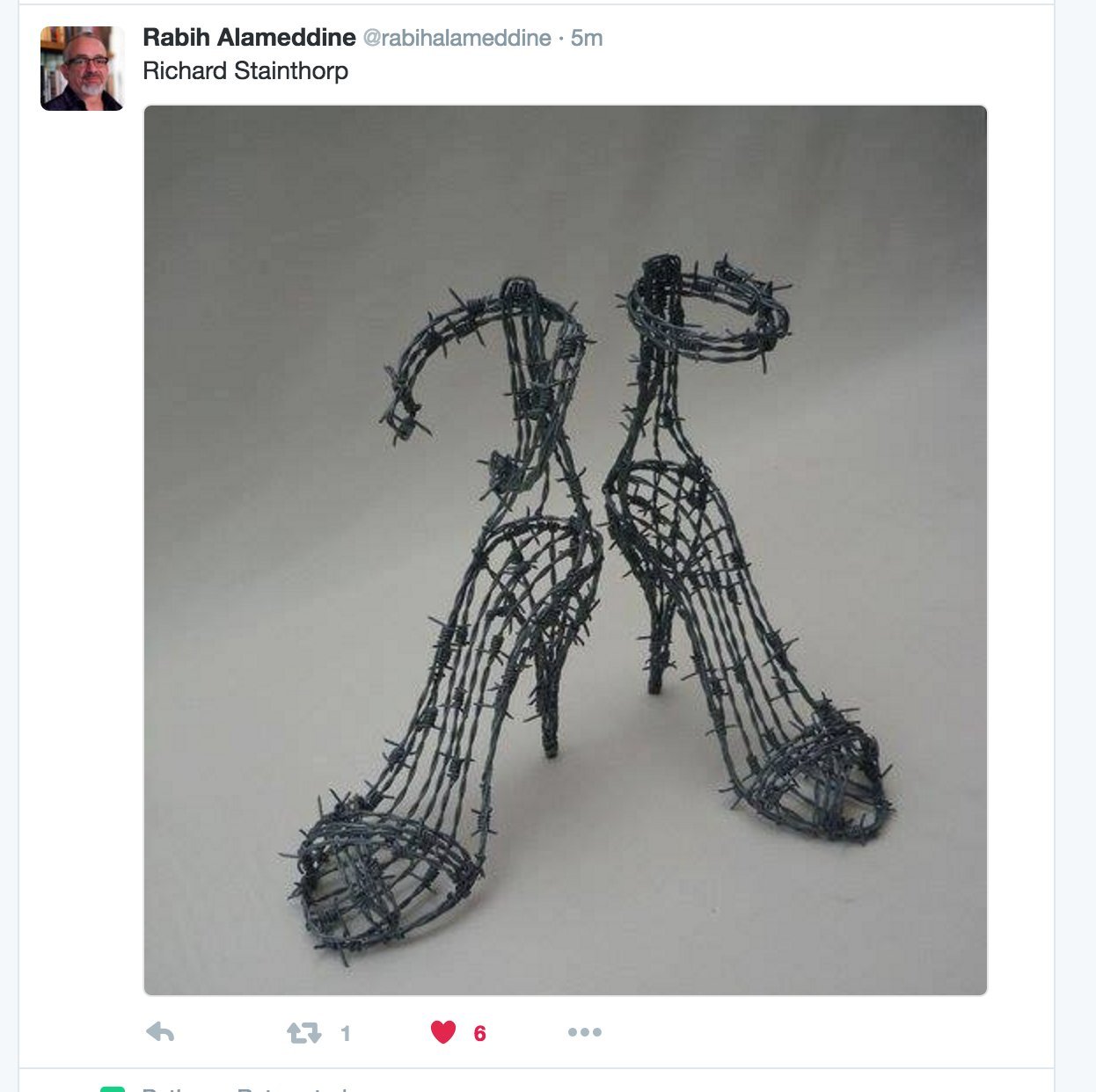
Richard Stainthorp's  wire sculpture (hat tip to Rabih Alameddine) makes the pain of very high heels visceral:  Ouch!


High heels are almost compulsory in fashion photographs, even so high heels that nobody could run in them should a saber-tooth tiger attack.  The reason is that they make women's legs look longer and tilt their butts to an inviting angle (for saber-tooth tigers?).

Many items of clothing which are intended to signal female gender hurt*.  Think of girdles which American women wore until fairly recently, think of Victorian corsets, think of those high-heeled shoes, think of dresses as tight as fish skin or belts pulled so small that the stomach commits suicide.  All those are intended to showcase female beauty.

From the other end, modesty clothes (to hide female beauty),  long dresses, niqabs or face veils, abayas or long cloaks,  hurt in a different way.  Abayas are stifling in hot climates, their bagginess means that they can catch on things which can result in accidents, and burqas, say, make women likely to stumble because they restrict vision .  Hearing is harder through several layers of fabric, too.  And in the colonial America women's long dresses could catch fire in the kitchens.

What both the "revealing" and the "covering" female-coded clothing share is that they make it much harder for someone to be physically active.   A woman or a girl cannot run in them, she cannot play soccer in them, she cannot climb a tree in them.  Even knee-length dresses make that tree climbing impossible, if anyone can look up that dress. 

Is it female passivity that these gender-coded clothes are intended to promote**?

Never mind.  No laws currently require American women and girls to wear girdles or high-heeled shoes or abayas, and it can be fun to take a little bit of pain when dressing up for a wild party.

But not all women on this earth are in an equally free position when it comes to their clothing.  Both Iran and Saudi Arabia have laws which stipulate that all women inside their country's borders must wear the government's approved version of Islamic dress, including women who are not Muslims.

And then there's this recent British case:

A receptionist claims she was sent home from work at a corporate finance company after refusing to wear high heels.
Nicola Thorp, 27, from Hackney in east London, arrived on her first day at PwC in December in flat shoes but says she was told she had to wear shoes with a “2in to 4in heel”.


Thorp, who was employed as a temporary worker by PwC’s outsourced reception firm Portico, said she was laughed at when she said the demand was discriminatory and sent home without pay after refusing to go out and buy a pair of heels.
Thorp found out that nothing in the British laws stops firms from requiring that their female workers wear high heels***.  I wonder if a British firm could demand that its male workers wear, say,  codpieces?  They don't seem to have the health risks  that high heels do, after all.  And I think they would look great!

-------------------------
Please support this blog.  It's the fund-raising week and I promise I won't spend the money on clothing.


*  This tends not to be the case for clothing intended to show that someone is male, though men's business uniform (suit, tie, clunky dark shoes etc.) might be more restricting today than the equivalent women's business uniform (unless high heels are required).

That is an exception to the rule.  In my opinion the reason is that the male business suit has not changed for roughly a century.  When it was first created it was considerably more comfortable than female clothing of the era.  But in the West women's clothes have changed a lot during those hundred years, while men's business suits have not.

**  And if so, was it always the case?  In the medieval era European women and men dressed more alike than they did for several centuries afterwards, with both sexes wearing tunic-type outfits.  Women's tunics were longer than men's tunics, but close enough in style so that medieval wills sometimes leave clothing to individuals who are not the same sex as the person who made the will.  I believe that it was the available technology and the great expense of cloth that caused this similarity.  Gender was signaled by head-dresses and jewelry, not by most clothing. 

It is only recently that the everyday clothing of the sexes has once again become pretty similar.

*** She launched a petition to change this.


Thursday, August 18, 2016

Life Is Complicated. A Re-Posting.


Originally from here.


Sometimes I despair of people's desire for very simple solutions to complicated problems.  Life is complicated, human behavior is complicated and the causes for many phenomena are myriad and interacting.  Yet what most people want are the kinds of explanations which can be made into television soundbites or which can be understood immediately by a person who has no training in the field.

Hence the popularity of, say,  evolutionary psychology where my guesses about the past are as good as your guesses about the past, and neither one of us needs actual data from that imaginary past!  We can just make up simple explanations.  That's partly why those theories apply to so many.  Why they apply to misogynists goes without saying.

Take that Search For Simple Answers to politics and you get Ron Paul believing in some weird god of free markets who will take care of everything for him.  He's not the only politician or public person who loves Simple-But-Wrong-Answers, and they are not all on the right side of the political aisle.  But that search for simplicity appears to be almost universal.  And very wrong.

I've been following the obesity debates and the same thing is going on there:  The Search For One Cause.  It's much more likely that the causes are many and that they, once again, interact, though I'm willing to bet quite a lot that the most important part of that puzzle is some change in the practices of the food industry, sometime before 1980s.  Other causes do, however, also exist.  But the change in extreme obesity levels, in particular, was too fast to be caused purely by lifestyle changes and the shape of obesity itself looks to me to have changed as well.  Fat deposits on the sides, even in an otherwise thin person, for instance.

The obesity debate is also interesting in revealing that unpleasant moralizing side of Americans (and probably people in general).  If only we all had enough willpower we'd all be slim and supple!  This turns the focus to purely individual solutions, purely individual failings and leaves the societal changes and frameworks unaffected.   Never mind that the food industry advertises soft drinks all the time!  Never mind that exercise has been cut in schools, that fears of pederasts make middle-class parents keep their children indoors and that the environment really is too dangerous for poor children to play outside.  Never mind that healthy food is expensive and bad food is cheap.  It's all about willpower and even that is assumed to be something you can acquire if you are good enough.

OK, that aside was more like a rant.  It's a hot day here at Snakepit Inc..

The Search For Simple Answers often has false duality built into it.  If the choices for an explanation are apples or bananas we tend to accept the initial setup and vote for either apples or bananas.  But what if the cause is in both?  Or in neither?   Public political debates are usually set up in those falsely dualistic terms and any attempt to explain that things are more complicated becomes inaudible.  For some weird reason.

Then take the reductio ad absurdum.  This is a common trick in political debates:  All liberals want to live off the government so that only conservatives end up working hard and paying all taxes.   All feminists want to kill unborn babies.

Substitute your own reverse argument for that one.  Then note how common such arguments are in political squabbling.  There's no good way of responding to those arguments, by the way, not because they were true (they are not) but because the debate would deteriorate into addressing an absurd argument.  Their point is not to present facts but to express loathing or hatred of the political opposition, and they work for that purpose.

The soundbite mode of public conversation makes things much worse, much more focused on short emotional comments.  Think of Twitter or television programs.  Television, in particular, may warp our understanding more than it aids it, given the short amount of time one has for presenting complex issues.  The one with the funniest soundbite wins!


Wednesday, August 17, 2016

Why The Republican Alternative to ACA Would Fail


The Republicans presented their alternative to  "Obamacare" (the Affordable Care Act or ACA) in June.  That would be the system they are going to install once ACA is properly destroyed, stomped on and sent to the trash bins of history.

There's lots I could write about that alternative, too fluffy to be truly viewed as an alternative realistic proposal.   But in this post I want to focus on one basic belief the conservatives will not let go: 

If we only give consumers more choice and greater incentives to learn about prices then competition will drive the costs of health care down and the quality of health care up.

Here's the same statement from the Republican manifesto:

Unleashing the power of choice and competition is the best way to lower health care costs and improve quality. One way to immediately empower Americans and put them in the driver’s seat of their health care decisions is to expand consumer-driven health care. Consumer-driven health care allows individuals and families to control their utilization of health care by providing incentives to shop around. This ultimately lowers costs and increases quality.

The problem with that statement is that it is largely false, or that at least it is false in evaluating the bulk of health care expenditure.  Greater consumer choice can lower costs when it comes to getting dental cleanings and check-ups, new eyeglasses and certain other simple-to-understand basic services essentially healthy people consume.  But most of health care consumption is not of that sort, and consumer choice will not result in lower costs or higher quality.

For more detail on my counter-argument, the following earlier posts are useful: 

This one and this one explain why health care markets are inherently not competitive markets, and this one (ignore the pre-ACA stuff and scroll down to the where-when-who-why part) gives more information about the characteristics of health care costs.

Finally, note that the Republican statement I quote also has that little bit about "providing incentives to shop around."  What might those incentives be?

My guess is that they want people to pay more out of pocket and to rely more on their own savings for health care spending.  But that, of course, means that health care would become less affordable to many individuals, especially those without high incomes.

That fits, in a way, given the Republican drive to abolish the Affordable Care Act.


Tuesday, August 16, 2016

For Your Toolkit 2.: The Challenge: Prove That Discrimination in Labor Markets Exists


This is the second post* in the toolkit series which tries to equip you with a few tools that might come handy in debates with people who don't believe in things such as labor market discrimination:


SleeZee Lyers in the comments to my earlier post on the gender gap in wages asks this question:

Regarding hidden discrimination, I would think that in the 50 years since the Equal Pay Act of 1963, that if such hidden sex associated wage discrimination as you hypothesize existed, that you would be able to find testimony to that effect from retired managers, retired executives, retired HR employees.
Surely someone must know and be ready to talk!
...
Occam's Razor isn't the be all and end all, but given a choice of personal choice / no discrimination or discrimination hidden by thousands for 50 years, I'd say the burden is on you to demonstrate that discimation.

This post is my answer to that Occam's Razor argument, though I wish to preface it with the fact that I believe the earnings differences reflect many reasons:  Choice based on societal expectations about what is appropriate for women and men,  gendered differences in family responsibilities, gendered preferences (whether innate or societally molded or both) and discrimination of various types.  Thus, there is no reason to go for just one explanation, such as choice.

To return to the main point:  That the burden is on me to demonstrate that gender discrimination exists in the labor markets:

First, there are fields of studies which do exactly thatThe audit studies are one group.  These consist of using trained actors, in this case men and women, to go out and apply for jobs in some industry.  The actors are coached to say all the same things and they are provided with equally good resumes.  The studies usually randomize the order in which they visit the firms and do other stuff to guarantee that the results make sense.  The studies then measure call-back rates and other measures to see whether the female and male job applicants, otherwise the same, are treated the same.

The classic study in this field is a 1990s study about server job applications in Philadelphia restaurants. It demonstrates some discrimination against female applicants to server jobs at that time and in that place.

The other important example of studies which have demonstrated the impact of gender discrimination is the classical orchestra study.  Musicians audit to get employed by orchestras.  A simple change in auditing rule:  introducing a screen so that the evaluators cannot observe the appearance of a musician but only his or her musical talent increased the probability that a female musician would be hired by an orchestra.

A further group of studies which can be used to study possible discrimination in hiring are the correspondence studies where various evaluators are asked to judge an application.  Some evaluators get the application with a female name, others get the exactly same application with a male name.  Given that the actual application is the same for both names,  in the absence of any discrimination we would expect the average evaluations of the candidates to be the same.

This is sometimes the case in such studies, but not always.  A recent study in this field shows that science faculty evaluated fictional female applicants to a laboratory manager position more severely than the fictional male applicant.  In other words, being called "John" rather than "Jane" caused the same application to be treated less harshly and also resulted in higher estimated salary offer.

Both male and female evaluators treated "Jane" worse than "John," by the way.  Thus, what these studies find is probably a societal and unconscious gender bias, not some kind of explicit discrimination by either men or women.  Other studies in this field have also found that female evaluators are usually no less discriminatory than male evaluators.

Correspondence studies about gender do not always show discrimination just against women in gender studies.  What seems to matter here is whether a job is regarded as somehow "belonging" to men or somehow "belonging to women."  Women are judged more harshly in traditionally male-dominated occupations (such as science and in writing plays), men are judged more harshly (in at least some studies) in traditionally female-dominated occupations (such as secretarial work). 

Most of this appears to be something the evaluators are unaware of.  In other words, they are not explicitly singling out applicants with female or male names.

But note that whatever the causes for this might be, the likely effect this tendency has is to keep occupations more gender-segregated:  Men are more likely to be hired in traditionally male occupations and more likely to be offered a higher starting salary, whereas the reverse applies to women in traditionally female occupations.  That the latter occupations pay much less is, however, important to remember in this context, because the benefits the applicants accrue from being treated as "typical" for their occupations are smaller for women than for men, on average.

Second, the existence of discrimination can also be measured from court cases which decide for the plaintiff in gender discrimination cases.  Such cases have appeared in the years since the 1960s and are too numerous to list here.  A few examples:  The AT&T case, the Price-Waterhouse v. Hopkins case and the Lily Ledbetter v. Goodyear Tire&Rubber Co case.

It is more difficult to study the existence of any possible gender discrimination in long-term labor contracts, because we cannot force actors to keep on acting roles over time and because it is much harder to control for individual differences in skills etc. under that setting.  The multiple regression techniques which studies us are a way around that.  If we could establish and measure all the variables which are non-discriminatory but which affect earnings, we could create studies where whatever gender difference we have been unable to account for after controlling for all those other variables would clearly be due to men and women being treated differently just on the basis of their gender.  But in reality there are always variables we don't have data about.  This means that the unexplained residual even in good studies could be an overestimate of discrimination.

At the same time, some of the variables which are included in the "neutral" category could themselves have a partially discriminatory background.  For instance, in my earlier post I noted that if women don't get promoted into certain jobs then the fact that they are not in that job category terribly often might not be a "neutral" part of the explanation.  That would require that occupations are simply chosen in the same way by both men and women.

This post is most likely a partial one.  It probably should include a discussion of the different concepts of discrimination (including institutional discrimination etc.), but I think I have written enough for the time being.

------
*  Originally from here.


Monday, August 15, 2016

John Tierney And His Woman Trouble Through The Ages

INTRODUCTION*


John Tierney is a right-wing libertarian science writer at the New York TimesWikipedia describes him as follows:

In 2005 and 2006, he was a columnist on the Times Op-Ed page, before which he wrote a column about New York, "The Big City", that ran in the New York Times Magazine and the Metro section from 1994 to 2002.
Tierney identifies himself as a libertarian and has become increasingly identified with libertarianism. His columns have been critical of rent stabilization, the war on drugs, Amtrak and compulsory recycling. His 1996 article "Recycling Is Garbage" broke the New York Times Magazine's hate mail record.[2]
Joseph J. Romm has written that Tierney is one of the "influential but misinformed" skeptics who have helped prevent the U.S. from taking action on climate change. In his 2007 book, Hell and High Water, Romm cites, and claims to refute, what he calls Tierney's "misinformation".[3]

Say hello to Mr. Tierney:


I read him a lot during his Op-Ed page years, less after those.  To me he presented a different angle from that reflected in the above quote:  He seemed to be a man who had never found an anti-uppity-woman study that didn't desperately need wider dissemination.

But it's always possible that I just happened to notice those columns by our John which worked against my beliefs, right?  It could have been that Tierney's writing over his career was much more balanced and impartial.

It could have been, but it wasn't.  Rather, Tierney used the space he was given to work against anything that just might allow women to be uppity.  The way he linked "science" to this was by lavish use of one sub-branch of evolutionary psychology, the kind I call EP or Evolutionary Psychology, the kind which is in favor in cocktail party debates about gender, the kind which ignores all cultural influences on human beings and which often results in JustSo stories about human evolution (1).

Over time, the percentage of Tierney's columns which were on the topic of what's-wrong-with-uppity women or on the topic of gender-equality-is-scientifically-proven-to-be-impossible is far too high to happen by accident, and neither is it  a random drawing from the gender studies which were published in any particular year (2).  No.  Johnnie just wanted to share with all the New York Times readers his views on women and so he picked those studies which support the same views.

Why would this matter?  After all, everybody knows that Tierney writes opinions, not facts.  He's like his brother-in-ideas, David Brooks, or like his sister-in-the-hatred-of-uppity-women, Maureen Dowd.  Just what the New York Times thinks us women might find fascinating on those kinds of opinions, right?

I wrote this post to answer those questions (which I asked myself, in a deep-and-heated political debate!):

First, it is salutary and enlightening to see what Tierney has written about us womenfolk over the last decade or so, in one place, in short lists, with the basic contents highlighted. History brought to life!  Facts gleaned from the dreck and pure noise of actual time passing, dinners, work, other articles and politics intervening!  Just pure Tierney, bright as transparent glass!  And it is great to see whom Tierney uses as experts on the "woman question."  People like Christina Hoff Sommers and Roy Baumeister.

Second, it shows you how the culture around us will affect us, will affect the information we hold, the ideas we agree with and our general beliefs about what others believe. Sometimes those cultural effects are orchestrated, and hearing the orchestra and who is conducting it (Tierney! New York Times paying for the performances!)  is an interesting and fun phenomenon. 

Third, putting together the work of one influential science writer in one influential place tells us something about the way various voices are given microphones at newspapers, something about the way "the balancing" of Democrats and Republicans and libertarians etc. in the stables of writers works out in practice, and what it's possible consequences might be.

I decided to write this post now for no particular current-events related reasons, but because I want to clean up my never-posted archives, to tidy up everything, to tie up all the loose ends, and while doing that I found research I had started into Tierney's career (3).  It seemed too good to waste, even though the research is not complete and doesn't pretend to reflect on the whole career of John Tierney (4).   So I'm tossing it out by first tossing it here.

Before we move to Tierney's work itself, I want to stress this:   

There's nothing wrong with Tierney covering certain opinions and studies which support those particular opinions.  What's wrong, in the context of opinion writing in science,  is ignoring other studies which don't support those opinions, over-using certain experts and not using others at all, and, in general, giving the impression that the studies one covers are somehow the consensus of all researchers in a particular field.     


TIERNEY BY THE YEAR OF PUBLICATION


Friday, August 12, 2016

Sex and Sermons: Fundamentalists and Women's Sexuality. A Re-Posting.


Originally posted here.


A delicious topic:  How fundamentalist religions cope with sexuality in general and with women's sexuality in particular?

The short answer is that all fundamentalist religions frown upon non-reproductive sex, including homosexuality.  They also wish to  take the ownership of a woman's sexuality away from her and assign it to her parents or her husband.  The deeper answer is that those religions want control of all fertility.  Those goals require that women should not be able to control their own reproduction. 

At this point in my writing I feel a strong pull towards discussing how getting more people-in-the-pews or on prayer mats keeps religions powerful and large, how that works against the whole idea of contraception or even non-reproductive sex,  and how it ultimately means that women must be assigned the role of producing babies for the common good but not the role of determining how many or at what intervals.

This time I won't go there.  Instead, I want to look at that fascinating storm of emotions which are revealed when, say, an Islamist preacher argues that the world will end if the sexes are allowed to intermingle at work or in the public sphere.  Why will the world end?  Because such intermingling will cause people to copulate like bunny rabbits, on the streets, in the stores and on the roofs!  Marriage will collapse!  Nobody knows what man sired what child!  Chaos ensues!

See what a frightening and powerful force sexuality is to such a preacher?  It's almost as if the only thing which stops him from participating in such orgies is that women are segregated from men and properly covered up.  One frail wall of fabric is all that keeps the flood of erotic tornadoes at bay.

And the maintenance of that wall of fabric is the duty of women.  Indeed, while all fundamentalist religions want to appropriate women's sexual agency, none of them wish to take any responsibility for the sexual attraction between heterosexual men and women.  That task they see as belonging to women alone.

Men are viewed as sexually liable to stray** and women are to stop that straying.  Hence the solution to the imaginary storm of random sex the fundamentalists so fear is to make women behave better, to make women the goalkeepers in the game of pre-marital sex (where heterosexual men are expected to try to get the puck in the net and heterosexual women are expected to try to avoid that outcome), to tell women to avoid places where rape and other sexual assault might happen (as John Kasich has just suggested), to tell women to cover up so that the weak men will not fall into sin (did she wear a mini-skirt?  was her hair showing?)

Thus, although the fundamentalists want to control all sexuality and rule out homosexuality altogether, much of their focus is on the control of female sexuality.   Customs such as female genital mutilation (FGM) are to make women less sexual, more faithful wives, less likely to take lovers***. Female masturbation is the most pleasant of roads to hell and dildoes the homes of Satan.

And then there is the novel idea of sado-masochistic sex as a road to heaven for women, a form of religious female submission turned into the language of pronography [sic], this being one depiction of the kind of sexuality that is seen as acceptable among some believing women of fundamentalism.

When I put all this together (whether it belongs together or not), I get an explanation of women's sexuality inside various fundamentalist movements:

Women should not be active agents in sex, they should be active agents in stopping the kind of sex the fundamentalist fathers don't want them to experience, but otherwise their role should be passive and subject to the control of their kin. 

The incentives for women not to have "improper" sex consist of largely punishments.  The US anti-feminist right and the home-grown misogynists argue that sexually active unmarried women become soiled toilet paper, will never be able to have a happy marriage, will end up alone and weeping over their cats, whereas nothing much is written about the destiny of sexually active unmarried men, as long as their partners are female.  That's because men cannot become soiled toilet paper.

Other types of desired punishments abound.  Some pro-life activists seem to regard unplanned pregnancies as the proper punishment for "sluts" and the resulting children as an appropriate life sentence.  Those who don't want to subsidize "sluts" having sex in their health insurance policies when contraception is also covered never to howl out in despair about how other people's Viagra prescriptions amounts to exactly the same kind of subsidies.

The differences are driven by the deeply hidden assumption that it is women who are responsible for not having sex of the wrong type.  On the whole, very few restrictions in that field apply to heterosexual men's erotic life.

Finally,  consider this form of punishment for women who report a rape or a sexual assault at the Brigham Young University:

Students say Honor Code involvement means a victim who reports an assault faces possible punishment if she or he was breaking curfew, violating the dress code, using drugs or alcohol or engaging in consensual sexual contact — all banned by the code of conduct — before an attack.
In a statement, BYU said a student "will never be referred to the Honor Code Office for being a victim of sexual assault," and that its Honor Code proceedings are "independent and separate" from Title IX investigations.
But multiple BYU students investigated by the school's Honor Code Office disagree, saying they were scrutinized as a result of reporting a sex crime. In some cases described by past and current students, Honor Code investigations were launched even when the accused assailants were not BYU students — the alleged victim being the sole possible target.

This smells to me like a (much) milder version of the difficulties of proving rape under the sharia law****.  If a woman fails to make her case she can then be punished for adultery.  In both of these cases,  the specter of punishment for consensual sex serves to make women less likely to report rape or sexual assault.
-------

*   From 2006, this story gives us the most explicit version of the belief:


In the religious address on adultery to about 500 worshippers in Sydney last month, Sheik Hilali said: "If you take out uncovered meat and place it outside on the street, or in the garden or in the park, or in the backyard without a cover, and the cats come and eat it ... whose fault is it, the cats or the uncovered meat?
"The uncovered meat is the problem."
The sheik then said: "If she was in her room, in her home, in her hijab, no problem would have occurred."
He said women were "weapons" used by "Satan" to control men.
"It is said in the state of zina (adultery), the responsibility falls 90 per cent of the time on the woman. Why? Because she possesses the weapon of enticement (igraa)."

** An extremely sexist assumption, by the way, amounting to assuming that men have no self-control at all or even need it.

***  FGM is a cultural practice but appropriated by religions:

No religion promotes or condones FGM. Still, more than half of girls and women in four out of 14 countries where data is available saw FGM as a religious requirement. And although FGM is often perceived as being connected to Islam, perhaps because it is practiced among many Muslim groups, not all Islamic groups practice FGM, and many non-Islamic groups do, including some Christians, Ethiopian Jews, and followers of certain traditional African religions.
It has been justified as follows:
Psychosexual reasons: FGM is carried out as a way to control women’s sexuality, which is sometimes said to be insatiable if parts of the genitalia, especially the clitoris, are not removed. It is thought to ensure virginity before marriage and fidelity afterward, and to increase male sexual pleasure.

**** For an extreme example, see Saudi Arabia's practice.


Thursday, August 11, 2016

Fractional Husbands. A Re-Posting.


This post* is from the imaginary series of what weird stuff Echidne's mind latched onto when it was supposed to do real work, and has to do with the way polygyny is traditionally defined:  One man with more than one wife, ranging from two to some very large number.

But suppose we flip that around, without changing the truth value of the definition at all:  One woman with a fraction of a husband, the size of the fraction depending on how many women have to share him.

Isn't that fun?  The first definition of polygyny sounds like a potentially good thing for the lucky husband**:  lots of sexual variation, lots of opportunity to make the wives compete with each other for attention, lots of power.

The second definition (mine) shows why polygyny may not be a good thing for any woman who would prefer at least one whole husband.

All that is simplified.  But the basic nature of polygyny is that the women are expected to share, and not only the one husband, but also his resources, including any inheritance he might one day leave behind.  And all the children must compete for the one man's attention.

Then there is the traditional division of power in polygyny:  The lion's share of it goes to the husband.  But even if that aspect was fixed the general sharing problem would remain.

-----
*  First published here.  For something similar, in that we tend to view some topics from a biased angle, see this post on mail-order husbands.

**  But not for all those heterosexual men who won't find even one wife because someone else is taking more than one.  That's a real problem, given the fairly equal sex ratios at birth, at least in the absence of enough warfare to kill lots of men.

Wednesday, August 10, 2016

Letters from the Ant-Hill. A Re-Posting.


This was first posted in 2010, but its concerns:  about the lack of proper vacation time in the United States,  are still with us.  If anything, they might be stronger today, because any hope of collective action by American workers might be waning with the waning of unions.  By the way, I find it deeply ironic that the so-called "family values" party doesn't want families to spend time together.  That's visible in all the policies the Republicans oppose: parental leave, proper vacations and so on.


Have a look at this list of statutory minimum employment leaves by country and then check out the attached map. Don't forget to scroll all the way down to United States. 

Now, I'd call that minimum requirement of zero days (and even the U.S. averages of actual leave taken) cruel, especially during times like this when a job is hard to get and difficult to hold onto. Who would ask for leave, however necessary it might be for health reasons, for reasons of relaxation and refueling and for reasons of spending time with one's children, work on one's relationships (or one's house or that great American novel) and so on?

And let's not forget that the forty-hour week is really just a pleasant pretense, these days, in many industries and especially in white-collar jobs with any income attached to them. Sure, you can argue that those "choosing" such jobs are picking the money over the time. But then they cannot really convert that money into time for themselves before retirement. If even then.

Could this be the reason for the fierce consumerism I sometimes lament here? If you are never going to have any real time for living, expensive toys are a good substitute?

Connect the rest of the dots in this story, by remembering the lack of proper maternity leave here, and you might start to see why this scarcity of proper and socially sanctioned time-off not only hurts all workers but also almost sanctions the traditional gendered division of labor:

The Designated Worker Ant is expected to be busy working, almost all the time. The other necessary tasks must either fit into the dwindling number of hours left over after work or they must be picked up by someone else: kids, laundry, those broken and tangled emotional connection threads. The latter work is unpaid but necessary, and the rigid labor market expectations may say that they honor those obligations from the Full-Time Worker Ants but that's just talk. In reality they'd prefer the workers to be robots which can be turned on and never turned off and all "negotiating" (to be discussed later) starts from that position.

The usual outcome is that women, the traditional providers of all those unpaid services, will be more affected by the myth of the Designated Worker Ant. It is women who are more likely to work two shifts: one at paid work and one at home, it is women who are usually in charge of finding and monitoring paid child-care arrangements, it is women who are more likely than men to not become the Designated Sole Worker Ant in ant families which pick this solution but to either work fewer hours for money or not at all, and therefore it is women who fall off the ant career paths more often than men.

But being the Designated Worker Ant is not all good for anyone. People are not ants and workworkwork with a few expensive toys thrown in is not a good prescription for a happy life. Not even for men, though the culture has managed to cast that fate as a form of winning for men though not for women. What it is one wins remains a mystery, however, given the losses of close family relationships, mind-expanding hobbies and time to work on that great American novel or that old family chair with the broken leg.

Why am I writing on this topic again? Probably because I just came back from a very long vacation (not all of it spent vacationing, though), and realized how life-saving it has been, how very necessary, how crucial for making me love writing again. Without the vacation I wouldn't have realized how dry I had squeezed my Inner Lemon, how tired I was, how hard I had worked. Even goddesses who love their work get tired!

So what about the rest of us ants in this anthill? Surely the same opportunity should be available for all of us? We are not robots. Maybe that should be tattooed on every forehead in this country, right next to "we demand better working conditions"?

Yes, something that extreme might be necessary, because the opposite messages keep playing in the media all the time: We Must Work Harder To Win The Globalization Wars! The Chinese Charge Less! The Indians Will Take Your Job You Lazy Ant! Europe Cannot Survive Its Long Vacations And Its Great Laziness!

And even the hesitant little stories questioning these rigid work rules frame the plot with questions such as "Why Do Americans Want To Work So Hard?" As if they were given any choices about it! But note that reading several such stories even I started believing that it's just something about the water here that makes Americans eager not to have vacations. Just the way it is.

But of course the real answer is much simpler: No country got nice vacations by gently asking for them politely, in private negotiations between one worker and one firm. The firm would just laugh at an applicant stating that he or she wanted four weeks off every year, because another sucker could easily be found who wouldn't make that demand. And if I'm applying for a job as a janitor at IBM or the local university I cannot make any kinds of demands at all.

No, all those great vacation rules were achieved through political action and trade unions, and collective action is the only way to get the counterveiling power which makes the corporations agree to more humane working conditions in general. Globalization has increased the power of the corporations to fight such actions, true. But without a renewed collective effort both here at home and internationally those conditions will never improve. Indeed, they will probably get worse.


Tuesday, August 09, 2016

For Your Toolkit 1.: Why HIre Any Men If Women Are Cheaper And Equally Productive Workers?


I'm offering you a hammer or a saw or a chisel in these toolkit posts, not to build furniture or a house with, but to equip you to argue with people who, say, don't believe in the existence of any gender gap (and/or racial gap) in wages.

This first post* in the series:


If you read the comments (yeah, I know) to this blog post about the Wal-Mart case, you will come across an old chestnut about sex discrimination in earnings. It goes like this:
If women were really as good workers as men but were paid less because of discrimination, why would Wal-Mart, or any other firm, hire men at all?
The implication is an obvious one: Wal-Mart does NOT discriminate against women. The reason women earn less is that they deserve less, being less capable workers. If this were not the case, wouldn't Wal-Mart just hire all women at those lower wages?

Or put in different terms, a firm run by someone who doesn't discriminate against women would use this information to hire an all-female labor force. Because women would cost less to employ for the same levels of productivity, that firm would have higher profits than the discriminating firms. Over time firms of the former kind would take over the industry, and -- presto! -- discrimination would die a natural and painless death.

This argument was initially made by Gary Becker, an economist, a very long time ago. It is not an uncommon argument from conservatives (or from certain types of anti-feminist sites.) That does not mean that it shouldn't be discussed. So let's do that by looking at what is unrealistic about the specific conclusions.

To do that, the model to begin with is Becker's basic model. He covered the concept of discrimination (whether based on race, gender or other group characteristics) as a dislike (or hatred) by either the owner/managers of the firm, by the co-workers or by the customers. AND he covered discrimination in an artificial model where all participants know all relevant information. That information includes the true productivity of every single worker.

Most of the time Becker treated the three possible discriminating identities separately.
Thus, in the first model only owner/managers have a dislike towards workers from a particular group. That, my friends, is the model from which the above conclusion comes, though even then it would only work to eradicate discrimination from the whole industry if the industry was essentially a competitive one. If the industry is not sufficiently competitive, the bigoted owner/managers can hang on and practice discrimination.

Did that read as rather dry? I can't think of a juicier way of telling the story, but basically Becker argues that if the only problem we have consists of some bigoted owner/managers, while everyone else is just so sweet, sufficiently well-lubricated markets can get rid of those nasty bigots, always assuming that everybody knows everything relevant about everyone else.

There are no misconceptions in the model. Even the bigoted owner/managers of a pizza parlor, say, know that Joe and Jane are equally good pizza-bakers. They just hate Jane and are willing to hire her only if they can get her for less money.

This cannot last if we can find at least non-bigoted nice owner/manager.

That's the background of the old chestnut. Becker, having become immersed in the imaginary world of his simple model, concluded that competitive industries would never exhibit any long-run sex or race discrimination. Only oligopolies or monopolies could survive with at least some bigoted owner/managers.

But what happens if we let not only the owner/manager dislike poor Jane,  but also the customers she serves?

Suppose that some customers storm out when Jane serves them but none do when Joe serves them. In what sense are the two still equally productive? Now Jane won't bring as much revenue to the firm, despite being an equally good pizza-baker. In fact, from the firm's point of view she is a worse employee than Joe, because she will contribute less to the firm's profit. And this has nothing to do with her baking ability.

The situation has changed, has it not? Even a sweet non-discriminating pizza parlor owner might have to get rid of Jane now. Even if her baking skills exactly equaled Joe's baking skills.

The point of this sub-model may be the fact that perfect information about a worker's productivity, a completely unrealistic concept, still wouldn't be sufficient to keep the discrimination against Jane separate from her ultimate productivity. Jane would end up either fired or earning less than Joe.

Which sorta cracks the chestnut, at least in service occupations.

The various Becker models can be played with to produce differing predictions. But they all suffer from that perfect information assumption. Information about people's actual productivity is not freely available. If it was, no firm would ever hire someone unsuitable or subject new workers to trial periods and such. Indeed, if everybody knew everything else life would be very different from how it actually is.

More realistic models allow for missing information about the true productivity of workers, at least in the short-run. What takes its place? One possibility is statistical discrimination.

Suppose that Jane has applied for a job, gotten an interview, and now walks into the firm's human resources office, clad in a neat suit, carefully made-up and carrying her resume. How will the representative of the firm on the other side of the desk assess her likely productivity?

One possibility is that the interviewer will use both the information in Jane's resume, the information produced in the interview and the interviewer's own ideas about how people who "look like" Jane have fared in the past. Or how that person regards them in general. That Jane is female is part of that information.

This might mean that the way the interviewer sees women in general could affect the way Jane is viewed. If the company has never hired women before, Jane presents it with a risk. If the interviewer doesn't think much of women's abilities in the advertised job opening, Jane may be rated lower than an equally qualified applicant who just happens to be called Joe.

More realistically, bigoted views about a certain group of workers can seldom be fully separated from their assessed productivity. Someone who dislikes Jane because of her gender will find fault with her pizzas, too. There are few jobs where the measurement of productivity is easily disentangled from the overall impression a worker gives someone. And it's the latter which often determines pay raises and promotions.

Which is a long way to say that firms mostly cannot tell the true productivity of their workers. It's bound up in the same tight bundle with all sorts of views, including possibly discriminatory ones, as well as personal likes and dislikes. A Wal-Mart manager who expects women to quit to have children will promote fewer women to management, not because she or he hates women but because of the use of the class "women" in the evaluation of all individuals in it.

And yet the basic Becker model doesn't even allow for such motives!

Neither does it include social norms. Social norms matter. A lot. Yet they are absent in that old chestnut, as well as in Becker's general work.

To see why they matter, suppose that in a certain society the social norm states that women should not supervise men at work. Suppose, also, that there are quite a lot of trained women in that society who could do the job of supervision, defined in the technical sense. Borrowing from Becker's world, wouldn't an owner/manager who doesn't care about this social norm have a great opportunity there? Just hire all these women for management jobs! They will work for less, given the lack of opportunities the social norm causes, right?

To make things really simple, suppose, finally, that there are enough male workers who don't mind a female supervisor and enough nice customers to patronize this firm. I have set up the whole thing so that great profits are an obvious conclusion.

Until the firebombs and the broken windows and the death-threats, perhaps, to make things lively. If the rest of the society cares enough about the upholding of this particular social norm, the fact that all the direct players don't care about it is irrelevant. The firm which violates the social norm will be punished. Perhaps not with violence but economic boycotts would work, too.

The point of this example is that well-lubricated markets and non-bigoted direct participants may not be enough to end discrimination against women or minorities.

This post has gotten very long, for which I apologize. I could have written even more about the problems of taking simple economic models for reality and the mistakes that causes. And on empirical findings which contradict the conclusions of the old chestnut. And so on.

-----
* Originally from here.


Monday, August 08, 2016

Housekeeping Post


The next three weeks will see lots of re-posting on this blog, as well as stuff I have created for your enjoyment in the last two weeks.  I'm going to add fresh posts when/if I get the chance.  I wish you all a very good August!