Monday, July 17, 2006
The Secular Fringe
That is what you attach to the hems of your lefty jeans: a fringe of secular, multi-cultural beads. Not really, but that would be much more fun than the reality, which is the idea that liberals and progressives make up the extreme fringes of the Democratic party in being rabid secularists who hate all religion. This is not the whole truth, by the way, though there are liberals and progressives who do hate certain types of religions, a lot. I might be one of those liberals and progressives, because I have a lot of trouble not at least fearing the fundamentalist religions of this world, mostly, because they'd prefer me not to exist or at least not to exist as an independent and autonomous deity.
Take the Christian Reconstructionists, an extreme sect of the religious right. These folks want the laws of the nation to match Old Testament laws. For example, adultery would be cause for execution. The same for homosexuality. And women would have no rights at all, because they didn't have rights in the world of the Old Testament. Doesn't that remind you of Osama bin Laden's views of Islam?
In short, there is lots to fear in religion of the types that nowadays make the news. That it is the most extreme type of religiousness that seems to affect our lives these days is probably one of the reasons for the growing frustration and anger more secular people feel. It's not just that one is expected to be religious in this country (can you imagine an atheist ever getting the presidential nomination) but that one is expected to accommodate religious beliefs of the most revolting sort, just because they are religious beliefs. As an extreme example, consider slavery. Now, some Christian Reconstructionists would argue that slavery should be legal in the United States because the Old Testament doesn't actually ban it anywhere, and this argument is a religious one. Religious arguments have a serious problem from the point of view of those who would like to argue back: no counterarguments suffice if one is seen as debating God.
I'm fully aware that I biased the discussion in the above paragraph. I did it for a good reason: to show why religious arguments are tricky in the public sphere. They can't be debated unless the religious person is willing to use criteria which are visible to the nonreligious person, something else than the assertion that God has willed the outcome a certain way, and this seldom happens these days.
Indeed, one of the consequences of the increased focus on religion in politics is by necessity an increased focus on politics in religion, not only in the sense the megachurches are all Republican now, but also in the very different sense that if we are to allow religion to affect public decisions then all people must be allowed to criticize the religious arguments from religious points of view as well as logically. I don't think most religious people want that to happen. Take the Christian pro-life stance in abortion. If Christianity is the reason why abortions should be illegal then I should be allowed to point out the fact that the Bible doesn't equate miscarriages or abortions with the death of born human beings.
Or consider the current marriage between the religious right and the Republican free-marketeers. If religion is to be openly used in politics, shouldn't we point out that Jesus was very disapproving of the rich and of those who exploited others in trade? And finally, note that Jesus advised his followers to give the emperor what was due him and God what was due Him, which could be read as recommending the separation of the church from the state. And so on.
I don't really want to have a political system where we use each other's religious beliefs in this way, and I can see the practical problems of doing this with all the different religions Americans have. A secular system is more manageable. By "a secular system" I don't mean a system governed by atheism or agnostism but a system in which arguments must rely on something individuals can observe and judge in this world, not just in some hypothetical future world.
After that long defense of secularists I'm ready to address their rabid rage at religions. For there are such people among us. As I mentioned earlier, I sometimes count myself amongs them. I believe the rage is a consequence of the last few decades of public debate, a debate which has been venomous from the religious right, a debate which has painted secularists as no better than the devils and which has defiled the values of those who do not regard themselves religious. Add to that the fact that the religious right advocates things which stand in direct opposition to many humanist values, and you can see the roots of the anger on the left.
More recently, the centrists in the Democratic party have started courting the religious voting blocs, and it's hard not to see this attempt as giving in on some of the basic values of progressive politics: equality of opportunity and fairness, values which many secularists hold dear. Wouldn't you feel anger if your most central values are seen as something easily tradeable for some voters-on-the-fence? Wouldn't you feel like nobody is representing you? Like you were of no worth to the party?
The final reason for some of my anger at the religious arguments is the often made assumption that I have not met those arguments before, that I have to be educated or converted, that I'm walking in the wilderness, just looking for a savior, when in reality I have read all the major religious texts and much of the attached literature, when I have thought about the arguments and rejected them for something different, and when that something different is every bit as spiritual as what the main religions offer their adherents. That I'm seen as not having values, other than the desire to consume as much as possible and have sex all the time. Not that those are my values anyway, but it gets old to have to argue that simple point.
How was that for a very long and not very clear rant?
Watch A Movie
You could do worse than seeing Al Gore's An Inconvenient Truth, but if you're pressed for time, watch this one.
What Can I Say?
People live in different realities. Just check this Doonesbury cartoon from Sunday (courtesy of Carty), which makes the happy point that feminism is no longer at all necessary and also perpetuates the old bra-burning myth (incorrect).
What can I say about it? Other than the whole contents of this blog for the last three years? Well, I could point out that someone not knowing who draws Doonesbury would have had no trouble guessing that it's a man, because it's much easier to assume that feminism is no longer necessary if you don't need it. Or I could point out that the cartoon is pretty much America-centered, ignoring the state of the majority of women in this world. I could even remind people of the post a few posts down where "Susan" worries about women who go to college and elaborates on the idea that women can never be autonomous, and this in the United States of America. Her story is just one example of the new attack by the fundamentalists against feminism.
But then I should mention that he also has a point, and that is the fact that progress has taken place over the last few decades in the West. A lot of progress. Still, the progress is not complete and the victories of feminism are not permanently safeguarded, and this means that the conclusions of the cartoon are wrong.
I once tried writing a piece about the differences in the average male and female perceptions of sex discrimination, but I couldn't find the metaphors for explaining what I meant. One metaphor I played with was about being stung by mosquitoes, over and over again, day in and day out. Suppose that happened to you but your best friend didn't even see the mosquitoes and was never bothered by them. He'd wonder why you keep scratching like mad and why you are always talking about mosquitoes when he didn't see any. And one day you might explode after yet another mosquito bite and wreck your office or room in front of him. Then he would decide that you are crazy, to react like that to one little mosquito bite.
Another metaphor someone suggested: Suppose that you go to a supermarket for your food and every time you go there the automatic door fails to work, so you pull and you push and you tug like mad. But the door works just fine for other people, so when you try to explain what you don't like about the supermarket experience they find you odd.
These stories convey some of the minor aspects of sex discrimination, but they fail to cover the major ones, and so far I haven't found a story that would translate well. But the correct story is not the one in the cartoon, though of course I would love it to be the final one.
It's About Time
For some serious money to be injected into the Democratic politics:
An alliance of nearly a hundred of the nation's wealthiest donors is roiling Democratic political circles, directing more than $50 million in the past nine months to liberal think tanks and advocacy groups in what organizers say is the first installment of a long-term campaign to compete more aggressively against conservatives.
A year after its founding, Democracy Alliance has followed up on its pledge to become a major power in the liberal movement. It has lavished millions on groups that have been willing to submit to its extensive screening process and its demands for secrecy.
These include the Center for American Progress, a think tank with an unabashed partisan edge, as well as Media Matters for America, which tracks what it sees as conservative bias in the news media. Several alliance donors are negotiating a major investment in Air America, a liberal talk-radio network.
But the large checks and demanding style wielded by Democracy Alliance organizers in recent months have caused unease among Washington's community of Democratic-linked organizations. The alliance has required organizations that receive its endorsement to sign agreements shielding the identity of donors. Public interest groups said the alliance represents a large source of undisclosed and unaccountable political influence.
It's true about the undisclosed and unaccountable political influence. Isn't it great? It's in the American tradition of trying to buy the best democracy available.
That was a semijoke. I'd rather see a political system where money can't buy influence, but until we get such a system it's probably better to have at least some Democratic influence, too, however tainted. The conservatives have been doing all this crap for eons.
(Do I look decisive and divine in this outfit? Do I look like someone deserving of a little bit of funding to cover the food bills and the vet bills? Do I?)
Sunday, July 16, 2006
Revelations
Now I know what's wrong with me. I went to college! And somehow slipped out of the male authority at the same time, too! And I wasn't properly trained for the job of being a housewife! And my sensibilities weren't protected, so I fell victim to all that shitty feminist indoctrination! So here I am now: half-snake, a minor divinity and a mess.
That's one way of looking at it, and the way a guest-poster called Susan takes on this blog:
I spent my years at college struggling to maintain a Biblical outlook on life. I was constantly attacked with every liberal "ism" known to modern man: feminism, humanism, relativism, evolutionism, etc. In my semester of student teaching alone, I felt that much of my purity was robbed from me as I was subject to horrifying discussions on unmentionable topics - often instigated by my mentor teacher! I survived 4 years in a secular university, but only by the grace of God. It was not an experience I would wish to repeat, though God certainly used that experience to teach me many, many lessons. If I could change one thing about my experience in college, though, it would not be to edit out all the crud or to delete my entire experience - though those would be close seconds! I spent much of my years in college bitter towards my parents and very judgmental of everyone and everything I encountered. If I could change one thing about my college experience, it would be my attitude. My first responsibility was to honor my parents and to glorify God in all circumstances, and I failed in that.
In general I would not recommend college to other women. I think, in general, that young women would make better use of their time and spiritual development by pursuing studies on their own and serving their family and their church during their years of singleness. There are many opportunities for home-based businesses that do not require a college degree or much initial capital. A typical college education is not good training for being a wife and mother, since it is normally coupled with feministic ideology and a focus away from home responsibilities. Women today are leaving college disillusioned as to their Biblical roles. In college they are masculinized by feminist teachings, and after 4 years spent focusing on training for a career, few women exit college still focused on being content and submissive keepers at home. I think there are valid reasons for women to attend college, but I think they are few and much farther between than is generally believed. Certainly a college education has some benefits, and I do not believe that every single woman is by default called to be a wife and mother. I do believe, though, that for the vast majority of young women - especially those who do feel called to serve God as a wife and mother - the negatives of college outweigh the benefits.
Put in a slightly shorter form, Susan tells us that going to college might open your home-schooled eyes and that is a no-no. Is the faith of these true believers so weak that they can't abide hearing the alternatives? Shouldn't battling with these questions make believers stronger? I guess not, if they are women. Women are really fragile and need to be under the authority of a man. Otherwise they will wilt or something. Though at the same time they are strong enough to have many, many children and to scrub floors on all fours.
It is an odd post, and it's not made clearer by a comment its author penned:
Living without her father or another appointed male authority figure, independently on a college campus, doesn't seem to properly keep with the notion of living under authority. When a girl is, say 500 miles away from her father, she can ask advice over the phone, but really, is that any different that chatting with her best friend for advice about a situation? In fact, I would guess the best friend's advice would be more often-sought and (in most cases) more readily taken, so it seems the girl would be more living under the authority of her friends than her father, if occasional long-distance advice suffices for authority.
And please let me make it clear that I am speaking of authority and headship in a positive sense, not in the domineering sense of a father with a power problem, who will not let allow his unmarried, adult daughter to purchase a new pair of socks without his permission. That is not Biblical headship; that is a power problem. I am talking of a positive father-daughter relationship where the father earnestly desires to lead his daughter and guide her in her every day life, and where the daugher earnestly desires her father's opinion and protection in her life on a regular basis, not just on major decisions like marriage. And I am the first to admit that I fail to properly display the daughter's side of the picture I just painted.
Or let me rephraze: The post is not odd at all if you believe that a) women are to be under male authority at all times (a common belief in early Christian times as well as one shared by many Muslims), b) women go bad or spoil very easily and must be protected from any chance of this happening (once again, not that different from what fundamentalist Islam believes) and c) a woman's proper place is at home, in subjection (fill in this parentheses; you know how by now).
I guess a college is frightening because it's a place where these assumptions are questioned.
The American Theocracy - Not Quite A Book Review
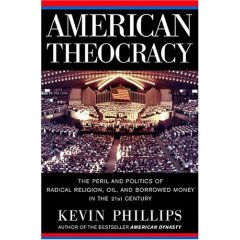
I finally read Kevin Phillips's American Theocracy, though I skipped around a lot, mostly because right now (while Israel and Hetzbullah are trying to give us apocalypse) I'm much more focused on the theocracy arguments than the rest of his book which is also about oil and the financial institutions. The book is the last of a trilogy which also includes Wealth and Democracy and American Dynasty, and Phillips uses it to tie together the themes he has followed. But I don't want to discuss the other two books right now. I want to talk about God in this country, and so what follows isn't quite a review of Phillips's book as much as it is a discussion of the Rapturists in this country and their sizeable power in all our affairs.
American Theocracy is a valuable read in that sense. I learned a lot about the history of fundamentalism from it and several myths I had in my head were nicely cleaned out, too. For example, I learned that the waning mainstream religions today are not a new phenomenom, but something Americans have always done. The educated and staid religions don't really apply to the American emotions. Once a church grows and matures in this way its adherents leave for the new fringe churches which make up their own simple theologies and allow lots of speaking in the tongues and magical stuff. It's all very emotional, very primitive (as Phillips calls it) and very simple. And it really doesn't have very much to do with my understanding of the Christian theology. Rather, all these churches make up their own theologies. The Mormons are a good example of the way someone's visions can be incorporated and elaborated on within a framework which looks Christian to an outsider but which might really be something very different.
All this explains why I was always so confused about what "Christianity" means to the fundamentalists who appear to ignore most of the messages actually attributed to Christ in the Bible. American Theocracy made me finally understand that the American fundamentalists are not really Christian except in the name they have adopted and that the best way to understand their religions is to actually look up what they say they believe. Silly, I know. But I'm silly that way, always looking for the logical in things which are not logical.
In hindsight I can see the error of my ways quite clearly. I started my explorations from the wider theological framework of Christianity, whereas the proper starting point would have been the market system of the United States, and the proper question would have been: What sells in a religion? Then the correct answers would have flown in like the wind. What sells is the promise of easy salvation, combined with lots of psychological good feelings and perhaps even the promise of money, wealth and influence in this valley of the tears we secularists call reality. And these are the things most fundamentalist churches offer their adherents, believe it or not, wrapped into a package which centers on the idea of personal and individual salvation. Phillips writes:
We have seen in previous chapters that evangelicals, Southern Baptist Convention adherents, and others oppose government social and economic programs because they interfere with a person's individual responsibility for his or her salvation. One recent scholarly analysis updated evangelical economic thinking to include the role of televangelists, specifically Falwell and Robertson, in upholding "a marriage between religion and American capitalism" during the 1980s. It further elaborated on "theology increasingly espoused by Pentecostal and charismatic preachers: ...that God's blessings are not confined to the next life. Indeed, God desires to bless his children materially in this world. By naming what you want (a new car, better job, good health), claiming it in the name of Jesus, and living in the faith that it will come to you, these believers no longer tied private property to the notion of hard work.
Less kind people would name all this magical thinking, and that sounds to me like the proper description of what is going on in much of American fundamentalism.
The most interesting and frightening aspect of this magical thinking is Rapturism, the belief that we are living in the end-times, that Jesus's second coming is near. End-timers have always existed in Christianity, but only in the last few decades have they actually had the political power to cause the world to end, and only in the United States. Doesn't that make shivers run up your spine? That you might live in the country which sort of likes the idea of an apocalypse, because then all the "good" Christians will be sucked up by the heavenly vacuum cleaner, while the rest of us sinners will be put through the heavenly torture mangle? Well, believe it or not, but there are many millions of Americans who are sighing happily right now while listening to the news reports from Lebanon. Every additional death takes them closer to the happy moment when Christ will open up his arms and these Christians will leap into his lap. Later in this post I will share with you some of that happiness of the True Believers Who Have Been Saved.
But first I need to talk a little more about the end-times belief. There is a psychological explanation for its popularity, of course. Whenever the world looks to have gone off its track, whenever everything is all gloomy and awful, whenever we are powerless to prevent the next disaster, that is the very moment when Jesus might be coming back to kick the sinners in the butt! This makes all the horrors quite all right and bearable, nay, orgasmically wonderful! And think of the fact that if You Are Saved and the next door neighbor is not you will be safe and comfortable whereas that rotten person will burn in eternal flames of damnation!
I can see the appeal. And thousands of people have seen it in the past. Historically, end-times have been proposed often, starting around the year one thousand for Christians. Almost every major war has been explained as the beginning of the end and as Jesus's second coming. When He has not actually turned up, not to worry; the predictions were a little bit off and the end will take place at the next worrisome international events. Thus, until quite recently, it was the Soviet Union who was supposed to be the evil anti-Christ which sets off the four horsemen of the apocalypse. Then it was Saddam Hussein (yes, that Saddam). Now it is Iran, perhaps. Whoever the anti-Christ might happen to be, the end times are always near, and their not happening doesn't disprove anything except the wrong timing.
The Biblical roots of the Rapturist thinking are fuzzy. This is one summary of the ideas, though you may also safely skip it if you're not interested in theology:
We referred to the fifth-century Council of Ephesus, which condemned belief in a future, historical millennium. Clearly the idea is very old. But with a lot of added features, it has become popular in the U.S. only very recently. We speak about the New Right in religion, as well as in politics, only since the late '70s. The preachers of these "new" teachings are the leaders of the new religious right. We will start our survey with a more moderate and serious view.
The Pre-millennialist picture. As we defined this teaching it holds that the Second Coming of Christ will be followed by a thousand years of Christ's earthly reign. George Eldon Ladd of Fuller Seminary, an exponent of this view, writes, "...the New Testament for the most part does not foresee a millennial kingdom"; and again, "The New Testament nowhere expounds the theology of the millennium, that is, its purpose in God's redemptive plan" (in The Meaning of the Millennium, op. cit. p. 39). Having made this careful statement, Ladd outlines the whole program to the end.
Before you read any further, I urge you to read Revelation 19:11—20:15 and take notes. This is important so that you yourself can judge and are not left between Professor Ladd's and my perceptions. For your independent view read the passage carefully: what happens, to whom, who does what? What are you reading about? What does it all mean? Try to visualize what you read. Then come back to this text and find out if your notes agree with what follows.
The Second Coming, says Ladd, brings Christ as conqueror who now destroys his enemies: first the Antichrist and all his supporters, then the one behind the Antichrist -- the dragon, or Satan, who is bound and imprisoned for a thousand years. The "first resurrection" of the saints takes place, they share Christ's millennial reign. At the close of this period Satan is released and finds supporters among the unregenerated who are prepared to stand against God. A final, eschatological war ends with the devil being cast into the lake of fire. The second resurrection -- of those not raised before the millennium --takes place, and they stand before God's judgment throne.
Finally death itself is vanquished; like the devil and the wicked, it is thrown into the lake of fire. To most of us this, as a prophecy about the end of time, is all new. How is it that some Christians know this much about the "program" of the end times while the rest of us do not? They are reading the book of Revelation, from chapter 19, verse 11, to the end of chapter 20, a sequence of apocalyptic visions, as if they were prophecies. And inevitably they interpret those chapters. If you read Revelation 19:11—20:15, did you find all of the above? I did not, and needed the interpretation of millennialists to make "sense" of some of the events. Millennialists like Ladd are restrained interpreters because they hold that apocalyptic literature is about the end time -- and as we noted, they read apocalyptic as if it were prophetic fore-telling. But they do not turn other passages into end-time predictions.
Dispensational approach. The restraint noted above is singularly lacking in this school of thought. John Nelson Darby, a founder of the Plymouth Brethren, and C.I. Scofield following him, developed a scheme of dispensations. They taught that God has two distinct plans for two distinct communities. God has an earthly plan for Israel and a heavenly plan for "born-again" Christians. The rest of humanity has the possibility of joining one or the other. This view was popularized by the Scofield Reference Bible, first published in 1909.
In the 1917 edition, Scofield writes in the introduction: "...the dispensations are distinguished, exhibiting a majestic, progressive order of divine dealings of God with humanity, the increasing purpose which runs through and links together the ages from the beginning of the life of man to the end of eternity."
Darby and Scofleld claimed to have discovered a doctrine of ages or dispensations in the Bible. The past is seen as a line of distinct, distinguishable periods; the present and the future are also part of the scheme of dispensations. They have discovered seven distinct dispensations:
1. Dispensation of innocence -- which ends with Genesis 3.
2. Dispensation of conscience -- ends with the flood.
3. Dispensation of human government -- ends with tower of Babel.
4. Dispensation of promise -- ends with Abraham's descendants going to Egypt and slavery.
5. Dispensation of law -- ends with the destruction of the Temple in A.D. 70.
6. Dispensation of grace -- ends with Second Coming of Christ.
7. Dispensation of the kingdom that will bring .history to an end.
The endings of the first five ages indicate that humanity failed completely and God thought up another dispensation and gave another opportunity in which humanity failed once again. Scofield warned of ruin, disaster, catastrophe to the end. There is no possibility of peace on earth until the millennium. Only true Christians need not fear because they will be with Christ. These and a number of other characteristics present in Scofield's dispensationalism became stronger and more obvious among his followers.
Dispensational interpretation of Scripture. Any passage from the prophets or apocalyptic writings can be used by dispensationalists as if it were speaking about the millennial reign of Christ. There is no justification for this, least of all by people who claim to interpret the Bible literally. The original meaning of the text -- that is, the intention of the writer in the historical, cultural context of the writing -- is disregarded by dispensationalists.
It is true that Jesus and the early Christian community reinterpret some texts, in the light of the Christ event and only in that light, not with reference to something yet to come. Matthew 2:15 reinterprets Hosea 11:1, "Out of Egypt have I called my Son." Philip reinterprets Isaiah 53 to the Ethiopian eunuch as speaking of Christ (Acts 7:30-35). But no other figure or event save Christ -- his cross and resurrection -- is ground for reinterpretation.
One example may show how differently biblical texts can be handled. We will look at Daniel 7:7-8, as commented on by John Calvin and C.I. Scofield. The verse speaks of the fourth beast, a dreadful creature with ten horns and "among them another little horn." When interpreters get to the little horn, says Calvin, they quickly point to the Pope or the Turks, that is, whoever opposes or threatens the faithful in their own day. But Calvin rejects this, because "they think the whole course of Christ's kingdom is here described," but instead God is showing to the prophet "what should happen up to the first advent of Christ." The convulsions of the age before Christ were too many, says Calvin. Dominion in the Near East went to the Persians, then the Macedonians -- "afterwards those robbers who made war under Alexander suddenly became kings" -- and strife and hostility were experienced. Then the Roman Empire took over. "Thus this vision was presented...that all the children of God might understand what severe trials awaited them before the advent of Christ." Daniel "does not embrace...the whole kingdom of Christ" (Commentary on Daniel 7:8). As here, so Calvin reads the entire book of Daniel as addressed to contemporaries at the time of writing with understandable historical and social references, therefore relevant for those who first hear or read it. It is speaking about the time before the first coming of Christ and needs to be interpreted in its historical context
According to Scofield the vision speaks of the end of Gentile world-dominion. The "little horn" is identified with "prince that shall come" (Dan. 9:26,27), the "king" (Dan. 11:36-45), "the abomination" (Dan. 12:11 and Matt. 24:15), the "man of sin" (II Thess. 2:4-8) and the "Beast" (Rev.13:4-10). What a horn!
Scofield's end of the Gentile world-power is still in the future. "The 10 kingdoms, covering the regions formerly ruled by Rome, will constitute, therefore, the form in which the fourth or Roman empire will exist when the whole fabric of Gentile world-domination is smitten by the 'stone cut out without hands' = Christ." How did Scofield know this? What reason can one find to say this is prophecy about the end of this world? None, according to the rest of us -- outside dispensationalism. That Scofield is really speaking of the end time he makes clear both by the phrase "Gentile world power" and by cross-referencing the Daniel 7 passage with a footnote to Revelation 16:14: "The time of the Gentiles is that long period beginning with the Babylonian captivity of Judah...to be brought to an end by the destruction of Gentile world-power,...i.e., the coming of the Lord in glory (Rev. 19:11,21). Until which time Jerusalem is politically subject to Gentile rule (Luke 21:24)." And again on Daniel 2: "Gentile world power is to end in a sudden, catastrophic judgment," that is, in Armageddon
That wasn't the clearest possible explanation of the belief in Rapture, perhaps, but the whole belief is pretty fuzzy. The clearest part of it is the idea that somehow the Bible can be used in a manner not that different from Nostradamus's predictions: to divine when the world will end. And the end of the world will be preceded by the coming of the anti-Christ, a war in Israel and lots of natural catastrophies. All good Christians (to be defined as one wishes, it seems) will be raised to the Heavens with Jesus while the rest of us will be subjected to incredible tortures by the Good Lord Jesus. Then there will be a second Rapture of a few additional "good" Christians and a handful of converted Jews.
The dangers of a wide-spread belief in the Rapture for the rest of us nonbelievers are obvious. Those who expect end-times all the time will not be bothered about the tsunamis, for example. They will quite rejoice in them. Neither will they worry about environmental degradation or people dying in unnecessary wars, because all these are just signs of the great events to come soon. And no believer in Rapture wants peace in the Middle East, because a war in Israel is a necessary prerequisite of the second coming of Christ.
It's not hard to see how a belief in Rapture, as general as it seems to be in the United States, could actually bring the world to an end by such effects. It's a totally different question whether we'd actually then observe the second coming of Jesus. But let me ask of those believers in Rapture this question: What do you think Jesus would say to you if it was you who caused the world to end when He wasn't yet at all ready to come back to kick your asses?
To return to Phillips's American Theocracy: These are the people who are now ascending in power. These are the people who affect the foreign policies of the United States. He makes it quite clear how the Left Behind-series has popularized the idea of Rapture (to tens of millions of people, mind you). He even suggests how it has worked as a blueprint for the policies of the Bush administration. To take one example, consider the removal of Saddam Hussein from the dictatorship of Iraq. A believer in Rapture would have seen the whole pre-emptive war as totally logical. After all, Saddam was supposed to be the anti-Christ. It didn't matter if Iraq had no weapons of mass destruction. Even democracy or its lack in Iraq didn't matter for these people. And you might be interested in learning that the evil anti-Christ in the Left Behind-series works for the United Nations and has the backing of a French banker. This puts a very different light to the U.N. hating factions of the Republican party and to their habit of making fun of the French, doesn't it?
Here you may want to get up and stretch your shoulders a little, if you just realized that we may have been running foreign policies based on magical thinking. Then you can sit back and read a couple of messages from the RaptureReady chatsite, a place where the believers in end-times meet and congratulate each other for belonging to the Chosen Few:
Originally Posted by bazza
Some of the old testament prophecies confuse
me regarding the time frame....but I have read
before that the following chapter-Isaiah 18- re-
fers to a country/people that could be the U.S.
If this chronologically follows Isaiah 17, then it
is time to really start to look UP!
bazza
I have heard that too, but I have no idea if it's true. No one except Israel is hated more than America. It makes me really sad, because I love my country. My prayer is that Jesus raptures us before that happens. It would break my heart to see the destruction of this beautiful land.
------
Hizbullah, though primarily in Lebanon & Israel is currently holding Lebanon accountable, is under SYRIAN Control (with the help of Iranian funding and support). The fact that they have just today kidnapped 2 Israeli soldiers and Olmert has declared this an ACT of WAR (against Lebanon for now), it's not hard to see how this could easily and rapidly escalate into the fulfillment of the Isaiah 17 prophecy.
Incredible times that God is allowing us to live in – May He be Praised !!!
-----
Wars and rumors of wars, boys does this not sound true,, middle east, korea, Iran, ten nation union and other hot spots around the world... as in the new superman movie "the world says it does not need a savior, but every day I hear it calling out for one!" but their savior will not be the Prince of Peace
Do you ever wonder, of all the time in history you or me for that matter could have been born, that we are born now... sure makes the hair on my neck stand up... everytime the world seems it is slipping out of God's hand "contol".... bam... God slap's us awake and makes us take a good hard look at who is really in control.. Now with Syria in the news and knowing what can and will happpen to Damascus makes you look up and see if the clouds are parting and the Lord Jesus Himself is standing there....
------
was watching Hannity & Colmes on Fox News with Oliver North giving his comments on the situation with Israel/Hizbollah. Oliver North actually said:
'IF YOU LIVE IN DAMASCUS, BE AFRAID, BE VERY AFRAID"!!!!
I almost fainted, as Damascus was on my mind as well.
He was great, defending Israel, and placing the blame squarely on Syria and Iran. He said Israel is surrounded, and they won't back down.
Hope we are going home soon!
-----
Damascus becomes ruinous heap, this eventually leads to the attempted Gog-Magog invasion of Israel. Russia is supernaturally obliterated. Makes sense to me.
-----
As much as it is to stir the pure hearts in Christians. That Syria is in the news--on the front page with a plausible path towards its destruction before our very eyes--should quicken the hearts of you who understand.
Keep an eye on Damascus. This is getting more interesting every day. And me thinks G-d is about to take center stage (for those who know what to look for). I get chills just thinking how priviledged we are to see the signposts through the clutter!
I also do not believe that non-Christians are going to turn to G-d because of the obvious signs we are and will be witnessing. Again, prophecy is meant to stir the hearts of Christians.
There are many excellent posts regarding Damascus and Syria on RR right now. May G-d continue to stir your hearts.
-----
Saturday, July 15, 2006
This Week's Friday News Dump
From the government. It's a study which compares the performance of public and private schools in the United States. The reason why the results of this study would be dumped on Friday, so as to escape notice, is this bit:
The Education Department reported on Friday that children in public schools generally performed as well or better in reading and mathematics than comparable children in private schools. The exception was in eighth-grade reading, where the private school counterparts fared better.
The report, which compared fourth- and eighth-grade reading and math scores in 2003 from nearly 7,000 public schools and more than 530 private schools, also found that conservative Christian schools lagged significantly behind public schools on eighth-grade math.
These results apply once the study standardized for the students' economic and demographic characteristics.
The article also points out the trouble the authorities took to downplay the findings:
The study, carrying the imprimatur of the National Center for Education Statistics, part of the Education Department, was contracted to the Educational Testing Service and delivered to the department last year.
It went through a lengthy peer review and includes an extended section of caveats about its limitations and calling such a comparison of public and private schools "of modest utility."
Its release, on a summer Friday, was made with without a news conference or comment from Education Secretary Margaret Spellings.
Reg Weaver, president of the National Education Association, the union for millions of teachers, said the findings showed that public schools were "doing an outstanding job" and that if the results had been favorable to private schools, "there would have been press conferences and glowing statements about private schools."
"The administration has been giving public schools a beating since the beginning" to advance his political agenda, Mr. Weaver said, of promoting charter schools and taxpayer-financed vouchers for private schools as alternatives to failing traditional public schools.
A spokesman for the Education Department, Chad Colby, offered no praise for public schools and said he did not expect the findings to influence policy. Mr. Colby emphasized the caveat, "An overall comparison of the two types of schools is of modest utility."
"We're not just for public schools or private schools,'' he said. "We're for good schools."
Of course it is true that a comparison of public and private schools in general is of limited usefulness. But just think of how the findings would have been touted had they turned out to go the other way: Private schools beat rotten public schools! Conservative Christian schools the best of all!
Make sure to mention this study to at least one other person this weekend. That way the Friday dump will not work to stuff it down the Memory Hole.
Friday, July 14, 2006
Friday Arty-Farty Dogblogging

This is Henrietta asleep, before she had a gray face. My attempt to use colored pencils.
The Market For Organs
Not organs or pianos but spare hearts, kidneys and lungs:
On Fox News' Your World, ABC anchor John Stossel advocated the legal sale of organs, citing the fact that "hot dogs don't spoil when we get to them" as evidence that "the market figures out ways to make these things work."
Claiming that "we have no shortages of anything else that faces the open market," ABC News 20/20 co-anchor John Stossel, on the July 13 edition of Fox News' Your World with Neil Cavuto, advocated the legal sale of organs. Responding to Cavuto's concerns that some organs "might not be safe," Stossel cited the fact that "hot dogs don't spoil when we get to them" as evidence that "the market figures out ways to make these things work." Despite Stossel's earlier assertion that "I have two [kidneys]; I only need one," he was noncommittal when Cavuto asked: "Would you give me a kidney if I needed one?" Stossel said he "would consider" it. Even when Cavuto suggested the offer would be high, Stossel responded: "I don't know, we'll have to talk later."
Stossel also made this comment which shows that he never passed Economics 101:
CAVUTO: But how would you -- yeah, OK, good, we got that covered, John doesn't believe in murder. Would there be a limit to this, though, or risk to this? In other words, would you be getting organs that might not be safe, that might, might have a whole lot of problems? Or those who are suffering from AIDS, and you're getting an AIDS contaminated --
STOSSEL: But the market takes care of these things all over the place. We don't get hot dogs --
CAVUTO: You love the markets. It's what you believe from --
STOSSEL: I do.
CAVUTO: You're a libertarian.
STOSSEL: It took me too long, but also, a consumer reporter who was hostile to markets, until I saw, wow, you know, the hot dogs don't spoil when we get to them. You know, there's all these greedy people selling them, the meat could be bad. But the market figures out ways to make these things work.
Such a touching trust he has in the ability of the markets to "make these things work". Too bad that the markets are not a libertarian god who can put all things right. Too bad that there are very specific reasons which explain why the market for hot dogs tends to work fairly well, now that we have government-decreed meat inspection systems, too bad, because these same reasons also explain why markets for transplantable organs wouldn't work very well at all.
Let's set aside all the moral questions for a while and let's first concentrate on Stossel's argument that having a legal market for organs would make more of them available for those who desperately need them. Doesn't this look like a possible outcome? Perhaps. But think of the related question of blood donations and the selling of blood. When countries or areas have allowed blood to be purchased a curious thing happens: donations of blood go down. Why bother to donate if other people are selling their blood for money? Most people who donate blood wouldn't sell it if that alternative was available. Donating blood is not that pleasant and can't be done frequently enough to make it into a paying occupation. The reason people give blood is because of the good feelings this offers. But these good feelings disappear if others are getting paid for their blood.
All this means that the increase in the number of organs that Stossel speculates markets would create might not be that great. It might not even be an increase, depending on the actual responses of those currently thinking of donating an organ. But there is a worse problem than this with Stossel's arguments, and the blood example helps us to see it: the quality of purchased blood is lower than the quality of donated blood. Purchased blood is more likely to be tainted with diseases. Why? Because selling blood is a rotten way of making money. Only the most desperate are willing to do this on a regular basis, and these people are more likely to be poor, malnourished, drug-users or alcoholics. Sold blood can be screened, of course, but the screening itself is expensive.
The same problems are equally likely to crop up in any markets for donated organs.
Then there are the equity concerns. Think about the market for kidneys. (It has the advantage of leaving the seller of one kidney alive, which allows me to ignore the question of how the organs are going to be harvested for just a little while longer.) Suppose that the market price for a kidney was set at, say, 30,000 dollars. What types of people would choose to sell a kidney in such a market? Wouldn't they be the poorest ones, the most desperate ones, the ones who can be most easily bullied into the transaction? Wouldn't these donated kidneys largely come from the poorest countries in the world, from places where living on one kidney is actually the most dangerous?
But I understand that Stossel doesn't care about the fact that markets are not at all good at equity or other concepts of fairness, except purely accidentally. He is only interested in the efficiency gains. I bet he would think a market for human slaves would be efficient, too.
And this brings me to the harvesting of the organs in a market-based system. With very few exceptions, the organs for transplanting are only available when a person dies. Suppose that the market price for a still-beating heart was set at a million dollars. Imagine the "markets" that would be created to supply such hearts. These would be illegal markets, true, but then we have such markets today for cocaine, say.
Or imagine the incentives for estranged relatives to speed up the death of someone who has signed up for organ transplantation schemes. Just imagining all this should tell you why people would not sign up for such schemes very often, and Stossel's markets would be severely undersupplied without the illegal harvesting operations. These are already rumored to exist in some countries, but their scope in Stossel's world would be quite different.
To make you feel uncomfortable, the market of hot dogs isn't really that different from what I have been describing, if we take the pig's eye view of things. It's only because we don't allow pigs to decide if they want to donate organs to us or not that the markets can be viewed as such a success. There.
The Bad News And The Good News
First the bad news:
But we ARE playing their game, the penis-measuring game. Violence has always been used in international politics. But it hasn't been used unlinked to international cooperation and reason on such a scale for a very long time. The "boys" on both sides have now decided that pointless cruelty and slaughter of anything that breathes is a good way of getting attention and of scaring everybody else to submission. And no, I'm not trying to compare whose violence might be the cruellest. Such comparisons are part of the new blood games, too.
What I'm trying to say is that we need to have the adults back in control. And here are the good news, though they naturally pale in comparison to the bad news. But I grab any straw right now:
That was the AP-Ipsos poll. Even the Fox News poll finds similar sentiments:
Oh how I hope this turns out to be true. I don't even care about the domestic issues right now. I don't care if the Democrats are corpocrats, too. All I care about right now is for someone to take control of the steering wheel, someone who can actually drive and think at the same time, someone who has studied international politics. And if that can't be had at least we might get a Congress which puts a stop to the most inane plans of this administration.
The danger of Iranian-backed adventurism is immense right now, but that's all the more reason for America and Israel to avoid past mistakes in countering it. Reliable strategic lessons are hard to come by in that part of the world, but here are a few:
The first is that in countering aggression, international solidarity and legitimacy matter. In responding to the Lebanon crisis, the United States should work closely with its allies at the Group of Eight summit and the United Nations. Iran and its proxies would like nothing more than to isolate America and Israel. They would like nothing less than a strong, international coalition of opposition.
A second point -- obvious from Gaza to Beirut to Baghdad -- is that the power of non-state actors is magnified when there is no strong central government. That may sound like a truism, but responding wisely can require some creative diplomacy. The way to blunt Hamas is to build a strong Palestinian Authority that delivers benefits for the Palestinian people. The way to curb Hezbollah is to build up the Lebanese government and army. One way to boost the Lebanese government (and deflate Hezbollah) would be to negotiate the return of the Israeli-occupied territory known as Shebaa Farms. That chance is lost for now, but the Bush administration should find other ways to enhance Siniora's authority.
A final obvious lesson is that in an open, interconnected world, public opinion matters. This is a tricky battlefield for an unpopular America and Israel, but not an impossible one. To fight the Long War, America and Israel have to get out of the devil suit in global public opinion. For a generation, America maintained a role as honest broker between Israel and the Arabs. The Bush administration should work hard to refurbish that role.
In the Lebanon crisis we have a terrifying glimpse of the future: Iran and its radical allies are pushing toward war. That's the chilling reality behind this week's events. On Tuesday the Iranians spurned an American offer of talks on their nuclear program; on Wednesday their Hezbollah proxy committed what Israel rightly called "an act of war." The radicals want to lure America and Israel deeper into the killing ground, confident that they have the staying power to prevail. We should not play their game.
But we ARE playing their game, the penis-measuring game. Violence has always been used in international politics. But it hasn't been used unlinked to international cooperation and reason on such a scale for a very long time. The "boys" on both sides have now decided that pointless cruelty and slaughter of anything that breathes is a good way of getting attention and of scaring everybody else to submission. And no, I'm not trying to compare whose violence might be the cruellest. Such comparisons are part of the new blood games, too.
What I'm trying to say is that we need to have the adults back in control. And here are the good news, though they naturally pale in comparison to the bad news. But I grab any straw right now:
Republicans are in jeopardy of losing their grip on Congress in November. With less than four months to the midterm elections, the latest Associated Press-Ipsos poll found that Americans by an almost 3-to-1 margin hold the GOP-controlled Congress in low regard and profess a desire to see Democrats wrest control after a dozen years of Republican rule.
Further complicating the GOP outlook to turn things around is a solid percentage of liberals, moderates and even conservatives who say they'll vote Democratic. The party out of power also holds the edge among persuadable voters, a prospect that doesn't bode well for the Republicans.
The election ultimately will be decided in 435 House districts and 33 Senate contests, in which incumbents typically hold the upper hand. But the survey underscored the difficulty Republicans face in trying to persuade a skeptical public to return them to Washington.
That was the AP-Ipsos poll. Even the Fox News poll finds similar sentiments:
Less than four months before Election Day, the latest FOX News Poll finds that voters strongly favor the Democrats on key issues such as the economy and gas prices, and give the minority party a double-digit lead for control of Congress this fall. For most of President Bush's second term in office, more Americans have said they disapprove than approve of his job performance and that is again the case in this new poll.
The president's approval rating dropped to 36 percent, down from 41 percent approval two weeks ago and 40 percent in mid-June. Bush lost ground this week among some key constituent groups, such as Republicans, whites and men. Overall, 53 percent of Americans say they disapprove.
"It is important to remember that the president got his bounce after the killing of al-Zarqawi in Iraq," comments Opinion Dynamics Chairman John Gorman. "While administration officials were careful not to overplay the significance of this, it naturally created hope that things would get better. Several weeks of bloody footage from Iraq have pretty much dashed those hopes."
Oh how I hope this turns out to be true. I don't even care about the domestic issues right now. I don't care if the Democrats are corpocrats, too. All I care about right now is for someone to take control of the steering wheel, someone who can actually drive and think at the same time, someone who has studied international politics. And if that can't be had at least we might get a Congress which puts a stop to the most inane plans of this administration.
The Wild Carrot Roast
I was trying to think of my equivalent for George Bush's wild boar roast in Germany, the one that was on his mind when someone mumbled something about Israel and Lebanon. If I were the president of the United States (imagine the shining snaketail at formal occasions!) it would have been a carrot roast.
Either that or something I would have caught on one of those dark streets. Something with a red tie or an underwire bra. Just kidding, just kidding. I'm not a vampire, alas. So it must be a carrot roast.
But nobody would vote for someone who eats carrots, even if I dug them up myself. But a wild boar! Now eating one of those shows how you are bubbling over with testosterone, even if you didn't catch the ferocious animal yourself. - Never mind that I probably have much more bare-hands fighting experience than George Bush. It's the carrots that would be my downfall in any presidential race.
Oh, and the genitals, of course.
Thursday, July 13, 2006
George Bush on the Middle East Crisis
From Froomkin's column:
And on Lebanon, Bush embraced what sounds like an improbable goal. "Whatever Israel does, though, should not weaken the Siniora government in Lebanon," he said. "We're concerned about the fragile democracy in Lebanon."
But you've got to think that Israel's bombing of the Beirut airport and blockade of Lebanese ports and airspace doesn't exactly strengthen Premier Fouad Siniora's hand.
Here's an exchange toward the end of the session:
"Q Does it concern you that the Beirut airport has been bombed? And do you see a risk of triggering a wider war?
"And on Iran, they've, so far, refused to respond. Is it now past the deadline, or do they still have more time to respond?
"PRESIDENT BUSH: I thought you were going to ask me about the pig.
"Q I'm curious about that, too. (Laughter.)
"PRESIDENT BUSH: The pig? I'll tell you tomorrow after I eat it."
Applause?
Your Mother Fucks Reindeer
Now I feel like a real blogger from the far left. Obscene and all.
The title is supposed to be a Finnish insult. I got it from this article on sports insults that soccer players can use:
The suggestion that Marco Materazzi might have insulted Zinédine Zidane's mother during the World Cup final seems justification enough for the head-butt that followed. But why is it that the worst insults in the world are always about your mum? Stuart Jeffries reports.
...
It was seven minutes before half time. Real Madrid were 2-0 down against already relegated opponents in May 2004, when David Beckham tackled Real Murcia's Luis Garcia. The England captain thought the tackle was clean but the linesman flagged for a foul. Leaping to his feet, the Dagenham-born galáctico unleashed a volley of idiomatic Spanish, calling the official a "hijo de puta" (son of a whore). The referee, Turienzo Alvarez, had no hesitation in producing a red card. But was that the right decision? After all, Beckham's Spanish had been so risible in press conferences hitherto that this sure-footed demonstration of his grasp of Hispanic rudery surely should have won him a round of applause.
Beyond questions of Beckham's linguistic (in)competence, though, there were cultural differences at issue. After the match, Beckham (reverting to English) told reporters: "I didn't realise what I had said was that bad. I had heard a few of my team-mates say the same before me." This is a bravura defence: in Britain, to call someone a son of a bitch or to deploy any derogatory barb that focuses on impugning the sexual integrity of the target's mother is hardly the worst thing one can say. If he had abused a fourth official at Goodison Park in an Everton-Man Utd game in the same terms, the linesman would not have got the hump; nor would the referee have seen red quite so readily. In Spain, it is different.
The Sun even drew up a list of mother insults that Beckham could deploy if he sought an early bath on future occasions. They included the rather infantile Tu madre tiene un bigote (Your mother has a moustache) and the frankly laborious Anda la puta que te pari (Go back to the prostitute who gave birth to you), but not the one that would surely have got him lynched in the Bernabeu, namely Me cago en la leche que mamaste (I shit in the milk that you suckled from your mother's breast). The Times concocted a letter of apology that Beckham might send to the linesman: Dear Assistant Referee, (Ayudante Arbitro) I am sorry that I called you a son of a whore. (Lo siento que se llamo hijo de puta .) I am sure that your mother is not a whore at all. (Estoy seguro que su madre no es una puta.) I am sure that your mother is, in fact, a respected figure within her community. (Estoy seguro que su madre es una mujer muy respetable en su comunidad.)" And so on. But neither helped him become as fluent in Spanish as his fellow English team-mate Jonathan Woodgate had become. In September 2005, he got into a rumble in the tunnel with an Espanyol player after calling him a "hijo de puta", which suggests his Spanish had developed as fast as the British press had hoped.
The article argues that mother-insults are more common in the Mediterranean cultural area and that this has to do with the Catholic worship of Virgin Mary:
"There are certainly cultural differences in swearing," says feminist socio-linguist Deborah Cameron, Rupert Murdoch Professor of Language and Communication at Worcester College, Oxford. "In Scandinavia, the taboo words are to do with the devil. Here [Britain] they're fuck or cunt. In Mediterranean cultures it has to do with the classic relationship that exists between a son and his mother. Italians, for example, adore their mothers. One's trespassing on a sacred relationship if one insults a man's mother." (Incidentally, the devil taboo does not mean that mother insults are unknown in Scandinavian countries: in Finland, for example, there is an expression "Äitisi nai poroja!" which means "Your mother copulates with reindeer!" Sweet!)
To put all this into perspective, trash talk is common in sports. The idea is to cause your opponent to lose control, to play worse because of that. Even my dog, Henrietta the Hound, uses trash talk to the other dogs to discombobulate them before dominating them into submission. Or so it seems to me. Though I doubt she calls them sons of bitches.
But why the mother-insults in men's sports? For I'm pretty sure that these are something only men use, both in sports and on the internet. Is it just misogyny that fuels the suggestions that whoever you insult had a shitty mother? Deborah Cameron seems to think that the answer is both in misogyny and in the importance of the mother as defining where we all come from:
Why aren't fathers the butt of insults so much as mothers? Had David Beckham said to the linesman "Tu padre es un gigolo que tiene cópula con una multiplicidad de diversos socios" (Your father is a gigolo who has intercourse with a multitude of different partners), he probably wouldn't have got a red card. Just a baffled look, and applause from those impressed by his command of his second language. "The underlying idea is you're attacking what your rival came out of," says Cameron. "That's why it's mothers rather than fathers who feature in the more potent insult. Everybody comes from their mother".
True. On the other hand, the mother shouldn't be summarized as nothing but the source of some man you want to disrespect. When we do this we are indeed being misogynistic.
Thank You, Wonkette, XOXO
Ana Maria Cox's bad review of Katha Pollitt's book has probably earned Katha quite a few extra royalties by now. Don't they always say that there is no such thing as bad publicity? Cox gave Pollitt the limelight by wondering if feminism is now too tacky and strident, and the answers have come rolling in. Jessica Valenti of feministing.com has an interview with Katha on the Salon, well worth reading for the discussion of the role of feminism today.
Then there is Katha's response in the New York Times, entitled Thank You for Hating My Book. It's funny, not at all tacky or strident. Though it does reveal a hidden side of Pollitt: her obsession with the book's rating on Amazon.com:
Of course, like every writer, I had been obsessively monitoring the sales ranking on my Amazon.com page since well before publication, ignoring the advice of my friend the historian. ("Don't look at Amazon, whatever you do! After they dredged up that Welsh farmer to review my book, it was like watching Enron stock implode.") By judiciously purchasing one book an hour — something I was going to do anyway, I have free shipping and a lot of relatives — I had managed to raise my rating from 101,333 at 2:25 on June 17 to 6,679 at midnight — a staggering advance of 94,636 places at a cost of only $110.60.
Skillfully timed additional purchases — I have a lot of friends as well — kept things simmering in the 4,000's. When I clicked on my number for the previous day, I could even see what books were selling like my own. On June 28, for example, when, inexplicably, my book had plummeted to 55,777, it was sandwiched between "Postcolonialism: A Very Short Introduction" and "Calligraphy Alphabets Made Easy." Fortunately, I found an old Rolodex with the addresses of a whole bunch of people I used to know in Canada — what better way to reconnect than to send them a book!
"Mom," my daughter said in that stern way she gets sometimes. "Stop it. Those numbers don't mean anything."
"Well, I don't know the precise algorithm, nobody does, but the ratings aren't totally meaningless."
"No, Mom, I mean your numbers don't mean anything. You're raising them by buying the book yourself."
I bet that those of you with blogs know exactly why she was doing the clicking. When I first started blogging I found out that if I clicked on my site through a different browser I gained a whole new visit! Not one of many multiples, but a new one that counted separately! So I installed all the browsers I could find on my computer...
A friend pointed out the pointlessness of this exercize. The visits didn't measure anything but my own obsessiveness. She didn't get the inner game I was playing at all. I miss that game now that I have too many visits to manipulate them that way. There must be some other version of the game I could play.
This has drifted quite far from the discussion of feminism I was planning. But maybe that's a good thing. Feminists are not obsessive enough to focus only on the big and important questions of the day.
Wednesday, July 12, 2006
Why We Hate Nerds
It's an interesting topic, and one as American as apple pie. Americans dislike intelligence and learning, and this dislike starts early. Teenage love dramas end with the cheerleader in the arms of the school athlete, while the rejected class genius wears glasses and large red spots on his or her ugly, crying face.
The adult version of the same hatred of the intelligentsia wears political clothes these days. It's the liberals, lefties and communists who are seen as smart, and this is why they are hated. The conservatives have done an excellent job in creating the impression that the only true elites in this country are people with learning. There are no financial elites, no political elites, no industrial elites, none at all. The only elites, the ones who rule everything that has turned out poorly, are the well-educated and intelligent lefties. Oh, and the Hollywood elites.
This retelling of reality is quite masterful. The idea that Hollywood and the universities run this country, even when the conservatives rule all the branches of the government, even when some of the wealthiest men on this earth run the industries of this country, even when George Bush courts the religious leaders almost daily. Even then it's only the ex-hippies with their John Lennon glasses who have enough power to be envied, despised and hated.
Why does this plot work? It doesn't conform to reality. What is it about learning that causes such a visceral negative reaction in so many Americans? Why are the owners of great wealth not regarded as elites to hate?
I'm not sure. Is it the myth of equal opportunity that makes people see great wealth as something almost within reach? If so, why doesn't the same myth work for higher education?
Billmon's post on Al Gore's movie An Inconvenient Truth addresses some of the same questions:
There's something deeper at work here than just conventional media bias or capitalist economics, although they're certainly part of it. There's always been a powerful current of anti-intellectualism in American politics, just as there is in American life. It's the dark side of democracy: The pressure to accept what the majority, or the most vocal minority, thinks is true as truth – even when the evidence is entirely on the other side. When Henry Ford said history was bunk, he wasn't taking about the past but about the present, and his ire wasn't directed at historians per se but at the revisionist historians of the Progressive Era, who were telling him and his fellow know nothings inconvenient facts they didn't want to hear. Pump Henry full of Hillbilly Heroin and put him on the radio, and you've got Rush Limbaugh, still making the same point.
The difference between Ford's time and Limbaugh's is that the political presumption against rationality is now shared, or at least pandered to, even at the top of the political and cultural pyramid. It's curious that people who are paid to think and write for a living, and who, like Gore, attended the "best" schools, are now nearly as susceptible to the politics of ignorance as your average conservative talk show host, but then the elite media ain't what it used to be. Like academia, it's fighting a losing rear-guard action against the spirit of the times and the angry, irrational prejudices that go with it.
Read the whole post, by the way. It is beautiful.
"It's the dark side of democracy", Billmon says about the question I asked. I wonder. Anti-intellectualism isn't anywhere near as common in European democracies. People there are more likely to hate the moneyed elites or the political elites than the educated elites, and being a nerd had no negative effect on my teenage dating successes (though naturally I had no red spots).
It could be that anti-intellectualism has to do with the way American democracy is defined, though, or more specifically with the myths of the American democracy. Think back to all those black-and-white movies where the simple cowboy type gets up and gives a speech straight from his heart and lo! everybody is convinced and the cowboy wins the debate. Mr. Smith Goes To Washington. Or all those thirty minute TV sitcoms which end with any and all serious problems completely solved. My hunch is that Hollywood might indeed be responsible for some of the nerd-hatred, simply by having made knowledge look too easy and something that can be found by a sincere study of ones heart, by having prepared for our consumption too many delicious scenes where the simple values beat learning, where they are seen as mutually exclusive.
Another way of looking at these myths in the context of American democracy is to argue that the democracy has so far failed in making higher learning genuinely available to all who are interested in acquiring it. The United States doesn't do very well in international comparisons of student performance. Public schools in poor areas are underfunded. College education is extremely expensive. All this makes book learning look like something that is out of reach for most lower income families or available only in a diluted form, and perhaps it's psychologically healthy to scorn something you can't get in any case. But the same scorn should apply to that mythical great wealth that awaits right around the next corner, and it doesn't.
What Is Profanity?
A rhetorical question, but one that might be worth asking of those mainstream journalists who have recently written so much about the profanities of the left-wing blogs. Somehow these snappy articles never mention the right-wing blogs at all, or certainly not with any disapproval. Yet the kind of writing that passes for polite on some of the wingnut blogs is much worse than any number of "fucks" on the lefty blogs, as this example Glenn Greenwald found demonstrates:
The blogger Misha of the blog Anti-Idiotarian Rottweiler is one of the most linked-to and popular bloggers in the right-wing blogosphere. He's the 42nd most linked-to blogger on the Internet, and he is in the blogroll of scores of right-wing bloggers, such as Michelle Malkin and Captian's Quarters Blog. He wrote a post today discussing the Supreme Court's decision in Hamdan and here is what he said:
Of course, this is the same Supreme Court that earlier decided in Kelo that private property rights only matter as long as a private company doesn't offer a better deal, above or below the table, to local authorities, so one shouldn't really be surprised. The unelected, black-robed tyrants have a long history of not giving a fig about the Constitution if they don't like what it says, not to mention a long tradition of usurping the powers of the legislative and executive branch by ruling by judicial fiat. . . .
Try doing anything to those mutilating darlings of the Supremes in order to extract life-saving intel from them, and then wait for the Supreme Whores to decide that you were "humiliating" them in doing so.
Five ropes, five robes, five trees.
Some assembly required.
He's advocating that the five Supreme Court Justices in the Hamdan majority be hanged from the neck until they're dead.
But he didn't swear while advocating lynching of the Justices, and that seems to make his statement something to be served with tea and cucumber sandwiches.
Here is another rhetorical question for you: Why is saying "fuck you" worse than advocating violence against various public figures? And does this have something to do with the fact that the violence comes largely from the conservatives who are in power, whereas the foul language belongs to the currently powerless?
This reversal is an ethical travesty, you know.
Tuesday, July 11, 2006
Let the Guys Win One
So pleads John Tierney. In this female-dominated culture, can't we let the guys keep their sports scholarships and easier access to colleges? The gals are winning in everything else, you know. He makes this whining into one laced with contempt towards women, as is usual in his columns:
When Title IX was enacted in 1972, women were a minority on college campuses, and it sounded reasonable to fight any discrimination against them. But now men are the underachieving minority on campus, as a series by The Times has been documenting. So why is it so important to cling to the myth behind Title IX: that women need sports as much as men do?
Yes, some women are dedicated athletes, and they should be encouraged with every opportunity. But a lot of others have better things to do, like study or work on other extracurricular activities that will be more useful to their careers. For decades, athletic directors have been creating women's sports teams and dangling scholarships and hoping to match the men's numbers, but they've learned that not even the Department of Education can eradicate gender differences.
At the University of Maryland, the women's lacrosse team won national championships year after year but still had a hard time getting 40 players to turn out for the team. The men's team had no such trouble, because guys were more than willing to warm the bench even if they weren't getting a scholarship, but the coach had to cut the extra ones to maintain the gender balance. The school satisfied Title IX, but to no one's benefit.
On or off campus, men play more team sports and watch more team sports. Besides enjoying the testosterone rushes, they have a better chance of glory — and of impressing the opposite sex. Thirty-four years after Title IX, most women's games still attract sparse audiences. Both sexes would still rather watch men play games, especially football.
Where to begin with this one? Should I start by noting that I just can't imagine anyone ever pleading "Let the Gals Win One"? It just would not happen, because gals are not supposed to win anything. And that is the real undercurrent in Tierney's whole piece. It's the guys who are supposed to win, who are supposed to rule and if that can't be arranged in a way that looks justified, well, let's just give it to them unjustified. Who cares about the gals? They are good for the bedroom and for cleaning and washing clothes, but other than that?
Or should I point out how odd it is that the male advantage in sports is seen as biological and inherent, but that the supposed female advantage in doing well in college is not? The latter, for this confirmed wingnut believer in innate gender differences is not innate at all!
Or should I start with a long piece about the oddly American idea that sports are an important part of the college experience, and not the sports that everyone can do but the elite sports which are there really just for show? And should I then point out that in order to explain the presence of such sports as a determinant for college success, both for students and for colleges themselves, one must somehow transform this bread&circuses entertainment into an educational module? For example, one can argue that sports teach students about leadership and determination and team work. Yes, that's a good one. Now we can justify spending so much money on sports.
The problem then is how to justify that it's only men who benefit from leadership and determination and team work, as taught by college sports. Somehow women students don't need these sports, but all students must pay for them in colleges where the sports teams don't make money. Must think about that one. - I got it! Let's just say that it's one of those ineradicable gender differences! Men need all this stuff to thrive, women not so much.
There isn't much of a step from that one to argue that men need all sorts of stuff that women don't, including getting into colleges more easily, because of something one suspects are innate gender differences. And then it's time to abolish all those silly Titles which tried to make the world more equal. Yeah, that's the ticket.
Men need to win, women not so much. And it's ok to use affirmative action to make men win. Affirmative action is only bad if it makes it easier for women to win. Used in its proper role, as sports-linked, it's just fine and dandy. And it has been defended that way for decades now, totally unlinked to any fear that boys are falling behind in education in general. Which they are not. It's just that girls, and especially poor and black girls, know that they will not make a good living without a college degree and work very hard towards that goal. The average earnings of a college educated woman equal those of a man with just a high school education, and that is probably the main reason for the gender differences in educational achievements.
Tierney is a bad influence on me. He makes me play the games he sets up, the games of a battle of the sexes, because that's how he sees the world. That makes me forget how the real problem with men's success in college is with the racial minorities and with the poor men, and these are the groups he'd see on sports scholarships, training eight hours a day and not having much time for studying. This would be no real solution, but Tierney doesn't care about real solutions. He cares about a society in which he can be happy that at least he was not born female. Then he can be the one playing in the field and he can still hear the female voices cheering for him in the stands.
And Nobody Expects The Spanish Inquisition
Now this is a much better fit for my odd desire to bring Monty Python's Spanish Inquisition into everything: Charlotte Allen has written a very nasty opinion piece on the sins of the liberal Christianity. Here is a sip from her KoolAid glass:
You want to have gay sex? Be a female bishop? Change God's name to Sophia? Go ahead. The just-elected Episcopal presiding bishop, Katharine Jefferts Schori, is a one-woman combination of all these things, having voted for Robinson, blessed same-sex couples in her Nevada diocese, prayed to a female Jesus at the Columbus convention and invited former Newark, N.J., bishop John Shelby Spong, famous for denying Christ's divinity, to address her priests.
When a church doesn't take itself seriously, neither do its members. It is hard to believe that as recently as 1960, members of mainline churches — Episcopalians, Presbyterians, Methodists, Lutherans and the like — accounted for 40% of all American Protestants. Today, it's more like 12% (17 million out of 135 million). Some of the precipitous decline is due to lower birthrates among the generally blue-state mainliners, but it also is clear that millions of mainline adherents (and especially their children) have simply walked out of the pews never to return. According to the Hartford Institute for Religious Research, in 1965, there were 3.4 million Episcopalians; now, there are 2.3 million. The number of Presbyterians fell from 4.3 million in 1965 to 2.5 million today. Compare that with 16 million members reported by the Southern Baptists.
When your religion says "whatever" on doctrinal matters, regards Jesus as just another wise teacher, refuses on principle to evangelize and lets you do pretty much what you want, it's a short step to deciding that one of the things you don't want to do is get up on Sunday morning and go to church.
It doesn't help matters that the mainline churches were pioneers in ordaining women to the clergy, to the point that 25% of all Episcopal priests these days are female, as are 29% of all Presbyterian pastors, according to the two churches. A causal connection between a critical mass of female clergy and a mass exodus from the churches, especially among men, would be difficult to establish, but is it entirely a coincidence? Sociologist Rodney Stark ("The Rise of Christianity") and historian Philip Jenkins ("The Next Christendom") contend that the more demands, ethical and doctrinal, that a faith places upon its adherents, the deeper the adherents' commitment to that faith. Evangelical and Pentecostal churches, which preach biblical morality, have no trouble saying that Jesus is Lord, and they generally eschew women's ordination. The churches are growing robustly, both in the United States and around the world.
This is very nasty. I want to point that out, because before I learned about the radical religious clerics in this country I used to think that believing Christians were very kind people.
Allen makes two arguments. The first one is that liberal churches are failing and that conservative churches are thriving. The implication is that people are moving from the gay-loving henpecked churches into the scourging and male-dominated ones. And the second argument is that this is happening because what people really want from religion is male priests and strict rules and fundamentalism.
I found the last paragraph in the above quote very funny. Take out the two sentences of interest and see how they read to you:
A causal connection between a critical mass of female clergy and a mass exodus from the churches, especially among men, would be difficult to establish, but is it entirely a coincidence? Sociologist Rodney Stark ("The Rise of Christianity") and historian Philip Jenkins ("The Next Christendom") contend that the more demands, ethical and doctrinal, that a faith places upon its adherents, the deeper the adherents' commitment to that faith.
It makes no sense that way. She is pretty much saying that guys don't want women to be ministers so they leave. And this is somehow a sign of the leaving reflecting greater demands of faith? Sounds like the other way round to me.
Charlotte Allen is a Roman Catholic herself. So it's interesting that she doesn't quote figures for the Catholic church or doesn't point out how the Catholic church is growing due to its valiant refusal to allow female clergy. I got curious about this omission, because it was so very odd. And so I did a little research on these numbers Allen reports.
I found out that the Southern Baptists are famous for lying about the size of their church:
In the South, it is said, there are more Baptists than people. Besides a bit of humor about how numerous they are, the saying is a sly reference to the well-known Baptist practice of padding the church roll, yielding a larger total in the local Baptist association than there is in the census.
But far from being a provincial denomination of rural churches, the Southern Baptist Convention has evolved into an organization that asserts its political clout and claims its prominence as the largest Protestant denomination, with 15.7 million members.
Now convention leaders admit that figure is inflated by as much as a third. And since more reliable figures show that membership has remained flat throughout the '90s, they are searching for ways to start the church growing again.
Hmm. This is how you do demanding religion, I guess.
And what about the Catholic church adherents? Note that almost all immigration into the United States is from predominantly Catholic countries, and that the Latinos have the highest birth rates. Given this, shouldn't we find that the Catholic church is growing very, very rapidly? As Charlotte points out, it offers all those goodies that faithfuls need: no women in authority, loathing of the gays and such.
Why is she all silent about her own church? The answer is probably that the Catholic church is losing members, too, but that this loss is hidden by the new immigrant numbers:
The U.S. Catholic population at the start of 2004, according to the directory, was 67,259,768 -- an increase of some 850,000 over the 66,407,702 reported in 2003. Catholics continue to make up 23 percent of the total U.S. population.
I am unimpressed. Figuring out the sizes of churches is notoriously difficult to do, of course, and I'm no expert in the field of figuring out how to do it. Still, I found very different figures from those that Allen cited at this website. (I wanted to include a table but Blogger won't let me do pictures today, so scroll down and check the figures yourself.)
Two more things to add to Allen's view of religion. If you want to get a different explanation of what liberal churches think, check out pastordan's diary on Kos. And then you might ask yourself where all the adherents of Wicca, Buddhism and even atheism come from if the liberal churches are emptying because everybody has turned into a fundamentalist Christian.
The March Of Freedom in Afghanistan
If this U.K. Independent article is correct, things are not going well in Afghanistan:
The letter pinned overnight to the wall of the mosque in Kandahar was succinct. "Girls going to school need to be careful for their safety. If we put acid on their faces or they are murdered then the blame will be on their parents."
Today the local school stands empty, victim of what amounts to a Taliban war on knowledge. The liberal wind of change that swept the country in 2001 is being reversed. By the conservative estimate of the Afghan President Hamid Karzai, 100,000 students have been terrorised out of schools in the past year. The number is certainly far higher and many teachers have been murdered, some beheaded.
In the province of Zabul a teacher and female MP, Toor Peikai, said yesterday: "There are 47 schools in my province but only three are open." Only one teaches girls. It is 200 metres from a large US military base in the provincial capital.
Across the south, schools burn during the night. According to a bleak report released by Human Rights Watch today at least 200 have been destroyed in the past year and half. Their blackened shells, many of them new buildings constructed with foreign aid money, are visible from the ever more dangerous road south to Kandahar.
Heartbreaking. And such irony to fight against schools by posting a WRITTEN letter of warning. I don't know what else to say.
Monday, July 10, 2006
A Sunday Monday Sermon
I really should have been a priest. I would have been an excellent priest. I have the booming voice and good acting skills and an excellent memory for Bible quotes and I'm gloomy and melancholy and would have been perfect as the comforter of the afflicted and the afflicter of the comfortable. But of course I lack the dangling bits between my legs and that means God can't use me as an intermediary. Too bad.
The loss of the church is your gain, of course. Today's topic in my godless church of liberalism is the following: Why don't the godless liberals understand that we are at war, that we must all stand firmly behind our brave leader (perhaps casting tentative peeks over his broad shoulder), that nothing is as bad as the Islamic terrorists, that no dissenting voice must be heard in this our shared fear and terror?
This is not my question. But it's the question I've heard from many on the right and even from Christopher Hitchens who recently decided to make a beeline (sort of) towards the wingnut bosoms, after a lifetime of extreme left-wing writing. And it's the question many conservatives ask on their blogs.
The basic mistake in this question is the assumption that there are only two possible positions one can take: Either you are for George Bush and everything he does or you are for the terrorists and everything they do. This seems to be the way many wingnuts see the world, and that is why they think we are pro-terrorist if we are anti-Bush.
A very simple view of the world. Handy, too, because no further thinking is necessary, and then you can go out and yell at stupid liberals for being unpatriotic and pro-Islamofascist and you can yell at stupid lefty feminists for not realizing that they'd be silenced and in a burqua were it not for George Bush and his forces of light, and you can point out that in the U.S. nobody beheads people for being gay, even though they can't marry and you can say how moonbats have no ability to tell these two things apart in their blaming of Bush.
All that flows out smoothly and simultaneously. Too bad it's based on a false premise: the idea that one is either for Bush and against the terrorists or the other way round. In reality, I'm opposed to both the ideas of the Islamic terrorists and the vast majority of the ideas of George Bush. At the same time, too! And yes, this is indeed quite possible. And no, it does not mean that I don't want terrorists apprehended and punished appropriately. I do want that, but I believe that Bush's foreign policies are not achieving their goals. Instead, he is making terrorism more popular among many Muslims and he is making the Western civilization, including feminism, a less attractive option for the same people. This makes the future worse than the past has been. I predict more acts of terror to come.
I'm also quite capable of grasping that being killed for gayness is much worse than not being allowed to marry a person of the same sex, and I also understand that the world bin Laden has planned for me would be much worse than the world George Bush has planned for me, and if I had to choose between the two of them as dictators of this world I'd choose George Bush. But the point of democracy is that there are many choices, not just two extreme ones, and that we don't choose dictators. When was it declared that everyone must decide between these two religious armies, anyway?
Many wingnuts believe that we are already in a religious war, the one between Christianity and Islam, and that is what drives their arguments. From their angle all Muslims are enemies, and so it is ok to occupy a country which didn't cause the horrors of 911. It is even ok to cause a lot of civilian casualties or to kill a lot of innocents, because it's their innocents that are being killed, not ours.
I can vaguely understand how someone could feel like this. The person probably watched the World Trade towers fall a thousand times and now suffers from post-traumatic stress disorder. Everything is frightening, everything causes flashbacks and reason has taken a vacation. I can vaguely understand this, but I don't have PTSD and I can still think, and I can still study world history to understand what actually happens in terrorism. The religious war is not here yet and if we act carefully and decisively at the same time we can keep it from happening.
George Bush is not acting carefully and decisively at the same time. He's resorting to nothing but violence to respond to violence and he's not too bothered about whom else he kills en route. I'd be pleased with this if I were bin Laden, because Bush is doing all that bin Laden wants the corrupt West to do. Osama bin Laden is now a hero in the eyes of many Muslims, and the credit for this goes to George Bush. Indeed, we might argue that not criticizing Bush's policies is what being pro-terrorist really means.
----
This was intended for Sunday but I fell asleep.
Sunday, July 09, 2006
Nobody Expects The Spanish Inquisition
David Brooks calls the opposition to Joe Lieberman liberal inquisition. Interesting that he selects a religious analogy for his angry column today. It's the people in his party that are much closer to inquisition these days. Consider the recent "outing" by a wingnut blog of a New York Times lowly photographer as punishment for the Times having dared to do a fluff piece on the vacation homes of Cheney and Rumsfeld. Consider the demands that Bill Keller, the editor of the same paper, be gassed as punishment for publishing already known details about a government program that monitors international money transfers to stop acts of terror. Consider what Ann Coulter routinely says about the liberals and progressives. Or Rush Limbaugh. Or Sean Hannity.
None of this is as exciting fodder as the blogfascists, yours truly included, I assume. Brooks summarizes the campaign to unseat Lieberman like this:
What's happening to Lieberman can only be described as a liberal inquisition. Whether you agree with him or not, he is transparently the most kind-hearted and well-intentioned of men. But over the past few years he has been subjected to a vituperation campaign that only experts in moral manias and mob psychology are really fit to explain. I can't reproduce the typical assaults that have been directed at him over the Internet, because they are so laced with profanity and ugliness, but they are ginned up by ideological masseurs who salve their followers' psychic wounds by arousing their rage at objects of mutual hate.
Next has come the effort to expel Lieberman from modern liberalism. In a dark parody of the old struggle between Eugene McCarthy and Hubert Humphrey, the highly educated, highly affluent, highly Caucasian wing of the Democratic Party has turned liberalism from a philosophy into a secular religion, and then sought to purge a battle-scarred warhorse on the grounds of insufficient moral purity.
...
The big story out of the campaign last week was the aggressiveness Lieberman has finally brought to his side of the fight. Over the past few years, polarizers have dominated Congress because people who actually represent most Americans have been too timid or intellectually vacuous to stand up. Even today many Democrats who privately despise the netroots lie low, hoping the anger won't be directed at them.
But Lieberman has had no choice but to fight, and he will probably prevail. If he doesn't, and if his opponents go from statewide victory in Connecticut to a national primary assault in 2008, then I hope the Republicans will be smart enough to scoop up what is sure to come — yet another wave of disaffected Democrats looking for a political home.
It's nice of Brooks to give impartial advice to the members of the party he wants to see destroyed, and I, for one, will accept it at face value. Of course David just wants a healthy Democrat(ic)* party and real democracy. This requires that Lieberman run in the Democratic primary and then, if he fails to get elected, he will run in the elections, anyway. As an Independent. The next step for him would be to declare that he will remain a Senator even if a Republican happened to get more votes. - All this because what the deranged haters on the lefty blogs want does not matter at all. They are not voters; they are horrible fanged monsters who bite poor David in the butt and who destroy everything he values.
Do you think that David Brooks might hate blogs with the same acuteness he ascribes the bloggers? I don't know. But it may not be that much fun these days to Google your famous columnist name only to find lots of vituperations and criticisms of your wonderful writings, all of them on blogs.
There is no liberal inquisition. If the Lieberman debacle reminds me of anything at all it is the Spanish Inquisition in Monty Python. We blogfascists are about as organized as the holy inquisitors of those skits. We hate Lieberman because we hate George Bush. No, I meant: We hate Lieberman because we hate Bush and because Lieberman supports the Iraq occupation. I'll come again: We hate Lieberman because we hate Bush and because Lieberman supports the Iraq occupation and because he thinks that rape victims in hospitals which refuse emergency contraception can just hop in a cab and take a short ride to another hospital for the pill (while wiping off the blood from the cab seats and trying not to shake so) No,....
Actually, that's how the wingnuts would frame it. But I really want to keep the Monty Python skit in. Brooks is welcome to borrow it for his next piece on the horrible bloggers whom everybody hates.
----
*Wingnuts shorten the party's name to the first version. That's one way of finding out if someone pretending to be a Democrat really is a troll.
Subscribe to:
Posts (Atom)