Saturday, October 27, 2012

On Rape And Republican Politicians

 Content warning:  Sexual violence


Kathleen Parker, the conservative pundit who Cares Not For Women, has written a column about how utterly trivial and unimportant the war on women is:

We shouldn’t be talking about this silliness — Big Bird, “bull­s----er” or a girl’s “first time.”
We should be talking about The Issues, we keep telling ourselves. But in the waning days of the presidential campaign, these are the issues — binders full of cultural issues that continue to divide us and by which Barack Obama hopes to win reelection.
It is no accident that the war of competing economic theories has devolved into the same old culture war, beginning with the debate about the contraception mandate under the Affordable Care Act. Ever since, the Obama campaign has strategically tried to push the Republican Party and Mitt Romney into a corner by advancing the war-on-women narrative.
That Obama has had ample help from certain outspoken players (Missouri and Indiana Senate candidates Todd Akin and Richard Mourdock, respectively, to name the most notorious) has only made Romney’s challenges greater. But the war against women has always been a red herring.
Todd Akin and Richard Mourdock told us silly women that one cannot get pregnant from rape (Akin) and that rape victims should not have access to abortions because they are now containers for another life (Mourdock)  and carry the rapist's future child.

We should discuss Important Issues, not something this utterly trivial, thinks Kathleen. The Republican strategist Ron Christie also called women's issues "small ball."  Talk about your Freudian slips there!

You know that thing about lie being half way around the world before truth gets its boots on?  That's how writing about these issues works for me.  I can provide reams and reams of data to show that on the state level Republicans are trying to strip pregnant women of all the rights that other citizens have and that Republicans in Washington D.C. almost always vote against anything which might help women in the labor force (family leave, anti-discrimination laws).  I can point out that having access to contraceptives and safe, legal abortions can be essential for women's economic equality, I can write that these issues affect not only women but also men (contraceptives sorta work for both participants in sex, you know), that gender pay discrimination hurts not only the women who might be discriminated against but also their families and so on.

After all that work, I take a nap, and wake up to a new wave of arguments about how trivial women's issues are and how all the anti-choice Republican extremists are just outliers... Like these


And I start putting my boots back on...

As Jill wrote recently, those comments are just the icing on the cake.  If people uttering similar things are "outliers" as Parker argues in her piece, then the Republican Party sure is chock-full of outliers.

Let's put this red herring, this small ball, this trivial topic into some perspective.  You might start by looking at the state level initiatives on abortion.  Most states working hard to limit reproductive choice have Republican majorities in the state house.  Examples of the kinds of things which are small ball:


(ENACTED) ARIZONA: In April, Gov. Jan Brewer (R) signed a measure that would allow a medical professional to withhold information from a woman about her pregnancy that may have resulted in her obtaining an abortion. The bill will go into effect later this year.

KANSAS: In May, the Senate adopted an omnibus reproductive health bill that includes a provision that would shield medical professionals from litigation if they withhold information from a woman about her pregnancy that may have resulted in her obtaining an abortion. The bill would also amend the state laws on abortion coverage, postviability abortion, abortions after 20 weeks postfertilization, abortion counseling, abortion training programs, abortion based on gender, tax credits for abortion-providing organizations, and sex education. No further action is expected since the legislature has adjourned its regular session.  

(ENACTED) KANSAS: In May, Gov. Sam Brownback (R) signed a measure that expands the state’s refusal clause for abortion and potentially contraception. The new law allows an individual to refuse to perform, make referrals for or participate in abortion services or services the individual “reasonably believes” would end a pregnancy. Current law permits an individual to refuse to perform or participate in an abortion. The new law also permits a health care facility to prohibit “the performance, referral for or participation in” abortion services or services that the facility “reasonably believes” would end a pregnancy. Current law allows a hospital to refuse to permit the provision of an abortion. The law goes into effect in July.
MISSOURI: In March, the House adopted a measure that would allow health care providers and facilities to refuse to participate in contraceptive services. The bill would permit health care providers, including social workers and health care facility employees to refuse to participate in, or provide counseling or referral for abortion, contraception and other specific health care services. A refusal would not be permitted if a patient’s life was endangered.No further action is expected since the legislature has adjourned its regular session.

It's like water torture.  Drip, drip, drip, and slowly reproductive rights will be erased.  Pregnant women in some states can now be given suboptimal medical care simply because they are pregnant.  Unless they might die, of course.  But they can be allowed to become much, much sicker than similar patients who are not pregnant.

Let's return to the narrower topic of rape.  Notice that this country has moved from discussing reproductive rights for women in general to some nightmarish place where Republicans debate whether the woman could ever be more valuable than the fetus.  So far the answer might be that the fetus' or zygote's  right to life  always trumps the woman's human rights, except perhaps when her life is at risk.

Given that the fetus or zygote would certainly die with its aquarium, allowing for an exception for the woman's life is not exactly that laudable.  What it amounts to is that women can have an abortion only because the fetus/zygote would die in both scenarios.  So at least there's some value to rescuing the woman!  Sheesh.

Parker thinks Mourdock's comments about no-abortion for pregnant rape victims have a point:

Mourdock may have been indelicate in stating his position, but he is hardly a monster for believing that the definition of life, like the definition of rape, should not be parsed.
Mmm. Whose definition of life should we not parse?

Mr. Mourdock has the right not to have an abortion should he become pregnant from rape.  But Parker gives him far too much credit for the facile argument that Mr. Mourdock has decided a human being is created at the point of conception (not before or after)* and that therefore pregnant women are Russian dolls with other people inside them.  Those other people must not be harmed, even if they are inside the woman because she was forcefully, legally and honestly raped!   She must carry on, accept the risk of possible death from the pregnancy and give birth.  If she then decides to keep the child, the rapist in 31 US states has fatherhood rights and can become a permanent threatening menace in the victim's  life.  Legally.

Did Mr. Mourdock think of that in his long struggle of figuring out what should happen to pregnant rape victims?  Did he consider how his views mean that rape would be treated differently from all other crimes of violence?  That there would be no attempt to return the victim to the pre-crime state as well as it can be achieved?  That, indeed, his views allow for the perpetuation of the crime of violation?

I wish Mr. Mourdock read this satirical take (WARNING FOR EXTREMELY TRIGGERING CONTENT) on the shadow side of his views:  The fewer rights we give the rape victim the more rights we give the rapist.
-------
*Before:  The sperm and egg are alive.  After:  In addition to the obvious point that an independent person might be viewed as created at birth (which we use in counting age, say), it's also the case that identical twins were just one fertilized egg initially.  If fertilized eggs are full human beings, then identical twins are one human being.  And so on. 

My point is that there is nothing obvious about picking one particular starting point for determining when a person exists.



Friday, October 26, 2012

The Tasteless New York Times


Content warning:  Mindless violence


This is not the time to write about the way the Old Gray Lady put her pearl-covered dainty slipper into her mouth, not right after a horrible, horrible killing of small children, apparently by their nanny.

But then this is the time to point out that the New York Times has carried out in a truly tasteless fashion, by turning the tragedy into a debate about whether parents should employ nannies or not.

The double homicide, on a well-to-do block near Central Park, elevated every parent’s worry to a new level. It especially unsettled those who rely on hired caregivers, strangers who become intimate members of their household and their children’s lives.
Few parents hand their children over to nannies lightly. It is a complex relationship, fraught with expectations and anxiety: Will they read enough or resort to TV? Are they on the phone too much? Do they substitute fries for carrots when parents are at work?
Those concerns seemed trite last night, as details emerged about the gruesome killings. A mother returned home around dinnertime to find two of her three children, ages 2 and 6, stabbed in the bathtub. The nanny lay nearby, gripping a bloody knife, having slit her own throat. Neighbors recounted hearing bloodcurdling screams, not of the children, but of the mother discovering what no parent could ever imagine. The nanny was arrested and taken to NewYork-Presbyterian Hospital/Weill Cornell Medical Center, where she was in critical but stable condition Thursday night.
Horror immediately swept through online forums for parents. Urban Baby, a chat site with a heavy following among affluent Manhattan and Brooklyn mothers, lit up with comments and stinging criticism, with some questioning why some stay-at-home mothers need nannies and others arguing that mothers who choose to work are asking for trouble.
One mother who was contemplating getting a nanny announced she would now stay at home until her children were in kindergarten.
Others wondered why so many mothers were up fretting about something so unlikely. Wasn’t the likelihood of cancer, or a car accident, far greater?

After reading all that you might assume that the utterly bereaved mother in this story has no partner.  But she does.   Neither is it clear whether she is in the labor force or not.  The same New York Times tells us, in a different article:

Ms. Krim had worked in California for a wholesaler of powders made from exotic fruits, like acai berries and pomegranates, according to her LinkedIn profile.
A neighbor said that in New York, Ms. Krim largely devoted her time to her children. This past year she taught a weekly early-childhood art class at the Hippo Playground Parkhouse on 91st Street.

Is this crucial information while reporting on a murder case? 

Other newspapers tell us that there is also an utterly  bereaved father who was away on a business trip.  Imagine what the NYT would have written had it been the mother who was far away.

Now I feel dirty and mean-spirited.  The true tragedy is about the dead children and the unimaginable grief of their parents and other family members.  But none of the other newspapers I consulted this morning chose the disgusting path the Times did.


Women Vote Their Hormones: The Study Itself


This relates to the recent fuss at CNN.com which resulted in the withdrawal of a post about the study I will discuss here, "The Fluctuating Female Vote:  Politics, Religion and the Ovulatory Cycle" by Kristina  M. Durante,  Ashley R. Arsena and Vladas Griskevicius.

I obtained the manuscript from Durante's website.  It may not be in its final form.

The justification of this study is pretty tough to understand for someone who is not steeped in the holy juices of evolutionary psychology.  For instance, the authors study both political values AND religiosity because, to quote from the study*:

Building on the idea that reproductive goals might drive political and religious attitudes (Kurzban, Dukes, & Weeden, 2010; Li, Cohen, Weeden, & Kenrick, 2009; Weeden, Cohen, & Kenrick, 2008), we examine whether hormonal fluctuations associated with fertility influence women’s politics, religion, and voting.

Reproductive goals.  How do these enter into the scenarios?

Political ideology is believed to serve deeper functions (e.g., Jost et al., 2003; Graham, Haidt, & Nosek, 2009). Several theorists, for instance, have proposed that political and religious ideology are related to reproductive goals, arguing that an individual’s current mating strategy drives that person’s political and religious attitudes (Kurzban, Dukes, & Weeden, 2010; Li, Cohen, Weeden, & Kenrick, 2009; Weeden, Cohen, & Kenrick, 2008). Specifically, lower levels of religiosity and more liberal political attitudes may facilitate a short-term mating strategy associated with more permissive and promiscuous sexual behaviors.
Consistent with this idea, studies find that mating concerns are a strong predictor of religious attendance (Weeden et al., 2008) and social political attitudes on legalizing marijuana (Kurzban et al., 2010). Experimental evidence also finds that the local mating ecology influences women’s religiosity, with the presence of many desirable single females leading women to become more religious (Li et al., 2009). Because a glut of single females might pose a threat to a woman’s own romantic relationship, women are believed to become more religious and espouse the sanctity of commitment to protect their relationships. Taken together, these findings suggest that religiosity and political attitudes are somewhat flexible, with people adjusting their orientations to serve their current reproductive goals.

Fascinating stuff!  I still don't quite get what "current mating concerns" might be.  Is this the interpretation given to the statistical correlation between more permissive sexual norms and voting liberal?  That lower "religiosity and more liberal political attitudes may facilitate a short-term mating strategy associated with more permissive and promiscuous sexual behavior? "  That's a weird twist on the usual take on these matters which would probably reverse the argument.  Besides, the question is surely empirical.  Find out if conservatives are more or less likely to carry out adulterous affairs etcetera than liberals.  What the study seems to believe is that people become less religious and more liberal when they want a one-night stand or two.

I haven't read the Li et al. article from 2009, about the glut of many desirable single females leading women to become more religious.  It's supposedly experimental, but obviously the researchers couldn't place such "single females" into some area to wait until they could measure the religiosity of other women's views there.  Some sort of an experiment with undergraduates, I presume.

You probably get the point.  Everything, my dears, is about mating strategies, and all those strategies are deeply hardwired in our tiny noggins.  We carry Stone Age minds, even though nobody knows what those minds looked like or whether we still have them.

If you have a hammer, all you see are nails.  If you study mating strategies, they apply to voting, too.

But I digress.  What's the female Stone Age mind supposed to want to do when it happens to be attached to ovulating ovaries?  This is the main thesis of Durante and her co-authors:

The driving theory behind this research is that ovulation should lead women to prioritize securing genetic benefits from a mate possessing indicators of genetic fitness (Thornhill & Gangestad, 2008). Accordingly, ovulating women have an increased desire specifically for short- term sexual relationships with men possessing purported markers of genetic fitness, such as symmetry, masculinity, and social dominance (Durante et al., 2012; Gangestad, Thornhill & Garver, 2002; Gangestad, Thornhill, & Garver-Apgar, 2005; Garver-Apgar et al. 2006; Pillsworth & Haselton, 2006). In fact, in the 2008 U.S. presidential election, ovulation boosted women’s preference for the more attractive and symmetrical candidate (Barack Obama) over the less attractive and less symmetrical candidate (John McCain) (Navarrete, McDonald, Mott, Cesario, & Sapolsky, 2010).
Given that ovulation leads women to be more open to short-term sexual relationships, ovulation might alter women’s religious and political attitudes to facilitate such relationships. Because openness to short-term sexual relationships is associated with lower religiosity (Weeden et al., 2008) and more liberal political attitudes (Kurzban et al., 2010), ovulation may lead women to become less religious and more liberal.

Wow.  What fun!   Note the word I have bolded, that "accordingly."  We leap from the idea that ovulating women want to have sex to the idea that ovulating women want to have sex in the form of one-night stands with large-eared men (sorry, Obama) as long as those ears hang symmetrically.  Symmetry, EP folks tell us,  signals good health.

From one-night stands we quickly move to the idea that ovulation may lead women to become less religious and more liberal.  Why?  Because ovulation leads women to be more open to short-term sexual relationships and because such openness is associated with lower religiosity and more liberal political attitudes.

Watch the powerful ovulatory machine!  It turns everything on its head.  More seriously, I think that chain of arguments consist of mostly weak links and questionable assumptions about causality.

But more importantly, IF it truly is the case that ovulating women have a hardwired evolutionary tendency to go for short-term sex when they ovulate, then we would expect that form of a relationship to have become dominant in the human societies over time, not the kind of monogamy or serial polygamy we actually observe.  Over time most children would have been born from such short-term relationships, and most children of any one woman would have different fathers.  This is not what we observe in this world. **

We could argue that cultural arrangements have stopped this from happening, allocating women to individual men as their property, say.  But EP folks never pay much attention to culture and in any case women usually are not supposed to want short-term sexual relationships.  That's what men want, we are told, over and over again.  Women want long-term providers.

I've confused myself here.  That's not my fault but the fault of the patchwork that stands for the rigid and misogynistic type of evolutionary psychology, the type I call EP.  The basic ideas keep changing, slippery as eels, and what women's sexuality might be becomes a kaleidoscope.

I've been told we women never competed in the reproductive markets, I've been told that men want many, many women,  and that women want only one man.  I've been told that men are therefore by nature adulterous and women are not.

When the logical impossibility of that was pointed out (as adulterous heterosexual men need some women, at least, to also be willing to have short-term sex), the EP canon decided that men and women are both adulterous but for different reasons:  Men to sow the maximal seed, women to get the highest quality seed possible.  And so on and so on.

It never ends.  But the latest story is that women are not quite without libido.  It rears its tiny head a little bit, especially around the time of ovulation!  And what delicious stories can then be told about women's reproductive strategies:
Ovulating women, for example, experience increased libido (Bullivant et al., 2004), have greater interest in attending social gatherings (Haselton & Gangestad, 2006), pay more attention to men (Anderson et al., 2010), and enhance their appearance (Durante, Li & Haselton, 2008; Durante et al., 2011; Haselton et al., 2007).

How does all this relate to voting behavior?  I'm not quite sure how seriously the authors take the argument that women vote for male politicians as if the latter were that mysterious strange lover they desire when ovulating.  That is mentioned in the article, but most emphasis appears to be on the thesis that being horny causes women to give more support to policies such as marriage equality and abortion access.  Sounds pretty weak to me.

What about the empirical data and analyses in the study?  Here I met with immediate difficulties.  The manuscript I read is not transparent.  It gives insufficient descriptive statistics on the samples the authors used.

This lack of descriptive statistics matters enormously, and this is why:

The authors discuss their results from the beginning to the end as applying to fluctuations in women's voting behavior and as applying to differences in the women's behavior between the fertile times and non-fertile times.

But, and this is a huge, huge but, the authors did not, in fact, ask the SAME women about the views at different times of their menstrual cycles.  They compared two different samples of women.  One consists of women who were assumed to be in the ovulatory stages of their cycles (based on a calculation formula), the other consists of women who were assumed to be neither in the ovulatory stage nor the pre-menstrual or menstrual stages of their cycles. 

Now, it's OK to use a cross-sectional study to draw inferences about something like ovulation and its many awful consequences.  What is NOT OK is to fail to give the descriptive statistics about the two samples.  We need to know how similar the two groups of women are, before we can use results from them to infer something about the effects of ovulation on any one woman.   Ideally, the two groups should be identical in all other aspects except for whether the women are ovulating or not.

And that data is not given.  The study mentions variables such as age, ethnicity and income, and discusses how they vary between the single women and the women in a committed relationship.  But the comparable discussion on the most important two samples in the study is missing.

Given that omission, I cannot really judge the findings***.  Whenever the authors find a difference between the two samples it could be because the women in the samples differ in more ways than whether they are ovulating or not.

The manuscript tells us nothing about the sampling process but mentions that the participants were obtained through the Internet.  They seem to have self-selected into the study (which paid a small financial compensation).  Given that possible self-selection, looking at the overall statistics on the ovulatory and non-ovulatory samples is crucial, to at least guarantee comparability of the two groups within a study.  Possible self-selection would also mean that the results cannot be statistically generalized to the overall population.

To reiterate:  The message of this study is in its title: "The Fluctuating Female Vote."  We need very strong evidence that data from two different groups of women can be used to draw that conclusion.  In concrete terms, the results of the study tell us nothing about that fluctuation because they compare Ann's views when she was ovulating to Betty's views when she was not.  The Anns in one sample must be like the Bettys in the other sample for the title of the study to apply.

But purely intuitively, many of the findings seem pretty weird.   For instance,  one finding is that single women are MORE religious than married women when in the non-ovulatory stages of their cycles but LESS religious when in the ovulatory stages.  What chameleons these women are!

Finally, if I could have one present for Christmas (or the equinox or whatever), it would be that some researchers outside EP (the narrow kind) went and replicated a bunch of these studies, possibly using the same data.  I really really want to see the results verified or falsified by good statisticians who have not drunk the KoolAid.
----
*All direct quotes in this post are from the study.

**In fact, the EP studies argue that women whose permanent mates are  less satisfactory (by failing symmetry or sexiness tests and so on, all assumed to measure reproductive fitness) have an increased amount of daydreaming about other men.  In questionnaire studies with, say, 50 pairs of dating  American college student couples, average ages around 20 to 21.  From this the studies conclude that ancestral women would have acted on those urges if they were able to get away with such behavior.   But the Durante et al. study doesn't make this distinction at all.

There's a deeper problem in all these ideas about evolutionary adaptations:  Humans probably lived in groups even in the prehistoric past and the outcomes of all sorts of mating strategies depended on more than the simple theories based on abundant sperm and choosy eggs:  The games people play.

Women cannot create children alone and neither can men.  The overall outcomes were probably based on many different variables.   Hence, it's pretty simplistic to assume that simple mating strategies would be the obvious evolutionary adaptations.  Remember that what genes are getting passed on is the pathway here, and those genes obviously depend on who finally mated with whom and which children were cared for to become fertile adults, in turn.   And so on, generation from generation.

***I could, of course, but there wouldn't be much point in it.  That must wait until the required descriptive statistics are available.


Thursday, October 25, 2012

The Second Bad Research (and) Popularization Today: The Disappearing CNN Study


They removed it darnit!

But I have it saved.  Besides,  the same piece is available here (via Greg Mitchell).  The title has a subtitle which runs like this:

Hormones may influence female voting choices

Yes, my sweeties, the popularization concerns an evo-psycho study, carried out by the same Kristina Durante whose work has appeared on this blog before (here, here and here).  She's into figuring out the female human animal!   Durante appears to believe that human female animals shouldn't have careers, jobs or education and that voting might be a bit beyond them, too.  Because, after all, they are animals, too, and must have animal behavior and so on.

I exaggerate and go all emotional there.  Must be those hormones.  How odd that evolutionary psychologists pay so little attention to male hormones!  When they do, it's to prove that testosterone makes men better financial analysts and so on.  One might almost think that the narrow field of Evolutionary Psychology (the nutty kind) has a hidden subtext.

Let's take a few deep breaths and calm down.  Why was this particular study deemed worthy of closer inspection by CNN.com, before the uproar made them pull it out?

The real reason is probably that it was posted as click bait.  Never mind if the study itself looks pretty bad, it has a sexee topic:  How women stink.

A short summary of the study:

A bit of background: Women are more likely to vote than men, other studies have found. Current data suggest married women favor Gov. Mitt Romney, in a 19% difference, over President Barack Obama, while Obama commands the votes of single women by a 33% margin, according to the study. And previous studies have shown that political and religious attitudes may be influenced by reproductive goals.
In the new study's first experiment, Kristina Durante of the University of Texas, San Antonio and colleagues conducted an internet survey of 275 women who were not taking hormonal contraception and had regular menstrual cycles. About 55% were in committed relationships, including marriage.
They found that women at their most fertile times of the month were less likely to be religious if they were single, and more likely to be religious if they were in committed relationships.
Now for the even more controversial part: 502 women, also with regular periods and not taking hormonal contraception, were surveyed on voting preferences and a variety of political issues.
The researchers found that during the fertile time of the month, when levels of the hormone estrogen are high, single women appeared more likely to vote for Obama and committed women appeared more likely to vote for Romney, by a margin of at least 20%, Durante said. This seems to be the driver behind the researchers' overall observation that single women were inclined toward Obama and committed women leaned toward Romney.
Here’s how Durante explains this: When women are ovulating, they “feel sexier,” and therefore lean more toward liberal attitudes on abortion and marriage equality. Married women have the same hormones firing, but tend to take the opposite viewpoint on these issues, she says.
“I think they’re overcompensating for the increase of the hormones motivating them to have sex with other men,” she said. It’s a way of convincing themselves that they’re not the type to give in to such sexual urges, she said.

Durante’s previous research found that women’s ovulation cycles also influence their shopping habits, buying sexier clothes during their most fertile phase.

I have bolded the most important bit.  A warning:  I have not scrutinized the study itself.  But even without that work, that bolded segment is utter rubbish.

It makes no sense at all.  First, if ovulating women desire to have sex with other men than their regular partners (and that is a humongous, humongous if), we should note that both Romney and Obama ARE "other men."  Unless the study included Michelle Obama and Ann Romney.

Second, there is no evolutionary argument which would explain why "feeling sexier" would make a woman more likely to support liberal attitudes on abortion and marriage equality.

Third, and this is the most crucial criticism:  It's very bad to argue that because married ovulating women didn't go for Obama then they must be "overcompensating!"

The fact is that Durante's hypothesis was not confirmed by her data.  Married women were not more likely to prefer Obama when they were ovulating.  Her thesis failed!  You can't then add something about the women "overcompensating."  After all, remember how women have the same drives as other female animals and those drives even affect their voting behavior!   Other female animals do not "overcompensate."

-----

One day when I have more time I'm going to study that enormous field of literature about what silly stuff women might do when they ovulate*.  For decades  studies looked at what silly stuff women might do when they are premenstrual.  When that field was exhausted, evolutionary psychology arrived and a brand new time slot became available for these types of investigations.

I've read, for instance,  that ovulating women avoid calling their fathers lest they commit incest in that hazy state of sexiness caused by extreme estrogen poisoning.  Because one can get pregnant via phone signals?

No, silly goddess.  It's that Stone Age brain we presumably have which equates chats on the phone with having the father in the same room and perhaps accidentally available as a sex object!  That fathers have regularly been in the same rooms with their young, adult daughters for centuries doesn't matter for the basic EP theories.   Women have a father-avoidance hardwiring because the researchers argue that they do.

-----
*And when do women ovulate?  The timing of ovulation is highly individual.  The 95% confidence interval for that timing ranges from day 8 to day 20, counting from the first day of the previous menstrual cycle.  That interval is so wide as to make any attempts to use it as the "time of ovulation" meaningless.  On the other hand, unless ovulation is actually measured in those studies the results are somewhat based on guesswork.


Today's First Bad Study Popularization


Is this one:

Men and Women Can't Be 'Just Friends'
By Adrian Ward

Why is it a bad popularization of a study?  Because the apparently hotwired link in this paragraph:

New research suggests that there may be some truth to this possibility—that we may think we’re capable of being “just friends” with members of the opposite sex, but the opportunity (or perceived opportunity) for “romance” is often lurking just around the corner, waiting to pounce at the most inopportune moment.
 leads to Google.com!  Not to any particular study or even its abstract.

Likewise, the rest of the piece never mentions anything which would let an avid reader actually find the study.

This piece was also published in the Scientific American with the same omissions.  A commenter there managed to find the actual link to the study, the one Adrian Ward didn't bother to include.

Here's the abstract:

We propose that, because cross-sex friendships are a historically recent phenomenon, men’s and women’s evolved mating strategies impinge on their friendship experiences. In our first study involving pairs of friends, emerging adult males reported more attraction to their friend than emerging adult females did, regardless of their own or their friend’s current relationship status. In our second study, both emerging and middle-aged adult males and females nominated attraction to their cross-sex friend as a cost more often than as a benefit. Younger females and middle-aged participants who reported more attraction to a current cross-sex friend reported less satisfaction in their current romantic relationship. Our findings implicate attraction in cross-sex friendship as both common and of potential negative consequence for individuals’ long-term mateships.

Whiffs of evolutionary psychology there!  And indeed, that's what at least the first of the listed authors, April Bleske-Rechek,  represents.   She states, in an earlier interview:

The results showed that men more frequently admitted attraction to their female friends while also overestimating their friend's romantic feelings towards them.

Women on the other hand were less likely to fancy their friends or assume that the males had those kinds of feelings for them.

Though the male answers may come across as egocentric, Dr Bleske-Rechek explained: 'Historically, men faced the risk of being shut out, genetically, if they didn't take advantage of various reproductive opportunities. So the argument is that men have evolved to be far more sexually opportunistic.'
Why didn't women face the risk of being shut out, genetically, if they didn't take advantage of various reproductive opportunities?   Remember that according to her men only evolved to be opportunistic because otherwise they risked being shut out. 

I think her argument is circular.  It works only if we assume men were opportunistic to begin with, so that all women found it quite easy to bed one man or the other and thus pass their genes on.  But I may be quite wrong here.

This study, by the way, appears to have been extensively discussed last May.  That's a considerable time BEFORE the article appeared in print (August).  It's very neat to have that advance start against all critics, as I've mentioned earlier.  Journalists should really stop taking that bait because it is bad for truly valuable discussions.

About that earlier net discussion:  Much of it translated the topic into a normative one, asking whether men and women "should" be friends.  To make something "one can use" out of the study?

Getting the actual study costs 25 dollars and I need those for my chocolate-and-nectar budget, sorry.  But I should note that there are very strong gendered stencils on how one answers questions of those types, and those stencils work in the direction of the results the study obtained.  Or put in other terms, alternative explanations for the findings should be discussed, even in the popularizations but certainly in the study.  Not everything about human behavior should be automatically viewed as some f***ing "evolved mating strategies," given the utter impossibility of traveling backwards in time to watch that hypothetical evolving.

Finally, "friendship" itself needs to be defined for the argument that "cross-sex friendships are a historically recent phenomenon."  That may be the case for very exclusive and strong platonic friendships between one man and one woman (although even there the societal restrictions should be taken into account) but it is not true about human interactions in general.  After all, women and men live in the same society, inside the same families and even work together. 


Wednesday, October 24, 2012

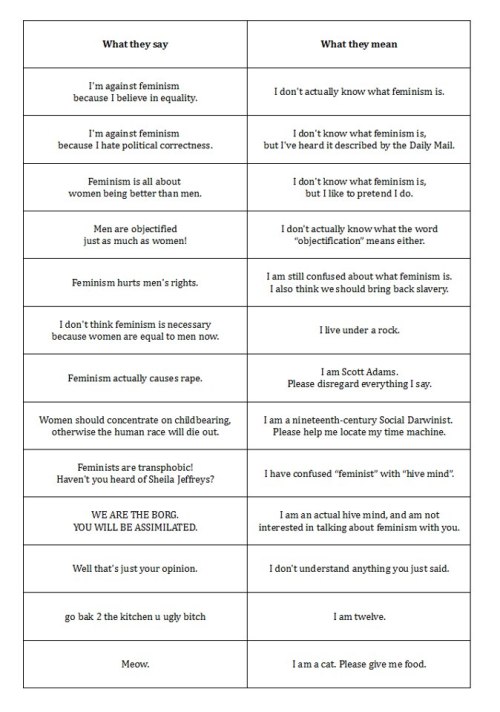
Today's Fun Table


It's on weird perceptions about  feminism  and how to respond to them.

I couldn't find the original to link to the creator of the table.  My apologies for that.
---
Added later:  Thanks to Indigo Fera in the comments for digging up the original source.

About Richard Mourdock. May Trigger.


His name should be Richard Morecock. What this worm uttered:
Indiana Republican Senate candidate Richard Mourdock said Tuesday when a woman is impregnated during a rape, "it's something God intended."
Mourdock, who's been locked in a tight race with Democratic challenger Rep. Joe Donnelly, was asked during the final minutes of a debate whether abortion should be allowed in cases of rape or incest.
"I struggled with it myself for a long time, but I came to realize that life is that gift from God. And, I think, even when life begins in that horrible situation of rape, that it is something that God intended to happened," Mourdock said.
Did he struggle as much as he would have in the claws of a rapist?  Did his arid and theoretical ponderings ever make him feel at all guilty?  Did he ask himself why he is the person to whom God has transmitted His (and it's always He in these deranged theories) theory of  how a male god gives life, all alone?  Such as by using the penis of a rapist as the pen that writes the Word on the canvas that is the body of a frightened and suffering woman?

This is not about gods at all.  This is about who has the right to decide when a woman is to give birth.  That "who" are people who look astonishingly like Richard Mourdock.  It is those people who have decided that the penis of a rapist is God's golden pen, writing life, beautifully.  

I wish to know if God also uses the murderer's gun to write death, when needed, if every death is His intention.  If that is so, who are we to intervene in the processes of dying?  After all, cancer cells are alive.

Mourdock then clarified his disgusting assertion:

Mourdock further explained after the debate he did not believe God intended the rape, but that God is the only one who can create life.
"Are you trying to suggest somehow that God preordained rape, no I don't think that," Mourdock said. "Anyone who would suggest that is just sick and twisted. No, that's not even close to what I said."

So what does Mourdock's god do?  Cruise around, looking for convenient rapes that just happen to be happening, so that he can insert New Life into the outcome?  Isn't that worse than the suggestion that god preordained rape?  Couldn't he have prevented the rape altogether?  Or at least the conception?   Mourdock's god comes across as an opportunist here.

But that's because Mourdock is an asshole of the highest caliber.  All this is about his right to decide on the fate of women who have been raped, and he doesn't care about those women.  He cares about power over them. 

Still, Mourdock's religious background is not irrelevant here.  The three Abrahamic religions all pretend that life comes only from a male god, all by himself, and that the role of women is to be as fields under cultivation.  To be plowed and seeded, as the farmers will.

Once those religions erased the female power in procreation altogether (while making sure that women continue to do most of the actual work involved with children), it's pretty obvious that the access to abortion is  the work of the devil.  It negates the very essence of the male-god-alone-theory.

Josh Marshall refers to an earlier comment by yet another Republican politician on the question of rape.  I reproduce the comment because it ties into the general fairy tale told by fundamentalists all over this globe:

Commenting on the horror of rape, Smith said he knew how bad it was since he experienced something similar.
“I lived something similar to that with my own family,” Smith said. He then described his daughter’s out-of-wedlock pregnancy — from consensual sex. “She chose life, and I commend her for that. She knew my views but fortunately for me … she chose the way I thought. Now don’t get me wrong. It wasn’t rape.”
Smith affirmed that he believed his daughter’s pregnancy from consensual sex was similar to a rape. “Put yourself in a father’s position, yes, I mean it is similar.”

Those who make the point that Smith equates consensual sex with rape miss the godly boat.  Smith sees his daughter's vagina as his property.  Anyone using his property without his consent is guilty of a crime.  It doesn't matter whether his daughter consented or not, because it's not her vagina we are talking about here:  it's Smith's property, and he wasn't consulted.  That's the "father's position" he means and that's why he doesn't get why anyone wouldn't agree with him about the common aspects of the two cases.

That's it.  Fertility comes only from god but the fertility of women is the property of the oldest male in the family.  It's up to him to decide how those vaginas are used or not.


Tuesday, October 23, 2012

The Topic No-One Dared To Raise in the Presidential Debates


That would be climate change.

Casual Sex. A Post on the Meaning of Terms.


Nope.  This is not going to be about the pleasures (or otherwise) of casual sex!  The headline was just a hook to reel you in.  This post is going to be about how we interpret terms and words and how that differs depending on who we are.  You know, the kinds of terms as "freedom," "democracy," "justice."

But casual sex comes into it.  And the fact that I now live in a second language.  For some odd reason the images I get whenever someone mentions "casual sex" are these: 

A participant has a bit of sex, goes up and makes a cup of tea, stands by the window and watches the birds meditatively, goes back into the bedroom for a grope of two, remembers the bills and pays them, returns to the bedroom, gets up and pulls out extraneous body hairs, goes back to sex and so on.

This goes on at the same time as my divinely logical brain knows full well what the term really means.  And similar double images apply to many other concepts  which are tossed around flippantly.

"Freedom" is one of those.  Whenever a politician says "freedom" the audience inserts their own meanings, and those meanings can be quite different from the one the politician means.  For instance, a Mitt Romney calling for more liberty or freedom has no intention of giving it to me, ever.

"Family values" is a similar press-the-right-buttons term.  A few decades ago all conservative politicians were about family values.  They just never defined what they meant by "family" and "values."  The idea was for us to plug in those secondary images of our own families, love and apple pie and such.

Now think of the term "feminist."  What it means in my head is an important aspect of general equality, fairness, justice.  All those good things which are ultimately good for you.  What it means inside the head of someone like Rush Limbaugh is the end of a world where someone like he can sit in the top saddle, unchallenged.  My paradise is his nightmare. 

And when it comes to flavoring a concept with those secondary images, the Rush Limbaughs of this world are winning.  People with feminist values dare not use the term!  They might be accused of man-bashing!   Armpit hairs might be sprouting!  Ugliness would rear its head!  Besides, if you are openly feminist you get nasty e-mails.

It's social control, of a type, and it works. 

The reason why I write about this at the eve of the US presidential elections is because so many of the political soundbites apply those secondary meanings of terms.  We hook onto that part of the speech, rather than asking the important question about what the speaker truly means here.  Details are boring and require the use of the brain to absorb.  Much easier to float on the emotional stream, right?

Monday, October 22, 2012

And More About The Republican-Women-Are-Hot Study


There's no such study, yells Echidne while hitting her head against the garage door.  Poor garage door.  It gets the anger others elicit.

As I wrote below, no study has found Republican female politicians more beautiful than Democratic female politicians.  Rinse and repeat.

But that's the interpretation which has stuck:

But this U.C.L.A. study contains measurable scientific data collected by actual professional scientists who have just basically given us the green light to go ahead and judge a book by its cover. And though the data offered no evidence as to the relative “attractiveness” of either party’s representatives (as the face-modeling software controlled for superficial markers like makeup and hairstyles), why would that stop anyone from conflating gender typicality with sex appeal? The answer is ha ha, of course it wouldn’t, but I adore your innocence.
I can’t figure out which part of this story is the most unforgivably retro. Is it the part where the Internet is flooded by a tsunami of bickering over which political party has the “prettier” members of Congress and/or prettier voters? Followed by smug accusations of sour grapes, actual sour grapes, and finally resentful grumbling by lots of women in comfort clogs, maybe even including me. (It’s none of your business but I require them for the back support. Take it easy, I have a doctor’s note.)
Or is it the part that suggests that a key factor in the electability and, dare I say, presence of a female politician on a national stage can be dependent on something as random as the placement of her eyebrows? Are there really subtle ways in which people would consider a woman suitable for office that are rooted in their visceral reaction to the width and prominence of her cheekbones? Well, probably.

"Visceral reaction about the width and prominence of her cheekbones" will determine someone's suitability for political office?  Well, if the study said anything about that it said that this might be the case in the Republican Party, not in general.

Then there's that silly suggestion that the party which has the prettier politicians (but only female ones!) is somehow the winning party.  If that's the level on which people operate, bring me dictatorship in the form of Havelock Vetinari. 


Today's Fun Research Popularization: Conservative Women Are More Beautiful!


Yup.   The study, about the femininity or masculinity of  politicians' faces, was publicized in September.  It's not in print yet, as far as I can tell, though a very kind person sent me the manuscript.

That's the first bad trend in the way these studies are discussed:  Do the discussion before the study is available for reading and criticism.  That way nobody can tell if it makes any sense!  It's like telling who won a baseball game without letting people actually watch the game.

The second slightly odd aspect in popularizing this particular study is that its lead author, Colleen M. Carpinella,  is a UCLA graduate student in psychology.  We don't usually popularize studies by people who haven't even gotten their PhD yet.  I must stress that this is not a criticism of the study or of the researchers.  Work done by PhD students can be valuable and worth looking at, but mostly newspapers and websites don't do that.

Except for certain titillating topics, such as the idea that Republican women might be better looking than Democratic women.  Now, note that the study DOES NOT SPEAK OF THAT at all.

But the popularizations do.  Here's a representative sample of the headlines:*


The Daily Caller:

Study: Female GOP politicians are better looking than liberal politicians [SLIDESHOW]

World Net Weekly:

Hubba, Hubba!  GOP women better looking?

The Examiner:

She's beautiful...does that mean she's a Republican?


Get the idea?  This study was about beauty.

Except it was not.  That word doesn't appear in the study at all.  Or studies, because the researchers carried out two separate studies.   I'm going to discuss the studies separately because they provoke different concerns.

The first study tries to measure the femininity vs. masculinity of the features of the politicians in the 111th US House of Representatives by feeding the photographs of all those 434 members into a program which analyzes the facial features for their sex-typicality.  Note that sex-typicality is not the same thing as beauty or handsomeness.   From the article: 
We downloaded photographs from each politician's government website and coded for sex and political party. We imported each image individually into FaceGen Modeler using the Photo Fit Tool (Blanz & Vetter, 1999), and we measured each face's sex-typicality (i.e., masculinity for men and femininity for women) using the Gender Morph tool.1 Theoretical values ranged from −40 (highly male-typed) to +40 (highly female-typed). We converted this to a common scale for men and women, reflecting the objective level of sex-typical facial cues. Thus, positive values indicated sex-typical characteristics (i.e., masculine men and feminine women); negative values indicated sex-atypical characteristics (i.e., feminine men and masculine women). 

Why did they do this?  Because the hypothesis in the article is that Republican women would be more sex-typical than Democratic women.  The Republican Party supports traditional gender roles and its supporters might require more sex-typical looks from the women who want to exert an atypical leadership role in that party.   To counteract for the latter, perhaps.

The Democratic Party is less invested in traditional gender roles and therefore can allow more sex-atypical faces on their politicians.  Because its supporters don't care about rigid definitions of masculinity and femininity and so on.

What did the first study find?  That the Republicans and Democrats overall did not differ in sex-typicality but that the Republican women were the most sex-typical of all politicians. You may already have figured out what that combination must mean about the Republican men.  Yup, they were less sex-typical than the Democratic men.

If we translated THAT into those weird popularization headlines, how would they look?  "Democratic men are Hotties!, Republicans As Ugly As Elephant's Anuses?"

I think you are getting my point here, which is that first certain studies are picked for closer examination and then they are closely examined in one direction only.

I'm not familiar with how the FaceGen Modeler works.  Does it allow for the fact that "sex-typical" facial features vary by racial and ethnic group? ** If the Democratic Party has more racial and ethnic variety, not controlling for ethnicity and race could distort the results.

The second study in the article tries to find out whether sex-typicality vs. sex-atypicality of the politicians' faces could be used to predict the political party that politician belongs to.  This study is considerably weaker in my view than the first study, because it uses a group of UCLA undergraduates (120 total, out of which 35 were men) for the prediction part.

For instance, I don't believe in the argument that American undergraduates would be so removed from day-to-day American politics that they wouldn't already know the party affiliation of quite a few people in the pictures.  And this would affect the female politicians more because they are fewer and therefore somehow more memorable.  The most memorable of all the sex-party groups would be Republican women politicians as there are not very many of them.  Who doesn't recognize the features of Michelle Bachmann, for instance?

Likewise, the way one is dressed, made-up and coiffed can affect the findings in the second study because none of these were controlled for and to my untutored eye there are pretty big differences between the Republican and Democratic women politician on those issues. The researchers point out that the first study didn't rely on those indicators which is true.  But the second party could have relied on them.

So let's recap:  A study found that Republican female politicians have the most sex-typical faces of all US members of the 111th House of Representatives.  Republican men are less sex-typical than Democratic men.  The researchers believe that the greater sex-typicality of Republican women has to do with what kinds of politicians are allowed to wield power in each party.  From the article:

We predicted that judgments of political party affiliation would rely on the sex-typicality of facial cues. Our prediction was guided by the gendered nature of the liberal-conservative continuum, in both policy advocacy and gender attitudes.
Across democratic political systems, women's historic realignment with more liberal politics (Inglehart & Norris, 2000) reflects shifts in political parties' values. In the U.S., for example, the Democratic Party is associated with socially liberal policies that aim to diminish gender disparities (e.g., women's rights, abortion rights); the Republican Party is associated with socially conservative policy issues that tend to bolster traditional sex roles (e.g., military spending, national defense; Winter, 2010). These policy platforms are manifest in each party's image. Consequently, politicians may exhibit characteristics that reflect these values.
Gender attitudes also differ reliably by political ideology. Conservatives, in particular, encourage adherence to traditional gender roles (Lye & Waldron, 1997). Thus, communal and feminine women are highly regarded. Consequently, Republican women may be uniquely prone to exhibit sex-typical characteristics.

And how was all this popularized in several places:  Republican women are hotter!


-----
*Science Daily's headline:  The GOP Has a Feminine Face, Study Finds, is better than the others because it's closer to truth.  The Republican women are more sex-typical, the Republican men are less sex-typical, so the overall pulls the party towards what the study calls the "feminine" end of the spectrum.  But it's tricky to use the term "feminine" without pointing out that all this is about sex-typical features, not feminine in the sense of pink-fluffy-rabbits-dancing-among-roses.

**For instance, does the study compare a Latina's facial features to the average facial features of all Latinas?  Or what?  This matters if the parties have different ethnic/racial percentages.

The study:

Colleen M. Carpinella, Kerri L. Johnson "Appearance-based politics: Sex-typed facial cues communicate political affiliation," forthcoming in the Journal of Experimental Social Psychology.


Sunday, October 21, 2012

What War on Women? Republicans Love Women!


Here's an example of exactly how much:

Mitt Romney’s campaign won’t say if the GOP presidential candidate would have signed the Lilly Ledbetter Fair Pay Act into law, but on Sunday Sen. Marco Rubio (R-FL) — a top campaign surrogate — disparaged the measure as a giveaway to trail lawyers.
“I think that anyone who’s working out there and making a living, if you’re the most qualified person for the job, you should be able to get paid,” Rubio said. “You should get paid as much as your male counterpart, everyone agrees with that principle”:
RUBIO: But just because they call a piece of legislation an equal pay bill doesn’t make it so. In fact, much of this legislation is in many respects nothing but an effort to help trial lawyers collect their fees and file lawsuits, which may have nothing to do whatsoever to increasing pay equity in the workplace.

Bolds are not mine, this time.

Mmm.  And trying murder cases is just a way for the defense lawyers to rake in the big bucks.  But of course I think murder is very wrong.

Enough with the joking.  The official position of the Republican Party is that "everyone agrees with the principle" that equally qualified women and men should get the same for performing the job equally well.  The principle, note.

In practice, people like Marco Rubio do not want to do anything at all to enforce that principle.  In practice, people like Marco Rubio are always on the side of the employers in these cases.   Besides,  based on the hidden Republican agenda, women should be at home and not out there taking jobs from men.

The opposition to laws against gender discrimination is an example of the wider opposition Republicans have towards any laws which might "burden" corporations.  Whenever there's a choice the Republican Justices on the Supreme Court side with corporations and against workers.


A Guest Post by Anna: A Feminist Literary Canon, Part Eight: 1990-2000


Hillary Clinton (born 1947) is an American politician. In 1995 her speech at the 1995 UN Conference on Women, called Women’s Rights are Human Rights (1995) showed her “speaking more forcefully on human rights than any American dignitary has on Chinese soil” as the NY Times put it. It is often considered one of the landmark speeches in the global struggle for women’s rights, and condemns all abuses of women wherever they occur. It can be read in its entirety here.

Eve Ensler (born May 25, 1953) is an American playwright, performer, feminist, activist and artist, best known for her play The Vagina Monologues. This play is made up of various feminist monologues centering around women’s experiences with their vaginas, based on interviews Ensler did with various women. 
 
However, it has come in for some criticism, mostly due to the monologue "The Little Coochie Snorcher that Could", in which an underage girl (thirteen in earlier performances, sixteen in the revised version) recounts being given alcohol and then having sex with an adult woman; the incident is recalled fondly by the grown girl, who in the original version of the play calls it "a good rape." This monologue is omitted from some versions. 
 
In 1998, Ensler’s experience performing The Vagina Monologues inspired her to create V-Day, a global activist movement to stop violence against women and girls. V-Day raises funds and awareness through annual benefit productions of The Vagina Monologues, and has raised over $800,000,000 so far.

Susan Faludi (born April 18, 1959) is an American journalist and author. Faludi's 1991 book Backlash: The Undeclared War Against American Women argues that the 1980s saw a backlash against feminism in America, especially due to the spread of negative stereotypes against career-focused women. Faludi asserts that many who argue "a woman's place is in the home, looking after the kids" are hypocrites, since they have wives who are working mothers or, as women, they are themselves working mothers. This work won her the National Book Critics Circle Award for general nonfiction in 1991.
Naomi Wolf (born 1962) is an American author and former political consultant. She is most famous for the book The Beauty Myth (1991) which argues that as women have gained increased social power and prominence, expected adherence to standards of physical beauty has grown stronger for women. that "beauty" as a normative value is entirely socially constructed, and that the patriarchy determines the content of that construction with the goal of reproducing its own hegemony.

Rebecca Walker (born November 17, 1969) is an American writer. She co-founded the Third Wave Foundation, which aims to encourage young women to get involved in activism and leadership roles. The organization now provides grants to individuals and projects that support young women. 
 
Walker is considered one of the founding leaders of third-wave feminism. She wrote an article for Ms. Magazine called Becoming the Third Wave (1991), criticizing the confirmation of Clarence Thomas as a Supreme Court justice after he was accused of sexually harassing his employee Anita Hill. Using this example, Walker addresses the oppression of the female voice and introduces the concept of third-wave feminism, a term her article coined. Walker defines third wave feminism at the end of the article by saying “To be a feminist is to integrate an ideology of equality and female empowerment into the very fiber of life. It is to search for personal clarity in the midst of systemic destruction, to join in sisterhood with women when often we are divided, to understand power structures with the intention of challenging them.”

Riot Grrrl was an American underground feminist punk rock movement that originally started in Washington, D.C.; Olympia, Washington; Portland, Oregon; and the greater Pacific Northwest in the early to mid-1990s. The Riot Grrrl Manifesto (1991) criticizes male-dominated culture and encourages girls to build their own alternative. It can be read in its entirety here.
-----
Part Six of the feminist literary canon has been expanded to include some non-American writers. The expanded version is available here.
 
Also please note that Hélène Cixous was born in French Algeria, which I forgot to write on Feministing.

Saturday, October 20, 2012

Let's Just All Get Incorporated, Then!


The reason?  Watch this, from Fox News:


How oddly things intertwine and knot.  One reason for the 37% figure of federal income taxes paid by the richest one percent of taxpayers is that the calculations attribute the income tax firms pay to their owners, and most of the owners belong to that top one percent.  Here the suggestion is that ALL of the incidence of the taxes falls ultimately on the consumers!  You can't have it both ways, conservatives.

How the incidence of any tax goes is an empirical question, by the way, and depends on the characteristics of a particular marketplace.  But it's extremely unlikely that corporations can just raise their prices whenever corporate taxes rise.

And on those high US corporate income taxes:  That's the rate.  The actual taxes paid by US firms are much lower than the initial rate because of all the deductions and tax loopholes.  Indeed, the US ranks pretty low in corporate taxes paid among the OECD countries. 

Friday, October 19, 2012

The Most Hilarious Class Warfare Piece Ever!


Must be this one (via Alicu blog):

Class warfare is a form of bigotry; it shouldn’t be tolerated any more than we would other forms of bigotry in public life.
Most people think of bigotry only in terms of race, religion, ethnicity and sexual orientation. But at its core, bigotry simply is intolerance – which all too often leads to singling people out for attack based upon their group identity.
Think for a moment about the small business entrepreneur just starting out in his basement, mortgaged to the hilt, wondering if he will make it. Everyone loves these heroes when they are struggling to survive. But when they rise from the basement and make it all the way to the penthouse, these heroes suddenly are “not paying their fair share.” Today, it is open season on them.
As the spending-driven debt crisis grows in America and among the 50 states, we would not accept such vilification toward the poor and elderly who consume taxpayer resources. We certainly would not accept such vilification toward the working class or minorities. So why do we tolerate the vilification of those most successful in America?
According to the IRS, the top 1 percent of earners take home 17 percent of the nation’s total taxable income. Yet they pay 37 percent of the nation’s taxes. They are paying a disproportionate share of the burden of government and yet the Occupy protestors, public employee unions and even President Obama demonize them.

Even the title of the piece is wonderful:

The Unctuous, Impoverishing Bigotry Of Class Warfare

Just to get this out of the way:  I'm certainly not advocating bigotry towards the rich or stating that they are bad people just because they are rich or anything else similar.  But there's a huge difference between asking whether the one-percent is paying their fair share and calling asking that question "an open season" on them.

So why did I find the piece stomach-hurting funny?  Because a) most of the class warfare goes on in the reverse direction, nonstop, for decades if not for centuries and b) because of that data on how the top one-percent are paying a disproportionate share of the "burden of the government."

On part a):  Remember the 1990s?  Remember the piglets at the teats of the government sow?  Remember the moniker  "welfare queens"?  Those kinds of arguments are still common on the net but few people think they are a form of class warfare.  Neither is the Citizens United decision seen as part of that long-standing war.

On part b):  One reason* for those 17% vs. 37% figures is a previous one-percenter victory in that real class war:  The seventeen-percent-figure excludes capital gains (including realized capital gains) because they are not taxable income.  Yet capital gains are a major source of income for the very rich.  Indeed, it constitutes 60% of the income of the Fortune 400, for instance.

Another reason is that the 37% figure is about federal income taxes, not all taxes, and not even about all federal taxes.  The following quote corrects the same conservative argument using slightly older data:

When Rep. Bachmann or Karl Rove or anyone else claims that 1 percent of Americans pay 40 percent of all taxes, they are flat out wrong. That’s because they are conflating the federal income tax with all taxes. It’s true that in 2007 (the last year for which complete data are available) the richest 1 percent paid about 40 percent of all the federal income taxes. But the federal income tax is only one part of the federal tax system, and of course, there are also state and local taxes.
In fact, federal income taxes make up just 42 percent of all federal taxes, and only one-quarter of all taxes, systemwide across our country. The federal income tax is progressive—meaning that higher-income households pay, on average, higher tax rates—but it’s practically the only piece of our country’s tax system that is.
Payroll taxes, which make up 40 percent of all federal revenue, are regressive. According to the nonpartisan Congressional Budget Office, or CBO, in 2007 a household in the middle class paid about 9.5 percent of their income in payroll taxes while someone in the top 1 percent paid just 1.6 percent of their income in payroll taxes. State and local taxes are also regressive. The Institute for Taxation and Economic Policy reported that the average state and local effective tax rate for the top 1 percent is only 5.2 percent, while the average tax rate on the middle 20 percent is 9.4 percent.
By ignoring the regressive parts of federal, state, and local tax codes, and either implicitly or explicitly suggesting that federal income taxes are the only taxes, conservatives are artificially inflating the share of taxes paid by the rich. When other federal and nonfederal taxes are taken into account, the 1 percent’s share of taxes paid declines quite a lot.
The CBO found that the top 1 percent paid 28.1 percent of the total federal tax burden in 2007. And a more recent analysis by the Tax Policy Center estimates that the share of federal taxes paid by the top 1 percent dropped to 25.6 percent in 2011.
Furthermore, the share of taxes paid by the top 1 percent drops even more when taking into account state and local taxes. An analysis by Citizens for Tax Justice found that when state and local taxes are included the share of total taxes paid by the top 1 percent in 2010 is only 21.5 percent. This is just about half the “headline” 40 percent that conservatives like to claim.

Guess what the income share of the top one percent was in 2007?  It was 20.3% of all income.  So if the top one percent paid 28.1% of all federal taxes that year is the system terribly unfair?  If the top one percent paid 25.6% of federal taxes in 2011  and 21.5% of all taxes in 2011, is the system terribly unfair?  After all, their share in the income wasn't that much smaller than those percentages, especially given the absence of capital gains in the definition of taxable income.

Now compare that to the horrible-terrible-absolutely awful argument that a mere one percent of all taxpayers, with 17% of all income, paid for 37% of all "this nation's taxes" [sic].

 ----
*The post discusses other reasons but not the question whether corporate income tax payments should be attributed only to the shareholders or not.  The former lies behind the 37% tax figure for the top one percent.


The Value of Midwives?


A Finnish net article looks at  regional differences in the number of women giving birth who suffer from severe perineal tears. 

What caught my eye about the article wasn't that much the regional differences within Finland but the comparison to Swedish data.  One researcher notes that severe perineal tears happen in about three percent of all Swedish births whereas the Finnish average is only 0.6 percent.  It looks like the US comparable figure might be four percent.

Assuming these data are correct, why is the Finnish average lower?   The same researcher thinks this has to do with midwifery (my translation):

Mika Gissler, a research professor at the Institute of Health and Welfare, knows the reason.  According to him Finland has preserved the old manual skills of midwives:  In natural births one supports the baby's head so that tears in the vagina or the perineal area can be avoided. 

It could be that there's something off in the Finnish data.  It could also be that the same midwife skills have been preserved elsewhere.  But if not, here's something that could benefit women giving birth in other countries.  And the change wouldn't be expensive, either.

I also found it interesting that one reason for an increase in severe perineal tears is that obstetricians now try to avoid doing Caesarian sections.  An unintended side-effect of a good policy?


Caterpillars and Left-Handed Irishmen. The Republican Response to the War-On-Women.


This is good clean fun.  The would-be Vice-President of the United States, the still most powerful country on earth, believes that the best way to put to bed the utterly ridiculous view that the Republican Party is running a war on women is to ridicule the very idea:

GOP vice-presidential nominee Paul Ryan on Thursday night poked fun at the Democratic argument that the GOP is waging a “war on women.”
“Now it’s a war on women; tomorrow it’s going to be a war on left-handed Irishmen or something like that,” Ryan told donors at a Naples fundraiser, according to Shushanna Walshe of ABC News.
Probably better than Reince Priebus' caterpillar comment* from last April:

“If the Democrats said we had a war on caterpillars and every mainstream media outlet talked about the fact that Republicans have a war on caterpillars, then we’d have problems with caterpillars,” Republican National Committee Chairman Reince Priebus said in an interview on Bloomberg Television’s “Political Capital with Al Hunt” airing this weekend. “It’s a fiction.” 

"Poking fun" at the opponent's argument can be a good strategy.  It suggests that the initial claim was outrageous and only deserves a joke in return.  But when the initial claim is not outrageous but, in fact, true, "poking fun" adds insult to injury.

The war-on-women is so unimportant that it can be joked about.  By a guy whose votes on abortion would please Randall Terry, the founder of Operation Rescue,   and whose votes on fair employment for women would have pleased any extreme misogynistic patriarch until 2012 when he had to pretend to be more moderate, what with the elections coming.

The more serious Republican defense against the allegations that they wage war against women is that since Republicans don't think they are waging a war against people in general this must mean that they don't wage war against women. Or something of this sort (from last April but you have heard it over and over more recently):

“Because it is a fiction, Thomas,” Priebus replied. “It’s a fiction because, number one, there is no war on women. … The fact of the matter is that the real war on women, the actual thing that I think most women in this country are most concerned about, which is a good job, a good family, being able to live the American dream, provide for your kids and your family, that war on women is being perpetrated by President Barack Obama.”

We are supposed to ignore the fact that on all women-specific issues the Republicans vote against women's rights and fairness.  Had it been up to the Republicans in the Congress in 1960s there would be no Civil Rights laws, no Equal Pay Act and no federal laws against gender discrimination at workplace.  Indeed, Republicans have fought against all of the anti-discrimination statutes and still do.  And let's not even get into the reproductive rights issues!

But on one sense I get what Ryan and Priebus and others of their ilk are saying.  To many among that group women are so unimportant (except as the factories of future Republicans) that their issues can be safely ignored.  It's hard to see the treatment of people that unimportant as a war.


 -------
It was a bad analogue anyway because there IS a war against caterpillars.  It uses biological and chemical weapons.


Paper, Scissors, Rock


That guessing game (which is good for deciding on who will clean up after a party, say) is an example of a non-transitive relationship.  Aren't you glad to learn that?

It can also be used as a source for fun thoughts:


Except that fun games shouldn't be subjected to such scrutiny.  We can't even be bothered to subject political claims to any real scrutiny!

I always try to play random in that game because most people think the opponent does not.  And I hardly ever had to do the worst kind of cleaning after parties*...  Though I usually help out, of course, being a kind-hearted goddess who also cares about her pristine reputation.
----
*In two wins out of three games, mind you.

Thursday, October 18, 2012

Telling Your Workers Which Presidential Candidate Is Best For The Business


What do you think of that? 

Mitt Romney loves the idea:

Romney, speaking on a call to the very conservative National Federation of Independent Business, tells a group of business owners that they should “make it very clear” how they feel about the candidates. The audio, discovered by In These Times, also captures Romney telling the business owners to “pass… along to your employees” how their jobs might be effected by who wins in November:
I hope you make it very clear to your employees what you believe is in the best interest of your enterprise and therefore their job and their future in the upcoming elections. And whether you agree with me or you agree with President Obama, or whatever your political view, I hope — I hope you pass those along to your employees. Nothing illegal about you talking to your employees about what you believe is best for the business, because I think that will figure into their election decision, their voting decision and of course doing that with your family and your kids as well.

So does Joe Walsh, the Tea Party's Golden Boy:

“If you run, own, or manage a company, tell your employees! What was the CEO this week that said, if Obama is reelected, I may have to let all of you go next year? If Obama’s reelected, if the Democrats take Congress, I may not be able to cover your health insurance next year. If there’s ever a year where people who run, manage, and own their companies are going to energize their employees, it better be this year. We’re up against it.”

I think the imbalance of power makes these proposals unethical, whether they are legal or not.