Thursday, August 31, 2006
Idle Thoughts on News About Women and Girls
Not as much idle thoughts as sad ones, because I do feel sad about the way women and girls are covered in the news. I have only really understood how biased the coverage of us is since 2001 when I decided to keep a diary about what I heard, saw and read about women. This project wasn't a scientific one; I simply jotted down the topics of programs or articles I happened to come across on the general category of women, or on working women, or on mothers and so on, and the points of view of the major participants and the general tone and conclusions.
When I leafed through the diary a year later I was shocked by what I found, and especially shocked because I only really followed the fairly liberal or neutral sources of news. I expected the news coverage to be neutral, on average. Instead, everything, every single thing about women was negative. Women or working women or mothers or girls had problems, were a problem, and even good news were presented as "good news but..."
Women had health problems, mental problems, body image problems, problems getting married or finding boyfriends, problems after a divorce, problems in old age. Working mothers were a problem in themselves; their children always assumed to suffer, even if studies suggested that this was not the case. Poor women had problems all over the place and they were a burden for the society. Single mothers, oh boy, did they have problems! And single women had problems and cats. All women had problems racing the fertility clock.
Women had problems understanding science or mathematics. Women in the developing countries caused problems because they had too many children. Women in the rest of the world caused problems because they had too few children. Either women were too selfless and easily pushed around by their families or they were too uppity and independent and selfish to serve their families properly.
In comparison the only news items on men which were negative, fully or in part, were the question of how boys performed at school and one program about men's health, and the first also contained a way to turn something positive about girls: their improved performance at school and in college, into yet another negative, because girls' improvement is seen as having come at the expense of boys (by anti-feminists)and because college-educated women can't now find equally educated husbands, it is argued.
Not that there were very many news items about the group "men" or about any similar subgroup, either. My guess is that this is because men are mostly seen as just human beings and their problems are discussed as general human problems, not men's problems. For example, a program on urban violence never mentions that it's a program about mostly male violence.
Another reason for the scarcity of these types of news on men is that so many problems which really are human or societal problems have been neatly folded into specifically female problems or even feminist problems. Thus, the scarcity of women in the Congress is seldom discussed as a problem for the whole country, and questions having to do with childcare are quickly turned into a problem of working mothers. Nothing to do with working fathers, nothing to do with the wider society, though the wider society tends to have vociferous opinions on how well the working mothers are doing. It makes much less noise about the delinquent child maintenance payments of some divorced parents, many (if not most) of them men.
When I called the tone of these news on women and girls negative I didn't mean that the negative tone was easy to spot. It wasn't. The negativity was slight but consistent, like an irritating hum in the background, and I doubt that I would have noticed its overall effect without my little diary experiment. It's true that the file included a few monsters, programs which had made me already angry while watching them. But the vast majority of the articles and documentaries and debates I followed were not openly contemptuous or misogynistic.
No, the negativity was subtle and often expressed as confused puzzlement. Something that the so-called concern troll on political blogs practises: pointing out concerns while pretending to take your side in the argument. And the way this was achieved was masterfully obscure, so obscure, that it was probably subconscious.
For example, advances in women's opportunities were always pictured as benefiting only some women, often only those who had already taken advantage of them, while any negative aspects of the same advances were discussed long and hard as applying to wide groups in the society. Or even better, the advances were discussed as really not being what women ultimately wanted, even if there was no evidence for that. Or at the least, the potential risks to women were widely discussed and debated.
Note that these were not programs about rape risk, for example, but about topics such as women getting graduate degrees in too large numbers at a time when their fertility is at its peak. - Come to think of it, there wasn't a single program about the risk of rape in my file covering one year of news on women and girls.
You Can Never Be Too Thin....

If you are a woman, that is. Even Katie Couric found this out, and she's regarded as one of the few women who have "made it". This is what happened:
The incoming "CBS Evening News" anchor appears significantly thinner in a network promotional magazine photo thanks to digital airbrushing.
The touched-up photo of Couric dressed in a striped business suit appears on the inside of the September issue of Watch! which is distributed at CBS stations and on American Airlines flights.
CBS News President Sean McManus said he was "obviously surprised and disappointed when I heard about it."
The original picture was snapped in May and was widely circulated to the media as an official photo of Couric.
Couric, 49, said she hadn't known about the digitally reworked version until she saw the issue. The former NBC "Today" show host told the Daily News, "I liked the first picture better because there's more of me to love."
Gil Schwartz, executive vice president of communications for CBS Corp., said Wednesday in a phone interview the photo alteration was done by someone in the CBS photo department who "got a little zealous."
Perhaps. But note that a slimmer woman is seen as a better selling point.
Wednesday, August 30, 2006
You Don't Introduce A New Product Line Until After Labor Day
But Fox News seems to have taken a head start in selling the Iran war (note that it's "n", not "q"):
Today Fox has aired multiple segments featuring pundits who claim that a U.S. military attack on Iran is both essential and imminent. Fox anchors repeatedly parrot these arguments. Watch a compilation of clips culled from the last several hours.
You can watch a video at Think Progress.
I don't quite know what to think of all this warmongering. Any war would have to consist of air attacks as the U.S. doesn't have enough troops to do the wars already started properly. But air attacks are not those precision hits the advertising campaign tells us; they would kill a lot of innocent bystanders. That wouldn't make the Iranians overly happy, and America's reputation in the rest of the world would sink even further if that was possible. - I really doubt that Bush would find any comrades for this adventure. Even Blair might blanch at the idea.
That attacking Iran ("pre-emptively") is a lunatic policy doesn't matter here or there, as this administration appears to consist of an alien breed which thinks quite differently from the rest of us. So I wouldn't discount all those war cries just because the whole thing is pure madness. There are many Americans (some even in the wingnutty blogosphere) who fear every single Muslim and who already live a global war between fundamentalist Christianity of some types and fundamentalist Islam of some types, and these people, most unfortunately, have more power right now than the more-or-less sane among us.
Then there is the whole masculinity thread underlying much of the slurs between Iran and the U.S., and I wouldn't discount its ability to overpower saner arguments. Even if real people die real deaths because of it. Even if the only solution to the distress so many wingnuts suffer from would be to nuke out every single Muslim in this world.
Add to this the election troubles the Republicans are facing. I can see the value of fanning the flames of fear in this way, if nothing else. Perhaps enough voters will be scared so much that they press the Republican button again, assuming that they can crawl out from under their beds on the election day. Would just talking about the war work? Or would the wingnuts actually start the bombing before November?
I feel a little bit crazy just writing about this, as if it was something valid to write about. So far have we come in the faith-based years of the Bush reign.
The Boys' Judicial Treehouse?

Ann at feministing.com has a post on the scarcity of women among the Supreme Court clerks, a position which is an important stepping stone in a legal career:
A few days ago, a lawyer friend sent me a daily law journal article about the paucity of female Supreme Court clerks this year-- 19% of the 2006 clerks are women, down from 37-41% over the five previous terms. Scalia, Thomas, Alito and Souter hired only male clerks this term.
...
In a brief telephone interview, Justice O'Connor said she was "surprised" by the development, but declined to speculate on the cause. Justice Ruth Bader Ginsburg expressed no such surprise. In a conversation the other day, she knew the numbers off the top of her head, and in fact had noted them in a speech this month in Montreal to the annual meeting of the American Sociological Association, during which she also observed with obvious regret that "I have been all alone in my corner on the bench" since Justice O'Connor's retirement in January.
Justice Ginsburg, who will have two women among her four clerks, declined during the conversation to comment further on the clerkship numbers. Why not ask a justice who has not hired any women for the coming term, she suggested.
Souter explains that this is "no more than a random variation," which is a really annoying excuse for his lack of female hires. I suppose the fact that there's only one female justice on the bench is also just a "random variation"?
It's very unlikely to be random variation. The proof is in this quote:
On June 29, 2006, the Supreme Court ended its 2005-2006 term. The Justices employed 37 law clerks this past term, 13 of whom were women. During the 2004-05 term, 15 of 35 law clerks were women. Initial reports for the upcoming 2006-2007 term appear to indicate that the number of women will again drop. A recent article by Tony Mauro entitled "High Court Clerks: Still White, Still Male" is available here.
Let's see how the run looks: From fifteen to thirteen to seven women in three years. Why is the "random variation" only going downwards? Now, it's not impossible for that to be the case, but I'd argue that the evidence supports a very different interpretation of the numbers. You make your own guess what that interpretation might be.
Linda Greenhouse in the New York Times offers more interesting and unwholesome evidence about some of the Justices:
Just under 50 percent of new law school graduates in 2005 were women. Yet women account for only 7 of the 37 law clerkships for the new term, the first time the number has been in the single digits since 1994, when there were 4,000 fewer women among the country's new law school graduates than there are today.
...
A post on one popular legal Web site, the Volokh Conspiracy, asked, "Why so few women Supreme Court clerks?" and drew 135 comments during a single week in July. The answers included the relative scarcity of female students among the top editors of the leading law schools' law reviews — an important preclerkship credential — and the absence of women among the "feeder judges," the dozen or so federal appeals court judges who, year in and year out, offer a reliable pipeline to the Supreme Court for their own favored law clerks.
Some speculated that Justice Antonin Scalia, who hired only two women among 28 law clerks during the last seven years and who will have none this year, could not find enough conservative women to meet his test of ideological purity. (Justice Clarence Thomas will also have no female clerks this year, but over the preceding six years hired 11.)
In a brief telephone interview, Justice O'Connor said she was "surprised" by the development, but declined to speculate on the cause.
Justice Ruth Bader Ginsburg expressed no such surprise. In a conversation the other day, she knew the numbers off the top of her head, and in fact had noted them in a speech this month in Montreal to the annual meeting of the American Sociological Association, during which she also observed with obvious regret that "I have been all alone in my corner on the bench" since Justice O'Connor's retirement in January.
...
Justice William O. Douglas hired the first female clerk, Lucille Lomen, in 1944, and it was 22 years before Justice Hugo L. Black hired the second, Margaret Corcoran. The first black clerk, William T. Coleman Jr., who is still practicing law here, was hired by Justice Felix Frankfurter in 1948.
Justice Frankfurter was not, however, ready to hire a woman when the dean of Harvard Law School strongly recommended a former star student in 1960. He turned down Ruth Bader Ginsburg.
Note that the number of women on the bench declined by fifty percent when Justice O'Connor retired, and the reaction to that was very muted. My own theory is that the more muted our reactions are the more likely the "No Girls Allowed" sign will be on the doors of the Supreme Court, because change is always cumbersome and it's much easier to pick clones of your own lovely self as your assistants. And because the anti-feminists figure out that they can satisfy their desires for an all-male environment without paying a price for it.
But the Supreme Court of the United States should not be a place where sex or race discrimination is practised.
Economics, Once Again
The U.S. Census Bureau has come out with some new findings on the incomes of Americans:
The nation's median household income rose last year for the first time since 1999, the Census Bureau reported Tuesday.
Median household income climbed 1.1% to $46,326 in 2005. That means half of U.S. households earned more and half earned less. Per capita income rose 1.5% to $25,036, the Census Bureau said.
The income jump hid some somber news. Earnings actually fell for people working full-time. Household income rose because more people worked in the households, albeit at lower paying jobs. Median earnings of men declined 1.8% last year. For women, the decline was 1.3%.
A few comments on all this: The median incomes for households rose because more people were working, not because wages and salaries would have risen. Instead, they decreased, but the effect of this decrease was swamped by the effect of more workers. Note also that both men's and women's earnings declined, but men's earnings declined more. This will show up as a reduction in the gender gap in earnings, but the reason for the decrease is not an especially joyful one. Men still suffer more from outsourcing and the losses of better paying blue-collar occupations.
If you read the USAToday link to this story you will find a table of income and poverty figures by state. Note that the poorest states are the most wingnutty in their politics. This is one of those great paradoxes.
What about poverty in general, then? What has happened to the percentage of Americans regarded as poor? Here's a partial answer:
In the world's biggest economy, one in eight Americans and almost one in four blacks lived in poverty last year, the U.S. Census Bureau said on Tuesday, both ratios virtually unchanged from 2004.
The survey also showed 15.9 percent of the population, or 46.6 million, had no health insurance, up from 15.6 percent in 2004 and an increase for a fifth consecutive year, even as the economy grew at a 3.2 percent clip.
It was the first year since President George W. Bush took office in 2001 that the poverty rate did not increase. As in past years, the figures showed poverty especially concentrated among blacks and Hispanics.
In all, some 37 million Americans, or 12.6 percent, lived below the poverty line, defined as having an annual income around $10,000 for an individual or $20,000 for a family of four. The total showed a decrease of 90,000 from the 2004 figure, which Census Bureau officials said was "statistically insignificant."
The answer is partial, because these statistics don't include the value of certain government benefits (such as Food Stamps and Medicaid or Medicare payments) while calculating poverty rates, and also partial in the sense that economists always argue about how to measure poverty best. For example, if we used an absolute measure of poverty (something to do with getting the minimum nutrition one needs to survive, perhaps), almost all Americans would be counted among the fairly affluent. But the measure we normally employ is a relative measure of property, telling us how some people do in comparison to the rest of the society.
Looking at the incomes of working Americans is important but not the whole economic story here. What has happened to the different ways of making a living? Consider, for example, the division of our national income cake between people who are wage earners and those whose income comes from investments. Though many people get income from both work and investments, the very rich tend to derive most of their incomes from the latter and the very poor, if not on welfare, from the former. So this graph (via a diary on Kos) is interesting:

Click on the graph to see a larger version. What it is telling us is that the American cake is sliced into fairy unequal wedges these days, and that the slices iced with the word "profit" are bigger and more luscious.
And what does this mean in terms of the 2006 elections? Hard to tell, given the tendency for the U.S. to have the best democracy money can buy.
What I Want To Know
First question: Do you remember that there used to be a time when we kept the jobs of presidents and clowns strictly separated? Yes, I'm looking at you guys: Ahmadinejad, Blair and Bush (in alphabetical order). I've given dozens of examples of the inappropriate clowning of Bush on this blog, and some of Blair's shenanigans, too, but Ahmadinejad is so cleary stark nutters that I haven't found him as fertile a field of funmaking. But this is fun:
Iranian President Mahmoud Ahmadinejad has called on U.S. President George W. Bush to participate in a "direct television debate with us," so Iran can voice its point of view on how to end problems in the world.
"But the condition is that there can be no censorship, especially for the American nation," he said Tuesday.
Must admit that he would have an edge in being able to speak English.
Second question: Do you, too, suddenly feel dizzy and out of breath when you start reading an article with the headline "Progress made in curbing Iraq disorder", and it starts like this:
Police found more than two dozen bodies across the capital Tuesday and the government said 73 people had died in fighting in the south as violence surged despite promising signs that a U.S. crackdown is curbing sectarian killings in Baghdad.
The U.S. military also said three American soldiers and one Marine were killed the day before — two in combat in Anbar province and two from non-hostile causes. A fourth soldier died on Tuesday in Baghdad. At least 13 American service members have died in Iraq since Sunday, according to the U.S. command.
Elsewhere, an oil pipeline exploded in southern Iraq, sparking a massive fire and killing at least 36 people and injuring 45, the Interior Ministry said.
The pipeline was located six miles south of Diwaniyah, the scene of fierce clashes between the Iraqi army and Shiite militia on Monday that left 73 people dead.
The reason for the explosion was not clear, but police Lt. Raid Jabir said several people had been siphoning fuel from the pipeline when the blast occurred. Iraqis have faced severe fuel shortages since Saddam Hussein's 2003 ouster. Insurgents also have frequently targeted pipelines and oil refineries.
The latest violence both inside and outside the capital occurred despite U.S. and Iraqi officials' claims that a new operation in the capital has lowered Sunni-Shiite killings there, which had risen in June and July.
Third question: Do you remember that there was a time when air traffic control was something to do with safety? Now safety is all about gel fillers in bras and water bottles, it seems:
The lone air traffic controller on duty the morning Comair Flight 5191 crashed cleared the jet for takeoff, then turned his back to do some "administrative duties" as the aircraft veered down the wrong runway, a federal investigator said Tuesday.
Separately, the Federal Aviation Administration acknowledged violating its own policies when it assigned only one controller to the Lexington tower.
Is this something to do with the inheritance Ronald Reagan left us? Or is it just part and parcel of the incompetence and callousness of this administration?
There! I feel much better now that I got all that extra snark bubbling inside me on the screen. You, my sweet reader, might feel worse of course...
Poetry in Translation
Poetry translates very poorly, which is sad, because I have a great urge to share with you my Finnish favorites, especially Eino Leino's Nocturne.
But it's hellish to translate. I haven't given up yet, though I decided to begin with another poem by Leino, his Jumalien Keinu, or the Swing of Gods. Leino wrote it in 1902. He was a great poet, an alcoholic and pretty much a mess otherwise, too, and all this matters in understanding the poem.
Here it is in Finnish:
Jumalien keinu
Kenen korkeat jumalat keinuunsa ottavat kerta,
eivät ne häntä yhdessä kohden pidä,
he heittävät häntä
välillä taivaan ja maan -
siksi kuin järjen valon häneltä ne vievät.
Ja kuka maailmoiden mahdin kuuluttaja on,
hän tänään pilvien ääriä kulkee,
ja huomenna makaa
maassa niin syvällä
kuin koski, mi vuorten
kuilussa kuohuu.
Kuka keinussa jumalien keinuu,
ei hällä elon aika pitkä ole.
Syyn, syyttömyyden
hän huiput nähköön -
sitten tulkohon tumma yö.
And this is my attempt at a translation:
The Swing Of Gods
Whom the High Gods harness to their swing,
he will not be held in one harbor safe.
He will be tossed
between heaven and earth -
until the very light of reason is extinguished.
And whoever wishes to sing of the might of the worlds
may today dance on the edge of the clouds
yet tomorrow sink deep
into the earth, as deep
as the foaming rapids
in mountain caverns.
Who dares to swing in the swing of the gods
will not survive for long in this life.
Let utmost guilt
and utmost innocence dawn -
then let come the darkening night.
I had to choose between "he" and "she" for the purposes of translation and the sound of the poem demanded the first option. The original poem doesn't imply a gender for the person, so "she" would be equally valid.
Sigh. It's impossible to get what fascinates me about this poem. Maybe if you read it aloud in Finnish?
Tuesday, August 29, 2006
Katrina - One Year Later
So many ways to go with this post. It's important to honor the memory of those who died, important to help and comfort those who struggle, important to demand accountability from the various levels of the government. It's important to ask why one of the cultural landmarks of this country is worth nothing much to the Bush administration, it's important to ask why the poorest among us are seen as worthless pieces of flotsam and jetsam, and it's important to ask what this says about the rest of us. All of this is very important, but there are others who cover these topics so much better.
The most I can do is to urge you not to forget the victims of Katrina, the survivors of Katrina, and not to let this administration flood them in orchestrated memory corrections. Then go read Digby for the larger picture, and if you find your anger waning too much, check out the stupid things that were said about the Katrina tragedy.
Blogger Problems
Blogger has been having hiccups since last night. You might get a "Server Error" page when you try to link to my blog or some others on Blogger or Blogspot. If you try again a little while later it might work or not. Some blogs are more affected than others, and if you are quite bored you could probably try to figure out why.
Which reminds me of something I just read in Temple Grandin's book Animals In Translation. Grandin is a high-performing autistic person with ideas that animals share some of the ways her brain works. One of the stories she tells is about an experiment in which both rats and humans got positive reinforcement if they pressed a lever when a dot appeared in a certain part of the screen they were watching. The dot appeared randomly (at a frequency of 0.7), and the best strategy was just to press the lever all the time, whether the dot was on the screen or not (there was no punishment for pressing the lever when the screen was dotless). Rats did this well, but humans didn't, because they tried to figure out the rules that governed the appearance of the dot.
This, I now tell myself, is the reason I do quite a lot of computing by trial and error... It's the new magic.
Stop Peeing, Right Now
If you are a man and want me to see your penis as sexy and mysterious. That's what one of the commenters at Powerpop gave as a reversal for this story which argues that mothers shouldn't breastfeed too much, because it's bad for their sex lives and marriages:
Why nurturing a passionate marriage is more important than breast-feeding.
The science section of The New York Times recently featured a lengthy study on breast-feeding and its benefits. Breast-feeding, the study found, helps reduce the chances of infection, cold, diarrhea, illness, and even later childhood obesity. No one argues with any of these benefits, but what the report neglects to mention, and what I have personally witnessed when counseling couples, is how breast-feeding can come between a husband and wife.
One of the episodes of "Shalom in the Home" this season featured a young couple in Pennsylvania who were madly in love when they married, but had slowly drifted apart after the birth of two children. Indeed, a Harvard University study maintains that a couples' love life decreases by 74 percent in the first year after the birth of a child. Now, given that sex is nearly dead in the American bedroom anyway, with national sex rates in marriage figuring at about once a week, a three-quarters decrease means that sex takes place once every few months—sparse pickings indeed.
With this particular couple, the situation was even worse. Their sex life had died completely, and one of the main causes was the mother's obsession with breast-feeding well into the child's eleventh month. The baby was attached to his mother like a limb, and he even slept with her every night, consigning her husband to a different bedroom.
I told the mother that in being so devoted to her son, she had committed the cardinal sin of marriage, which is to put someone else before her spouse, even if that someone is your child. Furthermore, I said, her obsession had turned one of her most attractive body parts into a feeding station, an attractive cafeteria rather than a scintillating piece of flesh.
...
In the end, there are two effects of breast-feeding that we often refuse to acknowledge. One is the de-eroticization of a woman's body, as her husband witnesses one of the most attractive parts of her body serving a utilitarian rather than romantic purpose. This is not to say that breast-feeding isn't sexy. Indeed, the maternal dimension is a central part of womanliness. But public breast-feeding is profoundly de-eroticizing, and I believe that wives should cover up, even when they nurse their babies in their husband's presence.
I believe this same problem comes up when men witness childbirth up close. There are certain poses in which a husband should not see his wife. By all means, be there for the entire labor, as I have been for the births of each of my eight children. But I strongly agree with the advice of the ancient rabbis that husbands should not be staring at the actual delivery. That is just too erotic a part of a wife's anatomy for it to become a mere birth canal.
The erotic nature of a wife's body is one of the principal elements of attraction in marriage. When a husband ceases to see his wife as a woman, and begins to see her as "the mother of his children," a negative trend has begun in his mind that can only subvert his erotic interest.
The Powerpop blogger, currently breastfeeding, gives the proper emotional reaction to this advice by a Rabbi, and the comment I started with gives all of it a funny angle. Though naturally some people only pee in secret, and our good Rabbi seems to recommend secret breastfeeding, too.
Is there anything useful that I can say about this piece of advice intended for breastfeeding women? Other than that it assumes that the way the hypothetical father feels in the stories cannot be changed by his own self-analysis or discussions? Other than the assumption that it is his sexual needs and how they are satisfied that is the basis for a good marriage? All this is pretty obvious in the original sermon.
Yet the Rabbi almost has a point, almost, because he loses the point by focusing on his fobias about the female body doing its stuff. The point is that marriages are indeed easy to take for granted, and that this easiness is not something only women are guilty of. The difficulty is similar to the trouble I have in seeing changes in my own face in the mirror, because I see it all the time. A new photograph suddenly puts things into a different perspective, oddly enough. Something like that goes on in close relationships. It's as if we have an old snapshot of the relationship and we assume that it reflects the current situation, too.
Fixing the problem, if it exists, isn't very easy. I dislike the idea of "marriage work" because it sounds like a chore. Something is needed to keep things fresh and open, and the only thing I can think of that really works is respect. Not love, though love can be the most wonderful thing, but just old-fashioned respect towards the humanity of the other. That, combined with the understanding that there are times (such as the first year with a new baby) when a relationship isn't going to satisfy every single need of the partners; that might take us a fair way into something better.
The Potemkin Village
How very sad that the story about the Potemkin village might not be true, because it is such a lovely simile for what is taking place in Mississippi as the anniversary of the hurricane Katrina draws near:
On the eve of the anniversary of Hurricane Katrina, President Bush returned to the devastated Gulf Coast today promising to continue federal assistance, and eagerly pointing out signs of progress.
"It's amazing, isn't?" he told a gathering under a sweltering sun. "It's amazing what the world looked like then and what it looks like now."
Mr. Bush, his presidency still marred one year later by the slow government response to the storm, spent the afternoon demonstrating his empathy and optimism in meetings with residents and officials along the storm-wracked coast. The trip marked an attempt by Mr. Bush to recast the legacy of the year before, when he lingered on the other side of the country before cutting short his vacation to deal with the crisis.
Mr. Bush acknowledged that, for some, rebuilding may have been so gradual as to seem non-existent. But, Mr. Bush said: "For a fellow who was here and now a year later comes back, things have changed."
"I feel a quiet sense of determination that's going to shape the future of Mississippi," he continued.
And then, in comments that could have been as applicable to the other main challenge of his administration — Iraq — Mr. Bush said: "As this part of the world flourishes, and businesses grow, people will find work and have the wherewithal to rebuild their lives."
Mr. Bush delivered his remarks at an intersection in a working-class Biloxi neighborhood against a carefully orchestrated backdrop of neatly reconstructed homes. Just a few feet out of camera range stood gutted houses with wires dangling from interior ceilings. A tattered piece of crime scene tape hung from a tree in the field where Mr. Bush spoke. A toilet seat lay on its side in the grass.
Bolds are mine.
What made "the camera range" so immutable? Surely the cameras could be moved a little.
---
Read Scout Prime on the topic of New Orleans after Katrina.
Monday, August 28, 2006
Autumn
Smell it. The scent of autumn is the scent of earth and its abundant harvests, things coming to fruition, to completion. I love this time. My garden has gone wild as is proper, and when I walk there my plants are taller than me. Imagine looking up and seeing a white-and-pink cleome looking down at you. Or a giant white tobacco flower, which also perfumes the night air that just now drifts in through the open window. And the velvet-smooth moths must follow the call of that perfume, that intoxicating, sexual call, wherever it leads them. Even if it is to my study.
I took a walk with my dog tonight, and watched our shadows in the streetlights lengthening and shortening and lengthening. We walked past dark yards with trees and shrubs half-asleep, with cars dozing in their parking spaces while their owners had retreated into brightly-lit nests of their own, and outside it was all autumn and excitement and the smells of ripeness, abundance and change.
Something quite wonderful must be happening just one street over. Do you ever feel that way? As if you are catching a call, a faint invitation to something incredible, so incredible that it sends shivers up and down your spine, so incredible that it's a miracle to live and experience it. The call of autumn.
Pope Benedict The Backward
Such a rude title. Tsk, tsk. Well, you can decide if it's too rude:
PHILOSOPHERS, scientists and other intellectuals close to the Pope will gather at his summer palace outside Rome this week for intensive discussions that could herald a fundamental shift in the Vatican's view of evolution.
There have been growing signs that Pope Benedict is considering aligning the Catholic Church more closely to the theory of "intelligent design',' taught in some US states, which advocates that some features of the universe and nature are so complex that they must have been designed by a higher intelligence. Critics say it is merely a disguise for "creationism", a literal belief in the Bible's account.
A prominent anti-evolutionist and Catholic scientist, Dominique Tassot, told the US weekly National Catholic Reporter that this week's meeting was "to give a broader extension to the debate".
"Even if [the Pope] knows where he wants to go, and I believe he does, it will take time. Most Catholic intellectuals today are convinced that evolution is obviously true because most scientists say so."
In 1996, in what was seen as an unconditional capitulation to scientific orthodoxy, John Paul II declared that Darwin's theories were "more than a hypothesis".
Last week, Cardinal Christoph Schonborn of Austria revealed that evolution and creation had been chosen as the subjects for this year's meeting of the Pope's Schulerkreis - a group consisting mainly of his former doctoral students that has been gathering annually since the late 1970s. Other participants at the closed-door meeting will include the president of the Austrian Academy of Sciences, Peter Schuster; the conservative ethical philosopher Robert Spaemann; and Paul Elbrich, professor of philosophy at Munich University.
Some idle wondering: How many women will attend this meeting?
And some more idle wondering: What is this all about?
The Pope also raised the issue in the inaugural sermon of his pontificate, saying: "We are not the accidental product, without meaning, of evolution."
A few months later, Cardinal Schonborn, who is regarded as being particularly close to Benedict, wrote an article for The New York Times that was seen as backing moves to teach intelligent design.
He was attacked by Father George Coyne, director of the Vatican Observatory. On August 19 Father Coyne was replaced without explanation. The announcement of his successor did not mention Father Coyne or his 28 years as observatory head.
Fast and decisive, our Benedict is.
Does he believe in the possession by the devil, too?
Good Choices and Bad Choices
Imagine our dear wingnut brothers and sisters living during the time of Jesus's crucifixion. How would they have reacted to it? Would they have said something like this: We all make choices in our lives. Some choices are good ones, some choices are bad ones. Jesus made some very bad choices, and look what it got him.
I've been thinking about the conservative emphasis on choices recently, because I came across a post somewhere on these wide and mysterious internets which told a story about the writer's travel from the political left right into the arms of wingnuttery, and the fuel in this trip was his realization that all his friends who ended up poor had made some very bad choices. Which proved, to him, that poverty and failure can be explained by choices alone.
Now this is all directly from the wingnut political bible: It's all your fault if you're poor or female or black or gay. The other side of the coin is that being rich and powerful and a heterosexual white male is all to your own credit, too.
Well, I'm exaggerating there a little. But in general the radical right has an overwhelming belief in the power of what they call "choice", but only in certain aspects of our lives. "Choices" have no impact on the environment, for example, so that it's perfectly acceptable to pollute as much as you desire.
It's also interesting that the wingnuts hardly ever blame a rich person of bad choices. What if someone got rich by fraud and deceit? That seems to be fine unless you get caught. Then you suddenly realize that you made some very bad choices, after all.
Why am I writing about this today? Why do I write about anything? But the impetus came from reading Pam Spaulding's post on Pandagon about the difficulties Ken Blackwell has in Ohio. She quotes a statement by Blackwell from an Ohio newspaper on the topic of homosexuality. Blackwell:
"I think homosexuality is a lifestyle, it's a choice, and that lifestyle can be changed. I think it is a transgression against God's law, God's will. The reality is, again, … that I think we make choices all the time. And I think you make good choices and bad choices in terms of lifestyle. Our expectation is that one's genetic makeup might make one more inclined to be an arsonist, or might make one more inclined to be a kleptomaniac. Do I think that they can be changed? Yes."
There it is, short and sweet, the radical right faith in individual choice. But when I checked the link Pam provided, all it now had was this:
Blackwell said homosexuality "is a lifestyle, it's a choice, and that lifestyle can be changed. I think it's a transgression against God's law, God's will."
What happened? Whose individual choice made the quote change? Did someone pull some strings. Was this a good choice?
All choice happens within constraints, you know. Constraints such as money, time, the health and education a person has, the social and religious norms that are felt as pressing. It has been said that the extreme right only focuses on the choice part of this and the extreme left on the constraints part, and that in reality both matter. I'd add to that the fact that the constraints themselves affect what we think we want to do and thus it's not always that easy to separate something called "free choice" from all the things that make it less than "free".
Sunday, August 27, 2006
Housekeeping

First, the blogads group that I belong to has changed their prices and ad selection. I may have been priced out by these changes. We'll see. But the ads help to pay for the broadband I really need for blogging (imagine trying to watch videos without it), so I hope that I'm wrong. If any of you, my dear and smart readers, are famous people who'd like to give me some praise to put into my sales-pitch, please e-mail me. Kisses and hugs.
I'm still incorruptible, at least until large amounts of chocolate are being offered, so the only bias you will spot in my writings is the goddess-based one. Easy to correct for.
Second, grammar. Should I clean my grammar up? I'm writing in a second language and a long time ago I decided that learning many grammars crowds the storage spaces of my brain too much. But if my grammatical errors really bother you I might be willing to work on it. Just send a donation with the instructions that I should follow....
Third, thank you very much for the lovely green skirt, you dear donor. You know who you are. Now a High Priestess of the Church of Echidne, an honorary post with no duties. (See how I'm nicely pointing out here the donation button? My Salon and NYT Select fees are coming up for payment.)
Fourth, feel no guilt at all if you can't contribute. You're still most welcome to read and to worship at my altar.
Fifth, I need to do something about the weekend blogging. I can't go on like this much longer, however much fun it is. So I'm trying to recruit some weekend guest bloggers, but if that doesn't work out I'm just going to not blog on Saturdays and Sundays. Or not very much anyway. Well, maybe a little... See the problem? I need to find a snake goddess therapist.
See how this post looks? I'm moaning for money and wanting to slack off. That's what comes from calling it "Housekeeping".
Iraq Is Not Really A Dangerous Place
That's the subtext of an article which appeared last night on the Washington Post website, written by a demography professor and a graduate student. It says lots of interesting and odd things:
The consequences of Operation Iraqi Freedom for U.S. forces are being documented by the Defense Department with an exceptional degree of openness and transparency. Its daily and cumulative counts of deaths receive a great deal of publicity. But deaths alone don't indicate the risk for an individual. For this purpose, the number of deaths must be compared with the number of individuals exposed to the risk of death. The Defense Department has supplied us with appropriate data on exposure, and we take advantage of it to provide the first profile of military mortality in Iraq.
This is the beginning, and a good beginning it is. Note how the article immediately points out the need to define risk carefully, by comparing the deaths with the number of individuals expose to the risk of death? This is what was wrong with the earlier wingnut cries about Iraq being less dangerous than Washington, D.C., because more Americans died in the latter place.
But the article then zooms on with just this one correction:
Between March 21, 2003, when the first military death was recorded in Iraq, and March 31, 2006, there were 2,321 deaths among American troops in Iraq. Seventy-nine percent were a result of action by hostile forces. Troops spent a total of 592,002 "person-years" in Iraq during this period. The ratio of deaths to person-years, .00392, or 3.92 deaths per 1,000 person-years, is the death rate of military personnel in Iraq.
How does this rate compare with that in other groups? One meaningful comparison is to the civilian population of the United States. That rate was 8.42 per 1,000 in 2003, more than twice that for military personnel in Iraq.
The comparison is imperfect, of course, because a much higher fraction of the American population is elderly and subject to higher death rates from degenerative diseases. The death rate for U.S. men ages 18 to 39 in 2003 was 1.53 per 1,000 -- 39 percent of that of troops in Iraq. But one can also find something equivalent to combat conditions on home soil. The death rate for African American men ages 20 to 34 in Philadelphia was 4.37 per 1,000 in 2002, 11 percent higher than among troops in Iraq. Slightly more than half the Philadelphia deaths were homicides.
The death rate of American troops in Vietnam was 5.6 times that observed in Iraq. Part of the reduction in the death rate is attributable to improvements in military medicine and such things as the use of body armor. These have reduced the ratio of deaths to wounds from 24 percent in Vietnam to 13 percent in Iraq.
The short message here is this: Hey, Iraq isn't dangerous at all! In the long-run we are all going to die! And young black men in dangerous places die at even higher rates (though of course they don't have armor)! And more people died in another war!
Indeed. Maybe we should ship our elderly to Iraq, to benefit from the lower risk of death there?
This is all hogwash. What are the person-years, by the way? Are all the mortality statistics in the above quote expressed in person-years? It's not clear at all, and if there is a skip from "person-years" to just people in thousands, are the results still the same?
But that's not the main reason for the hogwashiness of the article. Just consider this paragraph:
How does this rate compare with that in other groups? One meaningful comparison is to the civilian population of the United States. That rate was 8.42 per 1,000 in 2003, more than twice that for military personnel in Iraq.
Who on earth could call that comparison "meaningful"? The overall death rate includes the deaths to people in their eighties and nineties, and it includes all natural deaths. It covers the whole lifetimes of all individuals. How is comparing that to the risk of death from a war meaningful? Are the authors trying to tell us that going to Iraq is safer than just living your ordinary lives, to their natural ends?
The only way they could make such an argument would be if they also standardized the time periods of exposure. That would mean having American military born in Iraq, growing up in Iraq and staying in Iraq all their lives; all the time under war conditions. Then the comparison would make some sense.
The sharper criticism of all this is that the authors here failed to distinguish between the general risk of death from just living for a long time and the very specific risk of death from war. That the results seem to give the military in Iraq a lower risk of death is because those folks are much younger than the general population in this country. It's the nursing-home population which faces the highest risk of death, you know, and they are excluded from our forces in Iraq.
What about the second comparison, then, the one to young black men in certain areas of Philadelphia? That is a valid reminder of the shock and shame we should all feel for allowing such places to exist in the United States of America. But the gang wars fighters in Philadelphia don't have armored trucks or helmets. Neither do they have support troops which usually have lower rates of risk of death. If we are to compare this area to the Iraq war arena, we should use only the rates of those in direct combat positions in such comparisons.
More generally, what are we trying to do when calculating the risk of death from wars? Suppose that we send 100,000 soldiers into an area for one year and that 100 of them die. As a proportion this is one in a thousand. Suppose then that a soldier not yet sent into that area sees the data and regards himself or herself as the average type of a soldier. This would make the one in a thousand the relevant odds for that soldier to consider.
In short, we translate actual data on deaths into a measure of probability, one that would apply, on average, to future deaths if nothing major changes in the war. If the soldier we are looking at is not "average", we might need more detailed data on the deaths by the military branch or support-vs-combat duties, and if this data was available we could figure more precise odds of death for him or her.
From this point of view, the best way to calculate the differential risk of dying caused by the Iraq war would be to find out what the average risk of dying would have been for the same military population in the absence of the war and then to compare that to the actual death figures. We can't do this, as it's impossible to measure the alternative death rates of a reality that didn't come about (the Gore presidency, perhaps), but we can do almost as well by finding out what the risk of death is for the American military not in Iraq at the present time, always assuming that this group has the same age, sex and race distribution as the Iraq group.
Note that it's all in the questions we pose. If we ask wrong questions we get wrong answers, and each question we ask means something different politically.
Saturday, August 26, 2006
Saturday Cat Blogging
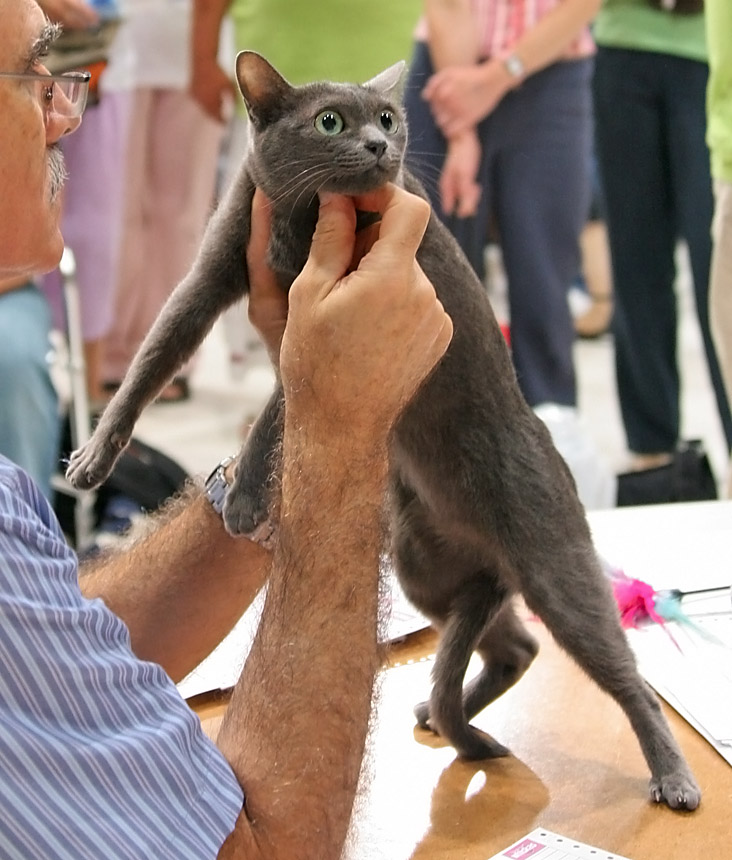
This is a little Korat being looked at in a show. Korats have heart-shaped faces. Thanks to hj for the picture, which allows me to balance all those dogs on this blog a little. - Somehow I don't think the cat is enjoying the probing.
A Day To Remember
The 26th of August:
At the behest of Rep. Bella Abzug (D-NY), in 1971 the U.S. Congress designated August 26 as "Women's Equality Day."
The date was selected to commemorate the 1920 passage of the 19th Amendment to the Constitution, granting women the right to vote. This was the culmination of a massive, peaceful civil rights movement by women that had its formal beginnings in 1848 at the world's first women's rights convention, in Seneca Falls, New York.
Shocking to think that there are still people alive in this country who were born before women could vote on our shared common matters. But it's also very salutary to remember how very young and fragile this whole business of empowering women really is, and how idiotic it is to read all those stories which wonder why a few decades of feminism didn't change every single thing about women's lives in this country. These things take a very long time, and vigilance is still the price of liberty.
Subscribe to:
Posts (Atom)