Thursday, October 27, 2005

Maureen Dowd on Feminism and Women


The New York Times has now published an excerpt from Maureen Dowd's soon-to-be-published book: Are Men Necessary: When Sexes Collide. The excerpt is only available for those who pay for the access, but I'm glad to tell all my faithful readers that you are not losing much at all by not being able to read the whole thing through. Not much at all, unless you really pine for some mind-blowing stupidity.

For that is what dear Maureen offers us all. The book seems to be on the battle of the sexes, that coy term which always makes me wonder if humankind should be exterminated at this very moment for using language so badly. The excerpt that we are given is all about how feminism has failed, how women have boomeranged to 1950's values and how the only way a man can get fucked is by paying for the dinner for both of them. This terrible state of affairs came about exactly how?

Well, Maureen tells us, in great detail, what her sources are: the books about catching a man her mother gave her when she was a teenager, similar books later on in her life (such as The Rules), interviews with carefully selected contacts (those who agree to say what Maureen needs to fill in on a page) and, lo and behold, several completely discredited studies: the Sylvia Hewlet study about how uppity women don't get men (see Garance Franke-Ruta for a very good critique of that one), the recently totally discredited survey of undergraduates at Yale (see Katha Pollitt for a demolition of that one) and an equally unsound study about the kinds of pictures men and women like to look at (men like to look at pictures of secretaries, you see).

You may have noticed that I am angry at Maureen, and this is indeed the case. I'm fuming, and not because she is not a feminist. I always knew that Maureen was no sister at all, and in any case goddesses don't have sisters as such. But I am really pissed off at all those story-tellers who make up trends from whole cloth and then bemoan the existence of this trend they have just created. Listen to how Maureen does this:

When I entered college in 1969, women were bursting out of theirs 50's chrysalis, shedding girdles, padded bras and conventions. The Jazz Age spirit flared in the Age of Aquarius. Women were once again imitating men and acting all independent: smoking, drinking, wanting to earn money and thinking they had the right to be sexual, this time protected by the pill. I didn't fit in with the brazen new world of hard-charging feminists.
...
Today, women have gone back to hunting their quarry - in person and in cyberspace - with elaborate schemes designed to allow the deluded creatures to think they are the hunters. "Men like hunting, and we shouldn't deprive them of their chance to do their hunting and mating rituals," my 26-year-old friend Julie Bosman, a New York Times reporter, says. "As my mom says, Men don't like to be chased." Or as the Marvelettes sang, "The hunter gets captured by the game."
...
There are plenty of ways for me to find out if he's going to see me as an equal without disturbing the dating ritual," one young woman says. "Disturbing the dating ritual leads to chaos. Everybody knows that."
...
In those faraway, long-ago days of feminism, there was talk about equal pay for equal work. Now there's talk about "girl money."
...

When I asked a young man at my gym how he and his lawyer girlfriend were going to divide the costs on a California vacation, he looked askance. "She never offers," he replied. "And I like paying for her." It is, as one guy said, "one of the few remaining ways we can demonstrate our manhood."
...
It was naïve and misguided for the early feminists to tendentiously demonize Barbie and Cosmo girl, to disdain such female proclivities as shopping, applying makeup and hunting for sexy shoes and cute boyfriends and to prognosticate a world where men and women dressed alike and worked alike in navy suits and were equal in every way.

Nowhere in the excerpt do I find a single statistical quote. Nothing about how women felt and acted in the odd single second of feminism that Dowd noticed and how they act now. Nothing about actually proving that the changes she so carefully depicts have actually happened on any large scale. Nothing about whether following The Rules actually leads to a successful marriage (I doubt it), nothing about whether women actually shop more nowadays or do more sexual servicing than they used to. It's all quotes, and I could probably write a reverse article by interviewing my friends. I could even add studies, better studies than the ones Dowd uses, and still I wouldn't be published in the New York Times. Now that is a trend worth weeping over.

Returning to the less interesting topic of Dowd, notice how she paints women with extreme colors. Feminists are mean, tight-lipped harridans:

I didn't fit in with the brazen new world of hard-charging feminists.
...
I thought the struggle for egalitarianism was a cinch, so I could leave it to my earnest sisters in black turtlenecks and Birkenstocks.
...
Jurassic feminists shudder at the retro implication of a quid profiterole

But nonfeminist women are not spared ridicule, either:

Many women now do not think of domestic life as a "comfortable concentration camp," as Betty Friedan wrote in "The Feminine Mystique," where they are losing their identities and turning into "anonymous biological robots in a docile mass." Now they want to be Mrs. Anonymous Biological Robot in a Docile Mass. They dream of being rescued - to flirt, to shop, to stay home and be taken care of. They shop for "Stepford Fashions" - matching shoes and ladylike bags and the 50's-style satin, lace and chiffon party dresses featured in InStyle layouts - and spend their days at the gym trying for Wisteria Lane waistlines.
...
A lot of women now want to be Maxim babes as much as men want Maxim babes. So women have moved from fighting objectification to seeking it. "I have been surprised," Maxim's editor, Ed Needham, confessed to me, "to find that a lot of women would want to be somehow validated as a Maxim girl type, that they'd like to be thought of as hot and would like their boyfriends to take pictures of them or make comments about them that mirror the Maxim representation of a woman, the Pamela Anderson sort of brand. That, to me, is kind of extraordinary."

It is all crap, really. Pure, unadulterated crap. But crap is what sells when the writing is about women. The idea is to make us rear on our hindlegs and charge into the battle, to spar, handbag to handbag, over the essential feminine questions: Prada or babies?

And all the time real women have real problems in their real lives. But that isn't going to make the kind of money dear Maureen is after.

(The funniest part of the excerpt has to do with the bit about oh-how-hard it is for successful women to find men. Dowd is very taken by this idea, and I wonder why. I have always had to swat men away like flies and I'm fairly smart and independent... And yes, this is quite beneath me. Heh.)

For Fun...


If you want to sublimate your violent emotions in a kind and gentle way (sort of), check out this site.

You can use your mouse to push him around.
----
Props to ao.

Sperm and Drinking


This is scary stuff, just in time for Halloween:

Problem drinking may dampen both a man's sex life and his chances of having children, according to a new study.

Researchers in India found that men being treated for alcoholism had lower testosterone levels and more sperm abnormalities than non-drinkers did. They also had a far higher rate of erectile dysfunction (ED) - 71 percent, versus 7 percent of abstainers.

Some past studies have suggested that heavy drinking can take a toll on men's reproductive health. One recent study found that couples had a higher miscarriage risk if the man had consumed 10 or more drinks a week around the time of conception.

Also, it's known that alcoholic men can develop signs of low testosterone, including shrunken testicles and enlarged breasts.

I haven't checked the study for any errors. That last little paragraph sounds fairly unscientific to me: "it's known that...".

If studies like these actually are found to be correct, will there be little warning labels on the beer cans one day? For men, I mean, like the ones we now have for women. I wonder...

The Cult of Personality


The American Prospect has a post about the Bush personality cult. It includes this snippet:

THE CULT OF PERSONALITY RETURNS. Over at The National Review, Kathryn Lopez has written the single weirdest response to Harriet Miers' withdrawal that I've yet seen:

You know what the relief is this morning? A return to the feeling that this president gets the big things right. There was a detour, but I'm confident we're going to have good news shortly on SCOTUS, because this president tends to get the big things right. That's the confidence so many of us have always had in him. And we may have been worried about our assessment for a few weeks there, but there's a renewed confidence this morning.


The National Review is a wingnut paper and Kathryn Lopez is a wingnut writer. Hence, the statement above shows how George Bush is made into something bigger than life, certainly something much bigger than he is. And of course he hasn't gotten any big things right, as the post notes later on.

But we on the left also have a personality cult (or lack-of-personality cult) concerning Georgie Porgie. It's true that ours is based on something closer to facts but it is still a cult in some ways. Maybe we should pay less attention to George and more attention to the silent forces in the background, the ones who are really ruling us?

Just think of the possible indictments of various bigtime powers in the Republican party. Such indictments would look like sweet karma to me and they would give me lots of personal elation. But would they save this country? I doubt it. That is one reason why I keep telling myself to stick to the fundamentals in political blogging, to try to talk about the issues and not about the games (though they can be fun, too), to look past the next three years of Georgereich to what might happen then. And this is where the Supreme Court comes in and why the nominations matter so very much. One day, sooner than you can believe, George Bush is history, but whomever he nominates on the SCOTUS will not be.

A Sane Republican?


They do exist, of course, but I seldom write about them because they tend to be quiet like little mice, hiding in the floor crevices. But here is one who has retired and no longer needs to fear the terrible consequences of not toeing the line: former U.S. Senator John Danforth. He said this recently:

Danforth, a former Republican senator from Missouri and an Episcopal priest, met with students during a seminar and held a luncheon talk at the graduate school.

"I think that the Republican Party fairly recently has been taken over by the Christian conservatives, by the Christian right," he said in an interview after his talks. "I don't think that this is a permanent condition but I think this has happened, and that it's divisive for the country."

He also said the evangelical Christian influence would be bad for the party in the long run.

Indeed. But moderate Republicans bear no clout whatsoever these days.

Miers Gives Up


Here is her farewell letter. It was the radical cleric wing of the Republican party that didn't like her, the ones who are single-issue voters. It will be interesting to see what kind of nominee will be dragged out next. Might give us some nightmares, that one.

The radical cleric wing is all about getting women properly submissive, and Miers wasn't good material for that. It is true that she isn't especially qualified and it is true that she is Bush's good crony, but these would not have hurt her at all if she could have shown that she has spent her whole life on trying to make sure no pregnancy is ever terminated. The radical cleric wing will not be appeased by anything less than overturning Roe, and then they start on banning contraception. Because nothing is as efficient in keeping women quiet than making sure that they have time for nothing else but procreation. So.

The liberals and progressives sometimes complain about single-issue voters on our side. Us women should be willing to give up reproductive choice for things such as fairer labor markets and better environmental protections. But lack of contraception would not make life easy for men, either, and without the right to determine when we have children we have no ability to control the other important parts of our destinies: income and education. And the way the radical religious wingnuts go about our bodies we might soon have no right to do anything at all but to sit quietly, preparing the uterus for its little visitors from god.

Ok, this is a rant. But it felt good.

White Sox


White Sox won the World Series (it's a baseball thing and doesn't actually cover the world, for those of you who read me outside the U.S.). The last time they won it was 1917. This shows that nothing is impossible. Maybe we can even get rid of the wingnuts, in a nice and polite way, naturally. Anyway, congratulations to all the White Sox fans. I had my fill last year.

Wednesday, October 26, 2005

2002


We have passed the two thousand figure in the deaths of American forces in Iraq. The total number of deaths in this war is manyfold.

Is Today the Day?


For Fitzmas, I mean. For the indictments in the Plamegate. So far it doesn't look like we will learn about the indictments quite yet. I hate this suspense. You can take foreplay too far, Fitz!

Midsummer


This is a really bad short story I just found I had, but it has a point I was trying to get to, and I am going to put it up here because of that point.

Elizabeth is nineteen, it is midsummer night's eve, she is in love with Nicholas who is also nineteen. Reason enough for her to dress in flimsy white, to paint on a magical face, to pick wildflowers and weave them into a bridal crown. He loves me, he loves me not, he loves me... The evening is milk and honey, still young but already unfolding into something more mature, into the powers of full summer.

(Start again: Elizabeth is nineteen and drinking beer in a small motor boat in the middle of the open sea. She and Nicholas are going to spend the night on a small deserted island. They have the boat, the beers, food and a tent. He is on his third beer and beginning to sing. She knows that they will make a fire for their hot dogs when they get to the island. What she doesn't know is whether he'll want to go to bed with her, and if so, whether she'll say yes to him. It would be the first time.)

The ocean is calm, its surface like blue silk. Sounds of music drift over the waters. Elizabeth reaches out and caresses the sea with her fingers. Nicholas smiles at her. The moon is round tonight, a white eye watching over them. They kiss; the whole world is nineteen and in love.

The island first looms as a dark shape in the distance. As they come closer they see its granite spine, a tall bare cliff rising up from the green woods. White gulls fly up from its shore, alarmed by their arrival.

Nicholas and Elizabeth pull their boat on shore, climb to the top of the cliff and set up their tent there. He goes looking for firewood, bringing each branch he finds back to her with a kiss. She lies down on the hard granite surface. The air is still warm and the growing darkness comforting, like a big velvet quilt. She watches the stars being turned on, one by one. She is almost falling asleep on this cliff top, lullabied by the sea and the woods.

(But: She is also groggy and bloated from all the beer and tired from their slightly drunken efforts with the boat and the tent. He picks up not only kisses on his return trips from the woods but also new cans of beer. She is supposed to get the hot dogs ready for roasting, but the uncooked flesh looks disgusting, like dead gray fingers, slimy as they resist being pierced by the sticks of wood he has gathered.)

When there is enough wood they make a fire. It throws bright sparks into the air. Elizabeth sees pictures in the flames, reflected back from the surrounding darkness. They eat and drink, curled up together. The smoke rises dreamily towards the sky. Nicholas sings old songs, Elizabeth leans against his chest. She is perfectly happy, right now.

The night has grown into its fullness. The ocean is a dark mirror cutting them off from everything else. There are other fires in the far distance, more music and laughter reaches them from somewhere unseen. Nicholas bends down to kiss Elizabeth on the lips, then on her neck. Her body sends sparks from his lips down her spine. His hands find her breasts and start caressing them. She runs her tongue down the nape of his neck. He tastes of soot and smoke. She is suddenly hungry, hot with tenderness and fierceness, opening up, crying of deep joy inside. She wants him now, she thinks. He responds and they forget where they are.

(Though not completely: Something presses painfully against her back, she doesn't want to make love in the open, she worries about the awkwardness of suggesting to him that they retire to the tent.)

He pulls her up, holding her hand and leads her to their tent. Inside it is very dark. Their bodies just fit into the narrow space. They meet each other hesitantly at first, then more needily. He buries his head in her breasts and kisses them, she pushes her hips against his and moans. He finds her center and she finds his. They can barely breathe; the air is thick with pollen, smoke and the scent of pine needles.

Somehow they have rid themselves of their clothing. He bends over her, leaning on his elbows, a question in his eyes. His eyes are veiled with desire but she knows that he is asking this question and gives him the answer he wants. She closes her own eyes and waits. She is full of summer and opening buds and honey. She is a hungry predator. She waits, ready to blossom, ready to eat. In the far distance she hears sirens.

She waits. Then Nicholas collapses on her, his jaw hits her cheekbone and air is forced out of her lungs. He snores. He is asleep. She can't believe this. She is stunned.

(She shouldn't have been. She knows how many beers he had had.)

Elizabeth pushes Nicholas aside, not gently, sits up and looks at his sleeping face. It has gone slack, saliva runs down his chin, his breath stinks of beer. Elizabeth gropes for her clothes and gets dressed. She is still excited, aching for him, trying to close her open body with her anger and disappointment. She crawls out of the tent.

The fire has burned down and the night air is rapidly cooling. Elizabeth wraps herself in a sweater and puts her shoes on. She doesn't want to sleep. She isn't sure what she wants to do.

She sits for some time on the top of the cliff, watching the sea, listening to the woods. A mist rises from the earth and at the moment just before dawn birds wake up to sing their shortest songs. Then the colors of the air begin to change, silvery reflections grow stronger on the water and the dark standing shapes of the trees turn into green pines. A slight breeze rises.

Elizabeth decides to explore the island. She climbs down the cliff to their boat and continues along the shoreline. The shore is full of giant boulders, wet from the sea and slippery from algae and moss. It takes all her concentration to cross them safely. Then the ground levels off and trees reach almost down to the water. She walks into the woods, into the green smell and the lush fronds of the ferns that grow under the trees. Her pant legs are wet with dew and her feet cold but she is serene, almost elated. The woods are a temple, she thinks. Something must worship here.

She has almost crossed the island. The ground rises steeply before dropping off to the shore on the opposite side. Elizabeth wants to see it. The climb is hard and she arrives at the top out of breath and scratched by tree branches.

The first thing she notices is the stench. It is nauseating, the smell of death, abattoires, putrification. Then she sees its cause: a large dead seal stranded on the shore. It lies on its back, bloated, its body pale and covered with fissures. The sun touches it and Elizabeth can't help seeing it as a cruel caricature of a fat, white sunbather on the first vacation day.

She feels a little sick, a little ashamed, but also fascinated. She watches the seal, its silence, the waves gently lapping at the silvery skin. It is the first live seal she has ever seen and it is dead. She studies it, trying to reach through its death to the seal underneath, wondering if it knows more than she does. If she squinches her eyes against the sun the seal is a large shimmering tear drop, a silver shield bouncing back sun's rays, almost beautiful.


Elizabeth sits there for a long time. Then she turns back to cross the island, to rejoin Nicholas (is he going to be sick?, is he going to stink?), to have breakfast, to pack up and to go out in a boat on this midsummer's day.

The Broadsheet


Salon has a new women's blog, called the Broadsheet. Reader reactions to it have not been uniformly positive. Some argue that there is no need for a separate blog on women's issues, others argue that having the separate blog ghettoizes these issues and therefore makes them even less noticed.

This is an old problem for feminists: how to insert women into an ongoing public debate or a lesson plan or whatever when many don't see the absence of women as an absence at all, but just the way things are. The solutions to the problem have varied over time, with varying rates of success, but whatever the solution one suggests there will always be the critical voice pointing out how that solution is deficient: If women's issues are dealt with separately then not only will it look like ghettoizing but it will also look like women are given something more than men are given, something extra. To point out that the mainstread dialogue is often closer to malestream dialogue doesn't silence this criticism. And if this separate-but-equal solution is rejected in favor of just adding women's voices to the general dialogue we often don't see it happen.

This might be one of those cases where we shouldn't let the best be the enemy of the good-enough. Read the Broadsheet if you can (you can sit through an ad if you are not a paying customer) and decide for yourself it it says useful things.
----
Thanks to JV for the e-mail on this blog.

Tuesday, October 25, 2005

Rosa Parks


Rosa Parks died yesterday, at the age of ninety-two. She is of course world-famous for her refusal to cede her bus seat to a white man when the Alabama law made such a refusal a crime. Many regard her act as the start of the Civil Rights Movement.

Parks was very important, but the mythmaking about her is also interesting. Even the BBC cast her sudden determination to stay sitting as something that just happened because Rosa was tired after a long day of work, as if she was a total political innocent, for example. Yet in reality she was very involved in the political movement that her refusal made famous. She was politically active and she worked in a group of like-minded people. The alternative myth is very appealing, but a myth it is, and its effect is to downplay the importance of political action in general.

Though I have spotted a human tendency towards similar mythmaking in other contexts, too. We seem to want to see our geniuses as lonely individuals, toiling away in a cold garret with no help from anyone else. It's a lot less exciting to read and find that they were amply supported by colleagues, mentors and often even the moneyed establishment.

None of this is intended to belittle the achievements we celebrate, including Rosa Parks's famous act of civil disobedience.

Monday, October 24, 2005

My Landline Is Down


Repair won't arrive until Wednesday, so tomorrow's posting will be less than usual. Sorry about this. I really need to get broadband.

ESP


Extrasensory Perception. The way the same local editorials suddenly crop up all over the place. This is something the wingnuts can do, it seems.

It is the astro-turf version of grassroots. Democracy from top down, not from bottom up. I blogged about something similar last summer, the large number of identical letters to the editors of small newspapers all across the country, each with a different signature. They all came from a wingnut website which provided both the letter to write and a handy list of local newspaper e-mail addresses.

Is this wrong? I'm not sure. It's not uncommon for various websites to give people hints on how to write a letter of complaint. But to do this with editorials seems a step closer to not-very-nice. What is your opinion?

On Guns


The Brazilians have decided that they don't want gun sales banned:

Brazilians soundly rejected a proposal to ban the sale of guns in a national referendum Sunday, striking down the bid to stem one of the world's highest firearm murder rates following a campaign that drew parallels to the U.S. gun control debate.

Brazil has 100 million fewer citizens than the United States, but a staggering 25 percent more gun deaths at nearly 40,000 a year. While supporters argued that gun control was the best way to staunch the violence, opponents played on Brazilians' fears that the police can't protect them.

"I don't like people walking around armed on the street. But since all the bandits have guns, you need to have a gun at home," said taxi driver Mohammed Osei, who voted against the ban.

Forty thousand deaths a year. How many terrorist attacks would that correspond to? But we don't think of gun deaths that way, and the reasons are many and complicated. There is something similar in all this to the way we react to statistics about car accident deaths. We are used to certain small-gesture ways of dying. It is the mass murders or mass accidents that still make us feel a little uncomfortable.

In any case, once guns are out of the bag, to coin a bad simile, it appears too late to stop the killings. The bad guys already have them, you see, and so the good guys need them, too. And then they will be available for children who play around the gun cabinet and for married couples who are having a spat and so on. It is a one-way process, the spread of guns into a society. I am quite despondent about it, as you may have noticed.

It's no longer possible to count the times I've heard someone say that idiotic thing about guns not killing people but people killing people. Sure. But it's only true in the same way as saying that it's not airplanes that take me across the Atlantic but people. Without the planes I wouldn't get there very fast and without the guns the people who do the killing would have a much harder time to kill.

The only solution to the gun dilemma I can imagine is the development of something even stronger than firearms. Maybe little personal nuclear bombs. Or we could always try to build a community and work on the issues that breed crime but it's hard work and so many of us don't believe in communities or our abilities to change them in any meaningful way. So we are more likely to get the personal bombs, probably in a choice of pretty colors.

Sunday, October 23, 2005

Ralph Reed-y


I have a personal reason to be angry at Ralph Reed, the former Christian Coalition stand-in-for-Jesus: he was the wingnut who woke me up from the hundred-year sleep though not with a kiss. It was more like a venomous bite to my butt. I guess more spiritual people would see him as having given me the gift of political awareness, but political awareness hurts.

Anyway, karma is finally getting even our little Ralph. It doesn't matter that he has no belief in karma, being a wingnut Christian. Karma is quite oblivious to your beliefs, it seems.

The specific way karma is tapping on Ralph's shoulder, to remind him, is this:

There was only one reason that clients ranging from Native-American tribes to Fortune 500 CEOs to Pacific Island potentates were willing to pay Jack Abramoff millions. The lobbyist at the center of a spreading scandal that has touched numerous lawmakers, including former House majority leader Tom DeLay, had access like few others to people in power. But in the place that mattered most, even someone as well-connected as Abramoff needed help. When he had to make sure his clients' concerns got the attention of the right people in the George W. Bush White House, Abramoff often turned to a longtime friend and business associate whose ties there—especially with the President's most trusted adviser, Karl Rove—were far better than his: former Christian Coalition executive director Ralph Reed, an operative of such political talent that he made the cover of TIME in 1995, at age 33, with a line that declared him "the Right Hand of God."

Reed, a key Bush campaign strategist and the favorite in the 2006 race to become Lieutenant Governor of Georgia, was an obliging, even eager middleman, judging by e-mail exchanges between the two, which have been obtained by TIME. (The e-mails have attracted the interest of federal investigators already looking into whether Abramoff defrauded his Indian clients—a charge he denies.) Ten days after 9/11, for instance, Abramoff was promoting a business venture to rent cruise ships to the Federal Emergency Management Agency (FEMA) to billet rescue workers off New York City. Reed assured Abramoff he had "put in a tag call to Karl to find out the best contact at FEMA."
...
Abramoff's friendship with Reed goes back to their political organizing in the early 1980s, when Abramoff was national chairman of the College Republicans and Reed was executive director. Reed slept on Abramoff's couch at one point and introduced him to the woman he married. After Reed started his consulting firm in 1997, Abramoff threw him what would end up being as much as $4 million worth of business on campaigns to stop gambling—which Reed had once called "a cancer on the American body politic."

However mutually beneficial that relationship was, it has returned to haunt Reed in his first campaign for elected office. Reed, a former Georgia G.O.P. chairman who was considered the engineer of an impressive sweep of Republican victories in that state in 2002, has tapped his national connections and swamped his rivals at fund raising in his race. Lieutenant Governor is largely a ceremonial job, but it could give Reed, 44, a leg up for a gubernatorial bid in 2010.

Yet in recent months Reed has mostly been on the defensive. Questions have been raised about his golfing trip with Abramoff to Scotland in 2002 and whether Reed knew that the ostensibly antigambling campaigns he waged with Abramoff were actually paid for by gambling interests eager to get rid of their competition. It is a particularly uncomfortable situation for a politician famous for his ability to rally religious conservatives. Those supporters largely dismiss the revelations as a left-wing smear, but Rusty Paul, Reed's predecessor as Georgia G.O.P. chairman, acknowledges "a lot of very nervous people around waiting for other shoes to drop." Allies of his chief rival in the primary have circulated a memo among local Republicans warning that having Reed on the ticket could jeopardize incumbent Governor Sonny Perdue and the G.O.P.'s legislative majorities.

Unsavory, I think. Ralph Reed, who hates gambling like a sin might also be helping people to get gambling rights. His defense seems to be that he wasn't paid with money earned from gambling. But the tribe only gets revenues from gambling. Tough for Ralph, isn't it?

Did You Read About This?


The U.K. Telegraph is reporting about a repeat of the Fallujah events where American contractors died, this time in Duluyia. Warning: It is extremely gruesome stuff!

This event was supposed to have happened nearly a month ago, but we have not heard about it here in America.
---
Link from P. O'Neill on Eschaton threads.

Saturday, October 22, 2005

Saturday Fun


This is one of those tests which allows you to psychoanalyze yourself, but this also lets you be artistic. Draw a pig!

Friday, October 21, 2005

Friday Power Tool Blogging


Don't buy the cheapest powertool, even if you think that you are an amateur who isn't going to need a lot of power. The cheapest tools are so crappily made that you might as well use your teeth and finger nails for the job. For example, the screws in a cheap miter box I own are made out of plastic. This means that you can't tighten them more than a couple of times. Not good for lots of mitering.

I own a router which died on me the first time I made some shelves. I keep it as a reminder never again to fall for the low price and pretty small size. Especially if you are a girl goddess. You need vrrroooommmm power to get the job done. And in case of routers you also need to buy the expensive bits that don't go dull the minute your beady eyes sees them. Sad but true.

The only exception to this rule I can think is my ancient sewing machine. It never cost much but it's so simple that I can fix and maintain it on my very own. It does sound as if it's in the last stages of tuberculosis, but it still runs a mean seam.

In all other cases, I'd recommend buying or renting the best you can afford.

A Cunning Wingnut Plot?


Have you noticed how the soundbites are somehow distributed through Wingnuttia? Suddenly all wingnuts talk about the same thing, be it Social Security or something Bill Clinton did in 1958. Often I can see why the topic is up for renewed chewing but equally often I can't see where they get a particular topic from. So I am semi-convinced that all wingnuts have little wires to their brains, and every Monday morning a message is sent about what to write and talk about that week.

This week it seems to be all about modesty and how well it protects women in the American society. I recently blogged on a speech given by a Harvard professor on this topic, and now a website is republishing Leon Kass's old musings about how lovely it all was when a man had to really work to get his penis home, so to speak. It was really good for women, too, because women were in power in this game. Sort of like baseball where you try to hit the umpire in the groin?

I have read Kass on the female modesty before, but if you haven't had the pleasure here is a taste:

But most young women strike me as sad, lonely, and confused; hoping for something more, they are not enjoying their hard-won sexual liberation as much as liberation theory says they should.2 Never mind wooing, today's collegians do not even make dates or other forward-looking commitments to see one another; in this, as in so many other ways, they reveal their blindness to the meaning of the passing of time. Those very few who couple off seriously and get married upon graduation as we, their parents, once did are looked upon as freaks.

After college, the scene is even more remarkable and bizarre: singles bars, personal "partner wanted" ads (almost never mentioning marriage as a goal), men practicing serial monogamy (or what someone has aptly renamed "rotating polygamy"), women chronically disappointed in the failure of men "to commit." For the first time in human history, mature women by the tens of thousands live the entire decade of their twenties — their most fertile years — neither in the homes of their fathers nor in the homes of their husbands; unprotected, lonely, and out of sync with their inborn nature. Some women positively welcome this state of affairs, but most do not; resenting the personal price they pay for their worldly independence, they nevertheless try to put a good face on things and take refuge in work or feminist ideology. As age 30 comes and goes, they begin to allow themselves to hear their biological clock ticking, and, if husbands continue to be lacking, single motherhood by the hand of science is now an option. Meanwhile, the bachelor herd continues its youthful prowl, with real life in suspended animation, living out what Kay Hymowitz, a contributing editor of City Journal, has called a "postmodern postadolescence."
...
The change most immediately devastating for wooing is probably the sexual revolution. For why would a man court a woman for marriage when she may be sexually enjoyed, and regularly, without it? Contrary to what the youth of the sixties believed, they were not the first to feel the power of sexual desire. Many, perhaps even most, men in earlier times avidly sought sexual pleasure prior to and outside of marriage. But they usually distinguished, as did the culture generally, between women one fooled around with and women one married, between a woman of easy virtue and a woman of virtue simply. Only respectable women were respected; one no more wanted a loose woman for one's partner than for one's mother.

The supreme virtue of the virtuous woman was modesty, a form of sexual self-control, manifested not only in chastity but in decorous dress and manner, speech and deed, and in reticence in the display of her well- banked affections. A virtue, as it were, made for courtship, it served simultaneously as a source of attraction and a spur to manly ardor, a guard against a woman's own desires, as well as a defense against unworthy suitors. A fine woman understood that giving her body (in earlier times, even her kiss) meant giving her heart, which was too precious to be bestowed on anyone who would not prove himself worthy, at the very least by pledging himself in marriage to be her defender and lover forever.

Once female modesty became a first casualty of the sexual revolution, even women eager for marriage lost their greatest power to hold and to discipline their prospective mates. For it is a woman's refusal of sexual importunings, coupled with hints or promises of later gratification, that is generally a necessary condition of transforming a man's lust into love. Women also lost the capacity to discover their own genuine longings and best interests. For only by holding herself in reserve does a woman gain the distance and self-command needed to discern what and whom she truly wants and to insist that the ardent suitor measure up. While there has always been sex without love, easy and early sexual satisfaction makes love and real intimacy less, not more, likely — for both men and women. Everyone's prospects for marriage were — are — sacrificed on the altar of pleasure now.

Yes, it is silly stuff. But Kass is quite serious beneath all the silliness. So it might be useful to note what mistakes his little sermon makes.

First, there is the tacit assumption that women and men in the past were happy, that it was a good thing to be ashamed of being born outside wedlock, that the courting system Kass assumes existed led to good and strong marriages. Note that in Kass's view of the history families didn't contain incest or rape or married couples who hated each others' guts and tore everybody else apart with their continual warfare.
We are not actually given any statistical evidence of this golden past.

Second, there is another tacit assumption Kass makes, and that is his belief that he knows what makes women happy or unhappy:

Women also lost the capacity to discover their own genuine longings and best interests. For only by holding herself in reserve does a woman gain the distance and self-command needed to discern what and whom she truly wants and to insist that the ardent suitor measure up.

How does he know that women lost this capacity? I am a female goddess and I have that capacity just fine. And maybe the reason he finds most women sad and lonely-looking is that they feel like that when they see Kass? I wouldn't be surprised.

Third, the whole article is extremely insulting to men, extremely so. Men are portrayed as wild beasts which must be steered towards the abbattoir of marriage, by their penises it seems. And the people to do this steering are the ones these wild beasts supposedly hunt for! Now that is curious.

Fourth, the whole article is based on anecdotal evidence and personal opinions. Which is fine in, say, a blog of a minor goddess, but not so fine in the writings of a professor and a bioethicist.

And so on. But Kass has a serious point, naturally, and that has to do with the "otherness" of women. His solution to this "otherness" is the old contract between gentlemen, the one that excludes the ladies when they get up after dinner in a Victorian dining-room to leave the men to their drinks, cigars and real power.
----
I got the topic from Crooked Timber. The discussion there is good.

Freewayblogging


Here is a proposal from Freewayblogger that could let you make a difference without much more than some paint and cardboard:

Here's the plan: The day after the 2,000th U.S. soldier is declared dead in Iraq, everybody paints protest signs and puts them on the freeway. So far I've got 700 fresh recruits and another 1500 fellow-travelers alerted.

Almost two thousand dead soldiers. I weep. Not to mention all the dead Iraqis. I think that they deserve to be commemorated.

Ellen R. Sauerbrey


Sauerbrey is Bush's nominee for Assistant Secretary of State, Bureau of Population, Refugees and Migration. The job of the assistant secretary is to oversee the U.S. refugee assistance and admission programs. Sauerbrey is an interesting choice for this position as she is largely known as an avid anti-abortion voice in the United Nations where she is the current U.S. Ambassador to the Commission on the Status of Women. Her experience with the problems of managing refugees appears to be roughly zero. Instead, she is famous for the following:

* She has not only repeatedly stated her opposition to the right to choose abortion but has also declared that abortion is not a legitimate element of reproductive health assistance.

* She approves of President Bush's withholding of funding to UNFPA, the United Nations Population Fund, charging that the money is "being used for coercive abortions in China," despite numerous findings to the contrary.

* Sauerbrey has also denied that adolescents have any right to exercise autonomous control over their reproductive health and has called abstinence-only-until-marriage sex education the healthiest and most responsible method of HIV prevention suitable for adolescents.

Along with opposing reproductive health and rights, Sauerbrey has taken extremist positions on other women's rights issues in the context of the United Nations.

In her role at the U.N. she has opposed ratification of the Convention for the Elimination of all forms of Discrimination Against Women (CEDAW), a United Nations treaty agreed to by more than 180 countries (excluding the United States), and has also objected to language in U.N. documents that requires countries to "condemn violence against women and refrain from invoking any custom, tradition or religious consideration to avoid their obligations with respect to its elimination as set out in the Declaration on the Elimination of Violence against Women."

Nothing really new in any of this. The Bush administration has been waging a war against the poor women of this world from day one, and it has always been clear that the religious wingnuts will be thrown some crumbs in the form of those women's lives who can't vote in the United States. Also, nominating incompetent people is fairly routine.

I just wanted to point out that this stuff is going on all the time, under the radar of most of us, that the wingnuts love it and that us nasty feminazis don't love it. If you want to protest Sauerbrey's nomination, check out feministing.com.

Thursday, October 20, 2005

A Funny Quote


By the arch-wingnut, Robert Bork:

With a single stroke--the nomination of Harriet Miers--the president has damaged the prospects for reform of a left-leaning and imperialistic Supreme Court, taken the heart out of a rising generation of constitutional scholars, and widened the fissures within the conservative movement. That's not a bad day's work--for liberals.

I, for one, am glad that he didn't get to sit on the bench.

A New Kind of Feminism


A Harvard professor has given a speech urging us to develop a new kind of feminism because the old kinds don't work. They tend to make women uppity and sexually wild and destroy the patriarchal family to the very stump. They also don't take into account how evolutionary psychologists have carefully proved (without any actual genetic evidence) that women are not promiscuous and that men are, which to this professor means that women are harmed by feminism.

The professor, one Harvey C. Mansfield, has also written a book called Manliness. You get the drift of his arguments by now, I'm sure, but just for the sake of completeness here are a few quotes:

We need a new feminism," said Mansfield, the Kenan professor of government, "because we have a new way of life."

According to Mansfield, this change in traditional society has grown out of women's desire to achieve success in the workplace and at home. In his lecture, entitled, "Feminism and The Autonomy of Women", the professor identified this problem as one arising from "radical feminism" which sought to "lower women to the level of men" in terms of sexual behavior.

Regarding that behavior, Mansfield wondered if "hook ups," which he initially referred to as "polymorphous promiscuity" are good for women.

"Hook ups," the perennially-dapper professor said, "will get you in a bad habit that is very hard to get rid of."

"By the age of 30, you see men," he cautioned, "who are used to getting free samples" and will not enter into loyal, reliable relationships. Citing evolutionary biology research, Mansfield said that "men are interested in quantity, and women are interested in quality."

"Women play the men's game, which they are bound to lose. Without modesty, there is no romance—it isn't so attractive or so erotic," said the professor.

Tracing the roots of "radical feminism" to the writings of the 20th-century French writer Simon De Beauvoir, Mansfield argued that the questions and confusion facing feminists arise from their attempt at achieving "autonomy" and asserting that "men and women have no distinct nature."

I wonder who decided to change the sex of Simone de Beauvoir? Professor Mansfield doesn't know feminist thought very well, and the whole thing is a little bit hilarious. But there is a deeper reason why I am writing about it, and it has to do with the idea of the new kind of feminism that professor Mansfield and so many other wingnuts advocate.

What would this new kind of feminism look like? I guess it would start from the premises given here, about the differences in the basic characteristics of the sexes and would go on from there. It would probable make having multiple sex partners illegal, maybe even punishable by death. It would fight against all human autonomy. Men would be genetically tested for "quality", and only the best would be allowed to mate. And so on.

Now, all that was a joke and not a very good one. I have a lot of trouble seeing any type of feminism, in the sense of equality of the sexes, in any of the "new feminism" arguments of the right that I have read. All they are really saying is that women should go back to being Victorian.

For Your Enjoyment


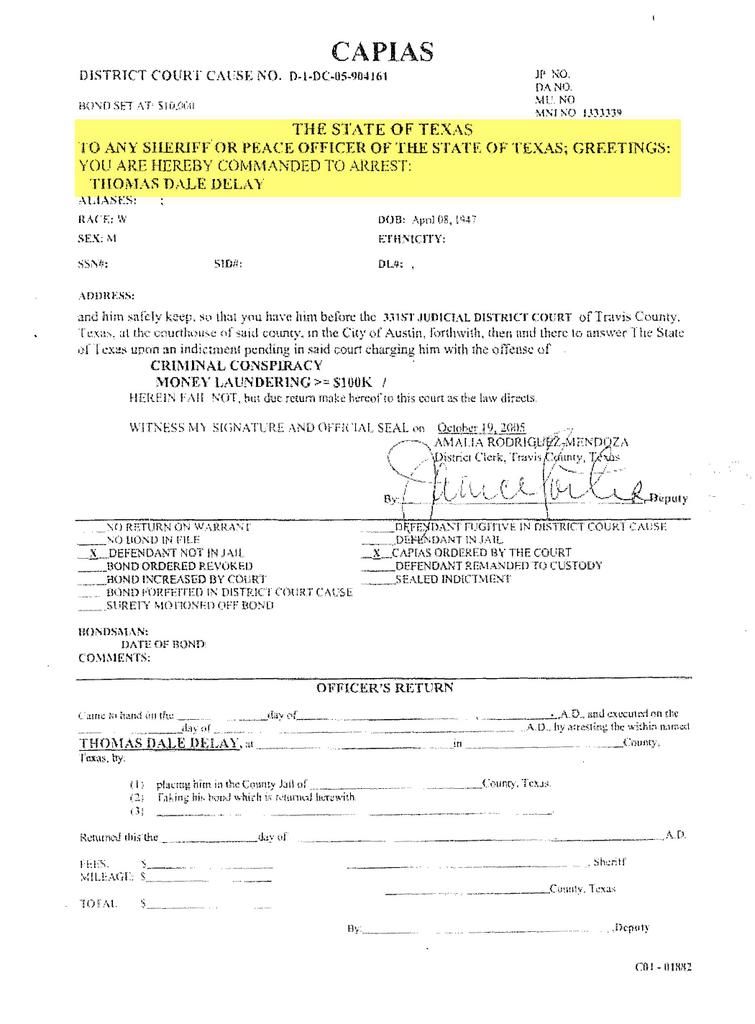
From John Gillnitz on Eschaton threads, Tom DeLay's arrest warrant:


Here is a link to his booking.

The Rats and The Ship


Now that Cheney is in trouble we are going to see much more criticism of the way he ran the country. The most recent piece is by Colonel Lawrence Wilkerson who was Colin Powell's Chief of Staff until last January. You can read his whole speech here. This quote from the attached article gives the main message quite well:

In a scathing attack on the record of President George W. Bush, Colonel Lawrence Wilkerson, chief of staff to Mr Powell until last January, said: "What I saw was a cabal between the vice-president of the United States, Richard Cheney, and the secretary of defense, Donald Rumsfeld, on critical issues that made decisions that the bureaucracy did not know were being made.

"Now it is paying the consequences of making those decisions in secret, but far more telling to me is America is paying the consequences."

Mr Wilkerson said such secret decision-making was responsible for mistakes such as the long refusal to engage with North Korea or to back European efforts on Iran.

It also resulted in bitter battles in the administration among those excluded from the decisions.

"If you're not prepared to stop the feuding elements in the bureaucracy as they carry out your decisions, you are courting disaster. And I would say that we have courted disaster in Iraq, in North Korea, in Iran."

We have been given hints of this all along. The Bush administration has always been run like a feudal hierarchy, and so has this country for the last five years. Interesting.

Wednesday, October 19, 2005

Meanwhile, in the sinful Massachusetts...


A piece of news that the so-called liberal media will not overplay: Massachusetts school children score the highest in the country in reading and mathematics. The reasons are actually more complex than what I as a political pundit would like to admit, but nevertheless there the results are.

And did I mention recently that Bush's approval rate is the lowest in the very same Massachusetts? Which also has low divorce rates and fairly low crime rates and so on. But it's all Sodom and Gomorrh, of course.

Goodbye, Sweet Friends


In recent weeks two great bloggers have moved on to other things. First, Christine of Ms.Musings has written her last post for the Ms. Magazine, though she can still be read on PopPolitics. Then Jesse Taylor of Pandagon went and got himself a real activist job. Pandagon still lives, of course, and Amanda there is required reading.

I will miss both Christine and Jesse. Christine allowed me the luxury of not following all the cultural commentary on women, because she condensed and presented it in one easily accessible place. I learned so much from her. There is a hole now in the blogosphere. Sniff.

And Jesse's kindness and sarcasm (such a potent combination) will also leave a hole behind.

I don't want bloggers to ever stop blogging. There should be a law that makes it impossible. But we all know, in our adult moments, that nothing stays forever. So carpe diem and all that. Thank you, Christine and Jesse.

Godfather IV?


I overslept. So I wake up to a world which reminds me of the Godfather movies, or perhaps that bit in Shakespeare where the king wonders aloud about who might rid him of that pesky priest. Or insert your own parable here for what one newspaper article argues that George Bush did when he heard that Rove had engineered things a bit in the Plame affair:

An angry President Bush rebuked chief political guru Karl Rove two years ago for his role in the Valerie Plame affair, sources told the Daily News.

"He made his displeasure known to Karl," a presidential counselor told The News. "He made his life miserable about this."

Bush has nevertheless remained doggedly loyal to Rove, who friends and even political adversaries acknowledge is the architect of the President's rise from baseball owner to leader of the free world.

As special prosecutor Patrick Fitzgerald nears a decision, perhaps as early as today, on whether to issue indictments in his two-year probe, Bush has already circled the wagons around Rove, whose departure would be a grievous blow to an already shell-shocked White House staff and a President in deep political trouble.

Asked if he believed indictments were forthcoming, a key Bush official said he did not know, then added: "I'm very concerned it could go very, very badly."

"Karl is fighting for his life," the official added, "but anything he did was done to help George W. Bush. The President knows that and appreciates that."

Yesss. Anything Karl did was for George, and that is so sssweet. Just like in the Godfather! This article might not be telling the truth, of course, but it's interesting to imagine what might happen if it does tell the truth. For example, could George himself get into trouble with the possible admission that he knew all along what was going on? Or at least knew about it early enough to go and give testimony in Fitzgerald's investigation? But I've heard that Bush has not testified under oath so he is probably safe.

Rove might not be safe, though all he is doing right now is canceling appearances:

Rove canceled plans to attend two Republican fund-raisers, the national party confirmed Tuesday. And he did not give his scheduled speech to the conservative Hudson Institute think tank on Oct. 11.

Republican National Committee spokesman Brian Jones said scheduling conflicts kept Rove from an RNC fund-raiser Monday night in Greenwich, Conn., and a Virginia Republican Party fund-raiser Saturday.

Jones would not specify what the conflicts were or whether they had anything to do with the federal grand jury that Rove has testified before four times. "He was unable to attend," Jones said.

I'm on tenterhooks, whatever they might be.

Tuesday, October 18, 2005

More Disapproval For George


This recent poll (via Kos) about Bush disapproval rates has data by state. Only six states have approval rates over 50% (Utah, Idaho, Wyoming, Alaska, Nebraska and Oklahoma). The lowest ratings come from Massachusetts where 28% of the respondents like his performance. That even in the liberal and elitest Massachusetts almost one in three answers this way is cause for some serious stomach ache, never mind that 61% of the respondents in Utah like Bush. He isn't even a Mormon!

More seriously, Bush's approval rates should average to a round zero. He has made a mess of everything he has tried to achieve, and I don't think it was God who spoke to him. Certainly not any one of the Mormon gods.

Barbara Bradley Hagerty


She is the NPR's religion correspondent, which is sad, because Hagerty has a very narrow and Republican view of what constitutes religion. I happened to listen to her reporting today on the reactions of evangelical Christians to the idea of Harriet Miers on the SCOTUS. Hagerty only interviewed right-wing Christians, many with very extreme views. It was as if there are no lefty evangelicals in this whole wide country!

Well, it is very clear that Hagerty is not one of those lefty evangelicals. Maybe she belongs to the Concerned Women of America? I wouldn't be surprised. What does surprise me is that she is allowed to have this religion desk all on her own, given how biased she is. But this sort of bias flies under the radar of the hawk-eyed politicians who accuse the NPR of being the breeding ground of communists and liberals and snake goddesses, too.

Miers on Abortion


This whole thing is so stupid. If we find that Miers is a radical cleric wingnut on abortion rights the liberals won't have her. If we find that she is not a radical cleric wingnut the radical cleric wingnuts won't have her. It really is idiotic and shows how far removed American politics is from politics as it used to be and how very close it is to a kind of civil war using only mental violence. It also shows how all the crap about the balancing effect of the judiciary branch of the government is just that: crap. It's all dirty politics and a terrible waste of energy, money and time.

Yet I see no alternative, and what is at stake here is important: our lives.

In any case, here is what Miers has told us about her views on abortion:

Supreme Court nominee Harriet Miers pledged support in 1989 for a constitutional amendment banning abortions except when necessary to save the life of the mother, according to material given to the Senate on Tuesday.

"If Congress passes a Human Life Amendment to the Constitution that would prohibit abortion except when it was necessary to prevent the death of the mother, would you actively support its ratification by the Texas Legislature," asked an April 1989 questionnaire sent out by the Texans United for Life group.

Miers checked "yes" to that question, and all of the group's questions, including whether she would oppose the use of public moneys for abortions and whether she would use her influence to keep "pro-abortion" people off city health boards and commissions.

The survey was part of the material sent to the Senate with Miers' Supreme Court questionnaire, according to two people, one a Senate official and the other a conservative Republican consultant working with the White House on her nomination. Both spoke on condition of anonymity, noting the papers are part of the vetting process.

All the usual reservations apply to interpreting this text. But as it was part of her hiring package I think that we should take it seriously.

What Is A Moderate?


Paul Waldman has written an excellent article on the American political moderate. He hits on all the important points, starting with poll results which appear to show that the conservative base is fairly large while the liberal/progressive one is smaller, which leaves moderates the people for the Democrats to court if they want to win. He then shows that the moderates are in fact a lot more like the liberals than the conservatives and that the Democratic strategy of courting the "center" is an error.

To explain this apparent paradox Waldman points out something that many of us liberals have been saying a long time: the very word "liberal" has been so successfully smeared by the wingnuts that most people are afraid to call themselves liberals:

if most "moderates" are Democrats who hold liberal policy positions, why don't they call themselves liberals? One answer is that these words have meanings outside the political realm that affect what kind of labels we are willing to place on ourselves. Many people are attracted to the ideas of "moderation" and "independence" even if their beliefs actually align fairly closely with one of the two parties. If you ask survey respondents whether they're Democrats, Republicans, or independents, between 30 and 40 percent will call themselves independents. But if you then ask the independents whether they lean toward one party or the other, most will say yes, to the point where the number of "true" independents falls to around 10 percent of the population.

But even if lots of people like thinking of themselves as "moderate," why should it follow that more people choose to call themselves "conservative" than "liberal?" The answer lies in a decades-long campaign to make the word an epithet -- from Ronald Reagan taunting Michael Dukakis as "liberal, liberal, liberal" to a host of Senate candidates who faced television ads calling them "embarrassingly liberal" or "shockingly liberal." Through endless repetition, conservatives succeeded in associating "liberal" with a series of traits that stand apart from specific issues: weakness, vacillation, moral uncertainty, and lack of patriotism, to name a few.

That is a familiar tale, but it is only half the story. Like so much else in our recent political history, conservative success in the area of political nomenclature was made possible only by liberal bumbling.

There was a time when a "liberal" was something most people -- even some conservatives -- wanted to be. On the stump in 1952, Dwight Eisenhower said "we need in Washington liberal and experienced members of Congress." Eight years later, Richard Nixon quoted FDR's definition of a liberal as "a man who wants to build bridges over the chasms that separate humanity from a better life," and said, "It is a wonderful definition, and I agree with him."

But when Republicans began to go after liberalism, Democrats cowered in fear, not only trying to distance themselves from the term but embracing the idea that a "conservative" is a great thing to be. Few Republicans would claim to be "social liberals" -- even if they are -- but Democrats are always claiming to be "fiscal conservatives," saying they have "conservative values" or chiding Republicans for not holding to the principles of conservatism on issues like the deficit. The message this sends to Americans who don't know much about politics is that, regardless of the details of policy, it's good to be conservative and bad to be liberal.
.
Waldman's article goes on to explain why it is important for the left to create a solid and unified attack against conservatism as an ideology, just as the conservatives have done the same to liberalism. It's a good read.

Monday, October 17, 2005

Cheney and the Plame Investigation


Now this is interesting:

As the investigation into the leak of a CIA agent's name hurtles to an apparent conclusion, special prosecutor Patrick J. Fitzgerald has zeroed in on the role of Vice President Cheney's office, according to lawyers familiar with the case and government officials. The prosecutor has assembled evidence that shows Cheney's long-running feud with the CIA contributed to the unmasking of operative Valerie Plame.

In grand jury sessions, including with New York Times reporter Judith Miller, Fitzgerald has pressed witnesses on what Cheney may have known about the effort to push back against ex-diplomat and Iraq war critic Joseph C. Wilson IV, including the leak of his wife's position at the CIA, Miller and others said. But Fitzgerald has focused more on the role of Cheney's top aides, including Chief of Staff I. Lewis "Scooter" Libby, lawyers involved in the case said.

One former CIA official told prosecutors early in the probe about efforts by Cheney's office and his allies at the National Security Council to obtain information about Wilson's trip as long as two months before Plame was unmasked in July 2003, according to a person familiar with the account.

It is not clear whether Fitzgerald plans to charge anyone inside the Bush administration with a crime. But with the case reaching a climax -- administration officials are braced for possible indictments as early as this week-- it is increasingly clear that Cheney and his aides have been deeply enmeshed in events surrounding the Plame affair from the outset.

It was a request by Cheney for more CIA information that, unknown to him, started a chain of events that led to Wilson's mission three years ago. His staff pressed the CIA for information about it one year later. And it was Libby who talked about Wilson's wife working at the CIA with at least two reporters before her identity became public, according to evidence Fitzgerald has amassed and which parties close to the case have acknowledged.

Lawyers in the case said Fitzgerald has focused extensively on whether behind-the-scenes efforts by the vice president's aides and other senior Bush aides were part of a criminal campaign to punish Wilson in part by unmasking his wife.

Once again we are reminded that all this is really about the Iraq invasion and the grounds on which it was sold to the American people. And it may just be the case that Dick Cheney was the snakeoil guy. Not that he will be indicted, of course. He is too high in the hierarchy for that.

More news about all this in this article.

Rumor Mill Grinding on


It's late and hard to think of good titles for posts, but this one is about a Raw Story story:

The New York Daily News is set to report in Tuesday editions that a well-placed source interviewed by the newspaper believes a senior White House official has flipped and may be helping the prosecutor in the case, RAW STORY has learned.

The Daily News will reveal that a top source believes that based on the questioning of Special Prosecutor Patrick Fitzgerald and his other contacts with the investigation, someone in the White House has turned.

Will I have to stay up all night now to find out what the New York Daily News is going to say? They might not have a real scoop, after all, but a diary on Kos thinks that the flipper might be Ari Fleischer. Fleischer does seem a little more humanlike than some of the other candidates.

Miller's Security Clearance


In her New York Times "memoirs" Judith Miller mentioned in an off-hand way that she had government security clearance:

In my grand jury testimony, Mr. Fitzgerald repeatedly turned to the subject of how Mr. Libby handled classified information with me. He asked, for example, whether I had discussed my security status with Mr. Libby. During the Iraq war, the Pentagon had given me clearance to see secret information as part of my assignment "embedded" with a special military unit hunting for unconventional weapons.
Mr. Fitzgerald asked if I had discussed classified information with Mr. Libby. I said I believed so, but could not be sure. He asked how Mr. Libby treated classified information. I said, Very carefully.

This has caused some consternation in the blogosphere, because most of us can't quite imagine why journalists would have security clearance and what such a clearance would mean. It's possible, of course, that it is just a formality caused by the "embedding" of journalists in Iraq, but perhaps not. An e-mail I received from John Conyers' office shows that at least some politicians are concerned about this, too:

The Honorable Donald H. Rumsfeld

Secretary

Department of Defense

1000 Defense Pentagon

Washington, DC 20301-1000


Dear Mr. Secretary:


We write about reports that journalists who were embedded with U.S. forces in Iraq were given security clearances. In her recounting of discussions with Scooter Libby, the Vice President's Chief of Staff, New York Times reporter Judith Miller, disclosed her belief that she had a security clearance. She specifically wrote, "[d]uring the Iraq war, the Pentagon had given me clearance to see secret information as part of my assignment 'embedded' with a special military unit hunting for unconventional weapons."1 She also noted she was not certain whether her clearance was in existence at the time she met with Mr. Libby.2


In order to better understand the scope of the program under which journalists received security clearances, we would appreciate your prompt response to the following questions:


1. Since March 20, 2003, the date of the U.S. invasion of Iraq, have any journalists been provided with a security clearance or with access to classified information? If so, please explain. At what level were these clearances granted? Were background investigations conducted on these journalists and, if so, in what manner? Of journalists receiving security clearances or access to classified information, how many were embedded with U.S. forces in Iraq?


II. Who approved the policy of providing journalists with security clearances or with access to classified information? What was the operational reason for granting security clearances to journalists? How does this policy comport with the requirement that classified information be disseminated on a "need to know" basis?


III. Did each journalist sign documentation delineating their obligation to protect classified information as is required by employees of the federal government? Were journalists required to sign any additional non-disclosure agreements by the Department of the Defense or the military department to which they were assigned? If so, please provide a copy of such an agreement.


IV. Did journalists maintain their clearances after completing participation in the embed program? Are journalists with a security clearance or other access notified upon the revocation or termination of such clearance or access? When does such revocation or termination occur? Have any journalists who are or have been embedded with forces in Iraq had their security clearances revoked or otherwise terminated?


V. Since March 20, 2003, what journalists were provided with security clearances or other access to classified information? How long did each clearance or access period last?


Please reply through the Judiciary Committee Minority Office, 2142 Rayburn House Office Building, Washington, DC 20515 (tel: 202-225-6504) and the Armed Services Committee Minority Office, 2340 Rayburn House Office Building, Washington, DC 20515 (tel: 202-226-9007).


1Judith Miller, My Four Hours Testifying in the Federal Grand Jury Room, N.Y. Times, Oct. 16, 2005, at A31.

2Id.

The letter is signed by John Conyers and Ike Skelton.

DeLay's Booking


It looks like Tom Delay will have his fingerprints and mugshot taken soon. He was indicted on charges of money laundering and related stuff, as you may remember, though it's hard to keep all the different legal scandals of the Republican party clear in ones head.

The Wingnuts and Harriet Miers


The wingnuts don't like Harriet at all. This we already know. But the plan to get rid of her is only now becoming clear, at least to me. It has to do with that little comment James Dobson of (Patriarchal) Focus on Family made, the one where he hinted that he knows how Miers would vote on abortion. Now the Wall Street Journal boys have used this to set up the next round of the Get-Miers game:

Two days after President Bush announced Harriet Miers's Supreme Court nomination, James Dobson of Focus on the Family raised some eyebrows by declaring on his radio program: "When you know some of the things that I know--that I probably shouldn't know--you will understand why I have said, with fear and trepidation, that I believe Harriet Miers will be a good justice."

Mr. Dobson quelled the controversy by saying that Karl Rove, the White House's deputy chief of staff, had not given him assurances about how a Justice Miers would vote. "I would have loved to have known how Harriet Miers views Roe v. Wade," Mr. Dobson said last week. "But even if Karl had known the answer to that--and I'm certain that he didn't because the president himself said he didn't know--Karl would not have told me that. That's the most incendiary information that's out there, and it was never part of our discussion."

It might, however, have been part of another discussion. On Oct. 3, the day the Miers nomination was announced, Mr. Dobson and other religious conservatives held a conference call to discuss the nomination. One of the people on the call took extensive notes, which I have obtained. According to the notes, two of Ms. Miers's close friends--both sitting judges--said during the call that she would vote to overturn Roe.

The call was moderated by the Rev. Donald Wildmon of the American Family Association. Participating were 13 members of the executive committee of the Arlington Group, an umbrella alliance of 60 religious conservative groups, including Gary Bauer of American Values, Richard Land of the Southern Baptist Convention, Tony Perkins of the Family Research Council, Paul Weyrich of the Free Congress Foundation and the Rev. Bill Owens, a black minister. Also on the call were Justice Nathan Hecht of the Texas Supreme Court and Judge Ed Kinkeade, a Dallas-based federal trial judge.
...
What followed, according to the notes, was a free-wheeling discussion about many topics, including same-sex marriage. Justice Hecht said he had never discussed that issue with Ms. Miers. Then an unidentified voice asked the two men, "Based on your personal knowledge of her, if she had the opportunity, do you believe she would vote to overturn Roe v. Wade?"

"Absolutely," said Judge Kinkeade.

"I agree with that," said Justice Hecht. "I concur."

Shortly thereafter, according to the notes, Mr. Dobson apologized and said he had to leave the discussion: "That's all I need to know and I will get off and make some calls." (When asked about his comments in the notes I have, Mr. Dobson confirmed some of them and said it was "very possible" he made the others. He said he did not specifically recall the comments of the two judges on Roe v. Wade.)

This is all bad, we are informed. (Yes, it is. But what looks really bad about it to me is that sitting judges are part of such religious cabals.) It's all bad because we are not supposed to ask how Miers would rule on Roe vs. Wade, we are just supposed to make sure that she would rule the wingnut way. Without actually asking anyone. Get it?

In any case, this incident will be used to argue that the Miers nomination is in deep trouble, that she really should withdraw her name or all hell will break loose. The article I quote points out that stealth nominations such as Miers are the Democrats' fault because of the vicious way Robert Bork was investigated. So we liberals get what we deserve and therefore should filibuster Miers? Nah. The wingnuts will have to filibuster Harriet Miers. It could be fun to watch.

Is the Miers nomination a red herring? Something that will pave the way for a much more stringent wingnut nomination? I doubt that Bush plans things out this way, but the radical clerics of the Republican party would certainly love such a development.

Sunday, October 16, 2005

Summarizing Judy


This article by the U.K. Times is as good as any I've read as a summary of the whole Judy Miller question. Reading it saves you time and trouble, if you are not interested in the ins and outs of the legal case.

Bruce Lee


I used to be a great fan of Bruce Lee, the martial artist, though not so much a fan of Bruce Lee, a person, at least based on what I learned about the latter. But Bruce Lee, the martial artist, seemed almost tailor-made for me: roughly the same size (small for a man), also someone between cultures (though not between the divine and the human in his case). And he managed with all this baggage to be remembered as one of the greatest of all times! Though I don't think Lee would have been flattered by my admiration, and my one-inch punch will not send you quite as much backwards as his did.

I have seen all the movies Bruce Lee made. He was no actor but a great kicker, and nothing is as funny as the ululations he emitted when he was ready to attack. In general I love the silly martial arts movies; they are great psychological drugs for all sorts of maladies though they may not amount to what is normally called art.

The books Lee wrote are a bit of a letdown. Nothing in them seems any different from the other kung fu books that I have read, which may mean that Lee didn't tell us everything he knew (not uncommon among the Chinese martial artists, I've learned) or that he just wasn't a very good writer or both. Or perhaps whatever made him so memorable can't be taught via books or at all?

He is also memorable because of the way he died: young and under mysterious circumstances. One rumor was that he overdosed on drugs while in the apartment of his mistress, another argues that he was allergic to an ingredient in a basic painkiller and died while resting in the apartment of a colleague. Make of all this what you want, but clearly an early death is a necessary part of the process that results in a larger-life-than-figure. You can count me out here, so I'm glad that the similarities between me and Bruce Lee aren't too deep. And I'm a girl goddess, to boot.

Still, I have a lot to thank Bruce for. If I hadn't learned about him I might never have learned about the real stuff. You know, the stuff that makes you very powerful whatever your size and physical ability. The stuff that I'm not going to reveal to you here...

Brooks on Innate Differences between the Sexes


David Brooks is babbling merrily again. In his most recent column he starts with an astounding statement:

Once upon a time, it was a man's world. Men possessed most of the tools one needed for power and success: muscles, connections, control of the crucial social institutions.

But then along came the information age to change all that. In the information age, education is the gateway to success. And that means this is turning into a woman's world, because women are better students than men.

This is astonishing stuff. Brooks thinks that Africa and Asia, for example, are not a man's world? He points out the long list of female presidents in America and Europe? He notes that everywhere women earn more than men? No. He does none of this, of course. What he does is scare people with the ominous picture of a feminized future. The terror of petticoats in power.

As you probably spotted from the last sentence of the quote Brooks's article is on the inferior performance of boys at school. He presents the usual threat that will come if women indeed outperform men ultimately, which is the possibility that women can't marry someone at least as educated as they are! I am old enough to remember what was written when men were the majority in colleges (as they still are in graduate degree programs), and never do I remember much worry about the men having to marry so much beneath them in education. Come to that, I don't remember much hand-wringing about the fact that women were a minority in higher education. It was just the way things are.

The neat thing about the group that believes in deep and important innate differences between the sexes is that everything, but everything, can be explained by appealing to such differences. Let me show how this is done: When the furor was about Harvard president Lawrence Summer's comments concerning the scarcity of women in mathematical and technical fields (where he speculated on the possibility that women are innately less likely to do sciences and mathematics), the innate school argued that the imbalance might be unavoidable.

Now that the furor is about girls outperforming boys in general, the innate school, in the form of David Brooks, argues that the environment must be changed:

In other words, if we want to help boys keep up with girls, we have to have an honest discussion about innate differences between the sexes. We have to figure out why poor girls who move to middle-class schools do better, but poor boys who make the same move often do worse. We have to absorb the obvious lesson of every airport bookstore, which is that men and women like to read totally different sorts of books, and see if we can apply this fact when designing curriculums. If boys like to read about war and combat, why can't there be books about combat on the curriculum?

Would elementary school boys do better if they spent more time outside the classroom and less time chained to a desk? Or would they thrive more in a rigorous, competitive environment?

For 30 years, attention has focused on feminine equality. During that time honest discussion of innate differences has been stifled (ask Larry Summers). It's time to look at the other half.

So let me see if I got it right: When men benefit from supposed innate differences we should let the situation be as it is, but when women benefit from supposed innate differences we should adjust the environment to make things so that women won't benefit?

The question why boys are not thriving at school is an important one. But why does it have to be made into a question about girls performing too well? Why is there this continuous need to make the situation into a zero-sum war between the sexes?

At least Brooks points out something I have argued for a long time: It is not feminism that has caused schools to become horrible places for boys (never mind what Tangoman will say in the comments later), because the same trend is seen all over the world, including in countries such as Iran where feminists are not exactly ruling the roost:

But Thomas G. Mortensen of the Pell Institute observes that these same trends - thriving women, faltering men - are observable across the world. In most countries, and in nearly all developed countries, women are graduating from high school and college at much higher rates than men. Mortensen writes, "We conclude that the issue is far less driven by a nation's culture than it is by basic differences between males and females in the modern world."


But this global appearance of the problem also points out that many of the suggestions Brooks makes, about giving boys more time to run around or about adding books about combat and war and so on, are unlikely to work because they address characteristics of only some school systems in this world.

I am not an expert in the field of education, but I have a few suggestions to explain why girls might, on average, work harder at school than boys, and they have to do with the fact that in the U.S., for example, the average earnings of a man with just a high school education roughly equal the average earnings of a woman with a college degree. A woman who wants to earn more than the minimum wage will pretty much have to get a college education, whereas a man need not go that far if he doesn't feel like it. Couldn't this simple economic fact go pretty far in explaining why women study harder? Think of a country like Iran here. Education is probably the only way a woman there can ever acquire any independence from her family. Indeed, I would be surprised not to find the Iranian college students at least sixty percent female.

In a sense I see the root of the problem in the very gender inequality that has so long prevailed, the one that Brooks flippantly casts as something that used to exist in the past. School just isn't as important for boys, because boys will grow to be men and men have a certain edge in the labor market partly due to custom and tradition. Blue-collar jobs often pay quite well and blue-collar jobs are among some of the more sexist ones. Just ask the women who have tried to enter, say, the occupations of electricians or plumbers.

In the same sense, some of the roots of the problem lie in the cultural values that make whatever women do well as somehow not worthy for men to do at all. We see this in everything from beer commercials to occupations: If women like it or excel in it men tend to disappear like mist in the morning. So why not so in education? Not worth trying it, it seems, if mere girls can ace it. But I'm just being bitter here, probably.

Saturday, October 15, 2005

Vacation Time


For Judy Miller. Raw Story tells that:

New York Times reporter Judith Miller, who spent 85 days in jail protecting her source in the recent CIA leak investigation, will take an indefinite leave of absence effective immediately.

"Judy is going to take some time off until we decide what she is doing next," Times' spokesperson Catherine Mathis told RAW STORY Saturday afternoon.

How long is indefinite? And what will happen after the indefinite has passed? A book deal, most likely. There is an ethics lesson in this somewhere, I'm sure...

Judy Miller's Role in the Plame Investigation - Take One


The New York Times has now published an article, perhaps only the first one of several, on Judith Miller's role in the Plame investigations. It is a long one and doesn't have any totally new and astonishing information, but it does tell us about what went on inside the NYT and about Miller's decision to go to jail.

I still think that her inability to remember who first gave her the name Valerie Flame (as it was written in her notebook) is not real.
---
Thanks to dancinfool in the comments who linked me to Judy's own memoirs of her testimony. This is good:

When I was last before the grand jury, Mr. Fitzgerald posed a series of questions about a letter I received in jail last month from Mr. Libby. The letter, two pages long, encouraged me to testify. "Your reporting, and you, are missed," it begins.
Mr. Fitzgerald asked me to read the final three paragraphs aloud to the grand jury. "The public report of every other reporter's testimony makes clear that they did not discuss Ms. Plame's name or identity with me," Mr. Libby wrote.
The prosecutor asked my reaction to those words. I replied that this portion of the letter had surprised me because it might be perceived as an effort by Mr. Libby to suggest that I, too, would say we had not discussed Ms. Plame's identity. Yet my notes suggested that we had discussed her job.
Mr. Fitzgerald also focused on the letter's closing lines. "Out West, where you vacation, the aspens will already be turning," Mr. Libby wrote. "They turn in clusters, because their roots connect them."
How did I interpret that? Mr. Fitzgerald asked.
In answer, I told the grand jury about my last encounter with Mr. Libby. It came in August 2003, shortly after I attended a conference on national security issues held in Aspen, Colo. After the conference, I traveled to Jackson Hole, Wyo. At a rodeo one afternoon, a man in jeans, a cowboy hat and sunglasses approached me. He asked me how the Aspen conference had gone. I had no idea who he was.
"Judy," he said. "It's Scooter Libby."


Battle Scars


Twistyfaster has given her blog the wonderfully mischievious name "I Blame Patriarchy". She also recently had a radical mastectomy for breast cancer, and I am linking to a picture of her scar here. You can choose not to look at it, of course, but I find a fierce beauty in it. This is a woman who has done battle, and she is standing up and showing us the scars, the scars of twenty-first century medicine. There is something heroic about it, and not only because Twisty took the picture so soon after major surgery.

Pictures of women's breasts are ubiquitous on the net, so ubiquitous that they have almost taken a life of their own, as something separate from women. As playthings. Twisty's picture reminds us that they are part of the woman, and that it is the woman who really matters.

Rove In Trouble


Via Washington Monthly I found out about this Washington Post article on Rove's testimony today in the Plame investigation:

Making his fourth appearance before the grand jury, Rove answered a broad range of questions for 4 1/2 hours, including why he did not initially tell federal agents about a July 2003 conversation about Plame with the witness, Time magazine's Matthew Cooper, the source said.

Rove's defense team asserts that President Bush's deputy chief of staff has not committed a crime but nevertheless anticipates that special prosecutor Patrick J. Fitzgerald could find a way to bring charges in the next two weeks, the source said.

The article continues to speculate about who might be indicted and on what type of charges, and it is all interesting if you like to follow such court cases. But what is more important in all of this is the fact that administration insiders are shown, finally, not to have the right to do whatever they want and to then call it politics as usual. It's not possible to overstress this.

Karl Rove has a reputation for very dirty fighting in politics (see, for example, the movie Bush's Brain). Whether this reputation is earned or not is less crucial than the fact that a man with such a reputation could virtually run a country and there was very little protest about this. Imagine the furor that would have arisen if Rove had been shown to bed another man, for example. There is something very wrong with our own ethics when most of us get upset over the latter but accept the former as just the way politics is most efficiently applied.

That the Special Prosecutor Patrick Fitzgerald is not interested in whom Rove beds but in what he says in his job is therefore a wonderful piece of news, never mind whether Rove actually gets indicted. It is a return to the rules of the political game that we have been taught, not the rules that have prevailed during the last five years or more in Washington, D.C.. And call me prudish if you wish, but I really want those old-fashioned ethical rules applied to all players of the games.

I've mentioned earlier that I feel all tingly and warm when I hear about Rove's misfortunes. But this is not really Schadenfreude over the misfortunes of a political opponent, even an extreme political opponent, but a feeling that finally decency is showing some teeth here. Maybe she will even bite a butt or two in the process.

Friday, October 14, 2005

Hank


This is a picture I've shown before. It was taken when Hank was a little puppy and Henrietta was a little worried about it all. Now they are inseparable, of course.

Hank has just been diagnosed with cancer. It will be another two weeks before the tests tell me if anything at all can be done. There is a small probability that her front leg could be amputated but a larger one that the cancer has spread. This reminds us of the importance of each day we spend with those we love and of the fact that we walk this path together only until our roads diverge.

Hank is six years old and fairly young to get cancer. I have found in the last few days that several youngish dogs in my area have or have had a similar type of cancer and all these dogs have gone to the same dogpark and have also been of the type that likes to run in the little stream there. All this may be pure coincidence and the incidence figures may be quite normal, but I also happen to know that the dogpark was built on an old city dump. To this day shards of glass and so on turn up every year.

I am going to look into this, if only to disprove the hypothesis of an environmental cause.

More on the Staging of Events


George Bush's little conference with the American soldiers in Iraq was shown to be carefully choreographed in advance. Yet Scott McClelland argued that this was not the case, at the same time as evidence of the very choreographing was shown all over the media. Media Matters for America notes this:

Discussing the event on the October 13 edition of MSNBC's Countdown with Keith Olbermann, Washington Post reporter Dana Milbank commented on White House press secretary Scott McClellan's handling of questions about the event:

MILBANK: Scott McClellan, who is a good and decent guy, has to get up there and say, This is not a rehearsed event, even when they've actually released the footage showing that it is a rehearsed event. So when he has to say up is down, and he has to go taking on challenging the motives of the press corps, he's obviously got a problem. I don't know how he could handle this any better, unfortunately.

Milbank calls McClellan a "good and decent guy" -- then, in the very same sentence, says that McClellan lied to Milbank's colleagues and the American people. Then he goes on to indicate that McClellan handled it as well as he could have. When did reporters start taking the position that lying to the American people constitutes handling things as well as possible? Wouldn't telling the truth be a better way to "handle this"? Why is Milbank defending McClellan's "challenging the motives of the press corps" -- Milbank's colleagues -- when he knows McClellan was lying?

Read the last paragraph of this quote again, it's that important. I'm beginning to see Mao's intent when he sent all the intelligentsia out to the farms for a while (though I don't agree with what he did, naturally). Some insiders in the media have lost their objectivity.