Friday, September 16, 2016
The Dish-Draining Cabinet
This year was the 120th anniversary of the birth of Maiju Gebhard. I bet you don't know who she was.
She was the Finnish inventor of a dish draining cabinet/cupboard (though similar inventions were earlier patented in the US by Louise R. Krause in 1932 and Angiolina Scheuermann in 1929). Here's one picture of what a dish draining cabinet is:
By Jarno Elonen - photo taken by Jarno Elonen, Public Domain, https://commons.wikimedia.org/w/index.php?curid=602283
The doors close, and the cabinet is right above the sink area. Note the plastic-covered metal grids which create the bottoms of the racks. They allow someone washing the dishes by hand to just put them into the cabinet and then close the doors. No drying is necessary, and, indeed, the everyday dishes can just live in the cabinet, to be taken out of it when needed.
The dish draining cabinet became common in Finnish households, though not elsewhere. Its industrial production began in 1948 and the plastic-covered metal wire grids were introduced in 1954. The sizes were standardized in the early 1980s.
The introduction of the dishwasher made the dish draining cabinet less useful, of course.
This story is an example of the era when some women began studying the ergonomics of housework and tried to rationalize and reduce the labor of housewives.
But I also like it because the dish draining cabinet or cupboard probably didn't cost much more to build than the ordinary kind of cabinet, yet saved labor for years to come (by making drying by hand unnecessary and by saving steps because the cabinet was right above the sink). It might have even been more hygienic than the practice of drying dishes by hand.
Besides, there's a "duh, that's obviously a good idea!" feeling about the whole thing.
Thursday, September 15, 2016
The New Times-CBS Presidential Race Poll. How Are White Men And White Women Planning To Vote?
A new Times-CBS poll suggests that the presidential race is tightening, though it's worth remembering that the questions were asked when Hillary Clinton was receiving even more negative public attention than she usually does. Here's the summary table from the poll:
Polls are not elections, of course, and direct comparisons with past elections are not without problems. Still, I decided to look at two rows in that table in order to see how they compare to what happened in the 2012 presidential election and in the 2014 mid-term elections.
Those two rows are the percentages of likely voters who are white women and white men*. In the above table white men go for Trump 57-33, while white women narrowly go for Clinton 46-45.
What happened in 2012? Sixty-two percent of white men voted for Romney, 56% of white women did. Those figures reflect the traditional party split among American whites. The reasons for that split are many. In the 2012 presidential election these reasons were suggested:**
Without much doubt, attitudes about race—and even outright racism—played a role, although one that is hard to quantify. But it’s far from the only thing. Income is important. On average, white men and women tend to be richer than non-whites, and voting Republican is strongly correlated with income. (In families that made less than a hundred thousand dollars a year, Obama won by eight points. In families that made more than a hundred thousand dollars a year, Romney won by ten points.) Age is another factor. Whites, on average, tend to be older than non-whites, and older people (male and female) tend to vote Republican in greater numbers. Religion is also part of the story. Most white women, like most white men, are churchgoing Christians, a group that is strongly Republican—especially evangelicals, who voted for Romney by almost four to one. Then there is ideology. Just as there are conservative men, there are conservative women.
The 2014 midterm voting patterns reinforce the above arguments: Sixty-four percent of white men voted Republican in that election, and so did 56% of white women.
Is there anything useful we might glean from those comparisons, given that the 2016 numbers come from a poll, that third-party candidates complicate analysis and so on?
I believe that a Trump-As-A-Misogynistic-Asshat*** effect is visible in those findings, especially when it comes to the possible voting patterns of white women this year. The majority of white women have traditionally voted for Republicans, but that may not necessarily be the case this year.
And the difference is because the man who is running on the Republican ticket this time is a man who doesn't even bother to hide his sexism the way past Republican candidates have hidden it.
But is there an effect from the Trump-As-A-Know-Nothing candidate? I'm not sure, because I don't have the time to do the kind of digging that would be required to guarantee that the numbers from various years are at least somewhat comparable. But it looks like there might be one.
-------
* Because these are still the largest voter groups and because Trump's support is especially strong among white men. It's not weak among white women, either, and both these numbers make me sad. Trump is a racist and sexist egomaniac. That so many people are fine with that makes me sad and cynical.
** That paragraph is about the 2012 elections where racism had a more open role to play. Sexism will take a comparable role in the 2016 elections.
Note, though, that the quoted explanation doesn't quite explain why in 2016 whites without college education might prefer Trump 58-32, whereas whites with college education prefer Clinton 51-40. The latter group has the higher income. But the case of one Donald Trump might be exceptional.
** He is also a racist asshat, a person knowing very little about the job he is applying for, a person who seems unable to contain his own temper tantrums, and a person who just might decide to nuke some country because he had a bad-hair day. Which is every day of the year.
Wednesday, September 14, 2016
Short Posts 9/14/16: On Undecided Voters, Missing Women On Conference Panels and Chelsea Clinton's Mothering Skills
1. Digby writes about one of the undecided voters profiled in a GQ story. That particular voter is not given a name in the story, only a profession, which would be politics reporting, so we can't tell if all the undecided people interviewed in the GQ article are men or all but one. I suspect that the anonymous person is a guy, too, and white, given the concerns that person has about Clinton and Trump:
I cannot stomach Hillary Clinton. I just can't get with her. Maybe because I know too much. I find so much of her world hypocritical, reprehensible. I think the rest of the country sort of gives her a pass, like, "Oh, she's always been attacked by Republicans, it's not that big a deal, email shmemail!" But I'm like, "WHAT! This is a huge deal."And then I also obviously struggle with Donald Trump. The things I like about him are: I believe that sometimes you just have to blow shit up to build it again, and I think that a Trump presidency would do that. But just when I sort of get there with him, like, Ohhhhhhkayyyy, he says or does something and I'm like, "No, I can't!" Like saying, "What do you have to lose?" to African-Americans. Like, WHAT? What?
...
Gun to my head, I would probably vote Trump because of my feelings about Hillary, and my—I just want to see what happens. But if I were to talk to you tomorrow, I'd be like, "Ugh! I've gotta vote for Hillary!"
What struck me about those opinions is the way different classes of people have different amounts of "skin in the game." If Trump's penchant for nuking other countries would be openly linked to bringing back the draft, perhaps the above opinions would have been different? The excitement with "blowing shit up to build it again" might have been somewhat more muted if blowing that shit up meant that the person: "politics reporter, Washington DC, 42", might get blown up as part of the shit or if it was that person's child who would be conscripted and sent to participate in the blowing up.
I could be wrong, of course, but when "shit is being blown up" some people get blown up with it first. Or some people get their lives made more difficult, their safety endangered, their incomes diminished, their bodies controlled. Maybe not people who can be defined as "politics reporter, Washington, DC, 42." In other words, for some the idea of "blowing shit up" is abstract, for others it is much more concrete.
2. A new study (which I have not read) is reported to cast more light on the impact of being viewed as a woman or as a man has on who gets a paper accepted at a scientific conference:
The study -- published in the Journal of Language Evolution -- is based on a change in the way paper proposals were reviewed for the Evolution of Language Conference, which takes place every two years and is a premier academic event for those in the field. For the most recent conference, held this year, the organizers switched from a single-blind review to a double-blind review.
In single-blind review, the names of reviewers are not disclosed to those who have made submissions. The idea is that reviewers need not fear offending anyone with frank comments. But the reviewers know who has submitted. In double-blind review, all names are shielded, so that reviewers' identities are protected, but they don't know the identities of those who are being judged.
When the language conference switched to double blind this year, the rankings of paper proposals from women or teams where a woman was the first author saw a gain of 4 percent on the ratings system. The ratings of proposals by men or where a man was the first author saw a 19 percent decline in their ratings.
Further, the study found a gender impact when looking at women and men who had submitted papers under single-blind review to prior conferences and to the most recent conference under double-blind review. Under double blind, the women-authored papers moved up and the men-authored papers moved down in the rankings.
I can make theories about what might have driven those findings*, but, in essence, the outcome looks similar to the one observed once orchestras began auditioning new members using a screen which hid the person's external attributes from the judges but left the music audible: Many more women were accepted as members.
Certain attributes: perceived biological sex, race, age, body size etc. can all function as seemingly relevant information to our subconscious judges about a person's skills and abilities, even when the information is not relevant.
It's also possible, of course, that this finding was a fluke one, caused by something having changed over time in the relative quality of the papers women and teams led by women submitted, as compared to the quality of the papers men and teams led by men submitted. Though I doubt that, and add it here just because I try to be a thorough goddess.
3. Here's today's fun piece of crap:
The subtext is that Chelsea Clinton might be a bad mother, but it's really tough to make that explicit enough.** So we are asked: Is it acceptable for one parent to drop the child off on the first day of school?
Hmm. Let me think about that one for a minute or two! Is it acceptable for just one parent to drop the child off on the first day of school if that parent is the mother?
What percentage of children have both parents drop them off on the first day of school?
What percentage of children, traditionally, had just their mothers drop them off on that day? Just their fathers?
Getting that subtext about bad-mothering accusations clear enough is hard if it is done in the context of "parenting," not in the context of "traditional mothering" obligations. Mmm.
Do weird kinds of journalists follow Trump's wife, sons and daughters around in order to find what kind of people they might be?
------
* But those theories are just idle speculation. Here are a few examples, for those who are interested:
It could be that people use academic rank as a signal of how good an article might be, and if women, on average, are less likely to be full professors, then that would hurt them. It could be that people use institutional affiliation as a signal of how good an article might be, and if women, on average, are less likely to have one of those truly fancy institutional affiliations (Ivy League, say), then that would hurt them.
Or both of these together or in combination of that psychological phenomenon where women at meetings or seminars or conferences may just not get their opinions listened to that seriously, what with being subconsciously viewed as individuals of lesser rank, less powerful to affect the career of someone else, and therefore safer to ignore when time and resources are short.
** Imagine if the story was reversed: Mark Mezvinsky, Hillary Clinton's son-in-law, misses the first day of his daughter's school. That wouldn't even be a story. And just as an aside, did Donald Trump take his children to school on their first days of school?
Monday, September 12, 2016
The US Presidential Campaigns as Rope-Dancing
I'm back in the US. But not completely up-to-date on the presidential elections or the most incredible, the most frightening, and the most hilarious debates about who might be the best person to run the still-most-powerful country on earth and which characteristics in that person matter and which do not.
Had someone written a book with a plot based on the 2016 US presidential elections before they began, the proposal would have been deemed far too unrealistic to be credible, though perhaps the way George Bush straddled the horse of freedom in 2000 should have lowered the bar.
And look what George Bush accomplished! He isn't the only one responsible for the slaughter and chaos that is Middle East today, but he certainly opened the doors for it, strengthened the powers of the most frightening religious lunatics in the recent history, and left the hoof-marks of his apocalyptic freedom-and-know-nothing horse all over the ground there and even in Europe.
See what did lowering the bar buy us before? I write "buy" because far too many, both among political journalists and the American public, see the election campaigns from the angle of a consumer or a sports critic or an art critic:
Are we enjoying this reality show? Are we entertained? We won't buy if we are not entertained!
That political participation is not consumption goes unnoticed by too many. We cannot refuse to buy if we believe the quality is too low or the price too high, some president will be stuffed into our shopping basket anyway.
Will it be Donald Trump or Hillary Clinton? If one sees the presidential campaigning as a circus act, as many appear to do, then these two are dancing on ropes and we, the audience, are judging their performances. Only, one rope, the one on which Trump cavorts, is stretched about two inches above the ground. The other rope is stretched high enough for us to see Clinton's knickers should we wish to do so (and should she stop wearing pant suits).
The New York Times' new ombudsman, Liz Spayd, believes that the two ropes are stretched on the same height, and if they are not, it's not for the journalists to point that out or to judge the performances any different:
The problem with false balance doctrine is that it masquerades as rational thinking. What the critics really want is for journalists to apply their own moral and ideological judgments to the candidates. Take one example. Suppose journalists deem Clinton’s use of private email servers a minor offense compared with Trump inciting Russia to influence an American election by hacking into computers — remember that? Is the next step for a paternalistic media to barely cover Clinton’s email so that the public isn’t confused about what’s more important? Should her email saga be covered at all? It’s a slippery slope.A wobble is a wobble! Journalists are not judges!
But of course journalists are judges, for how else could they decide when a wobble has taken place or when to report on one having been spotted?
A recent Politico article by Eli Stokols and Hadas Gold sees the accusations of "false balance" differently:
With fewer than 60 days left in this campaign, news organizations are still struggling to square their approach to covering two candidates who couldn’t be more different: Hillary Clinton, who adheres to the established rules of engagement, and Trump, a convention-busting, media-dominating nominee with an asymmetrical campaign. The result, Clinton’s advisers lament and news executives admit, is a wide gap in what the public expects — and accepts as credible — from the country’s top two presidential candidates. Trump’s bar is undeniably far lower than Clinton’s.But it's not just the news organizations which have trouble in judging the two rope dancers; it's also many voters:
Trump has seemingly withstood the onslaught because so many voters appear wiling to forgive his insulting rhetoric and policy ignorance. That’s certainly been borne out by public and private focus groups.It's just Trump being Trump... And politics is not about what happens after the elections, what happens during those four years, but it's about the show. Trump is a good showman! He will be forgiven all sorts of bad things, just as, in my experience, bullies and rude people are sometimes forgiven bad things on the premise that it's just how they are. Even the "boys will be boys" phrase is similar, referring to something that might be negative, but just can't be changed, because it is How Things Are.
“We’d show voters stupid things he’s said, and they’d just shrug and say, ‘That’s just Trump being Trump,’” said one Democratic operative who has observed Clinton campaign focus groups. “It was a fairly common response, and it was horrifying.”
In practice that means Donald Trump, while dancing on his rope barely off the floor, is judged as not having wobbled that much, because he's a guy who always wobbles!
So. And the competition, just as a reminder, is about who is to govern the most powerful country on this earth.
Thursday, September 08, 2016
The Burkini And Its Ban in France: Stripping The Layers, One By One.
On Female Modesty, the Burkini and Its Ban in France
The burkini is a form of religious modesty swimwear, intended for those who believe that Islam requires women to bare no more skin in public (where men not your close kin can see you) than what appears on the face, the hands and the feet (1)
It looks like a wetsuit-tunic combination:
Modesty swimwear is also available for Christian women. An example of the types of outfits I've seen for sale can be found here.
That religious modesty swimwear is marketed to both Christian women and Muslim women doesn't mean that the two markets are equally large.
My guess (2) is that many more Muslim than Christian women are affected by the religious stipulations for women to be modest. The Christian female modesty clothing is aimed at the fundamentalist market, whereas the Muslim female modesty clothing is aimed at a much wider market of women.
But what the two types of modesty swimwear share, of course, is that religious concepts of modesty are thousand times more often about women's dress, women's bodies and women's behavior than about men's dress, bodies or behavior.
That's something thoughtful people should keep in mind when reading about the recent events in the south of France: The ban of the burkini on the beaches of some thirty seaside towns and cities, including Nice, where 80+ people died in a terrorist attack on Bastille day this July.
The Nice ban has been overturned by a court, and so have the bans in some other cities (3). The court's argument concerning the Nice ban is worth quoting, because it also tells us about the motives behind the ban: The argument that the wear of the burkini poses a risk to public order:
A court in Nice suspended the city's burkini ban, citing insufficient grounds to justify the controversial decree.
In the ruling Thursday, judges from Nice's administrative tribunal court said the full-length swimsuit worn by some Muslim women did not pose a risk to public order on the French Riviera city's beaches.
•
The case was brought by the Collective Against Islamophobia -- a group of human rights activists who have been helping a number of women challenge fines. They argued that the ban is discriminatory, unconstitutional and that there has been no evidence to suggest that wearing a burkini has contributed to any acts of public disorder.
Over 30 towns -- largely situated along France's southeast coastline -- initially imposed a ban on the divisive swimwear.
The control of women's clothing has a long history everywhere, and the French burkini bans can be slotted into that history. At the same time, these bans are also the reverse of most of the past regulations about women's bodies in the public sphere: They amount to demands that women bare more skin, not less skin.
That's because the current case is not directly about controlling women's sexuality or about assigning them the complete duty of sexual gate-keeping, but about something different:
The fear of extremist religious terrorism, the belief (most likely to be false) that the burkini signals its wearer's allegiance to such terrorism, the definition of what it means to be French, what it means to be secular in the public sphere, and other similar questions.
While most regulations of women's swimwear have historically focused on enforcing female modesty and the duty of female sexual gate-keeping, this case is different: Modesty in the West has usually been employed as the counter-argument to individual women's demands to decide for themselves what to wear on the beach, but in the burkini ban modesty and those individual demands are on the same side, at least if we only look at the top layers of the case (4).
Feminists React To The Ban. Or The Man Behind The Curtain.
One particular feminist take of the burkini ban is about the news that a woman on the beach had been made to strip some layers of her clothing by a policeman. This take is a good example of the general feminist arguments I read in the social media:
Tuesday, September 06, 2016
Knocking Over Rock Formations
You may have read this story about a group of young men deciding to knock over a rock formation. They were caught on video.
There is a place in Finland near my mother's apartment which I have often visited on my previous trips when I needed solitude, the company of ancient giant oaks, spruces and white birches, and the odd temporary silences in the middle of the usual human noises when nature speaks to us.
It's a park-like area, with grass, those giant trees, a few stepping stone paths, all surrounded by a very tall hedge. Someone takes care of the area, but the gate is always open, and there is no prohibition to walking under those giant trees who mutter to each other in unknown languages when the wind rises.
I asked people about the place and was told that it was a cemetery for a few decades from the end of the 19th century to the 20th century, but its use was abandoned because of too high a water table. Initially the gravestones and metal crosses were left on the graves there, but vandals decided to play with them and so they were removed at some point in the 1980s. Still, there are graves under that green grass.
I also found that one of my fore-mothers is buried in that place.
Until this year, two massive stone benches allowed people visiting the site for exercise or for letting their children play or for just a place for an elderly person taking a walk to sit down and observe nature.
The benches were each built from three massive stone cubes supporting a very large rectangular stone, appearing impossible for anyone to move. My mother has a fifty-year old picture of two young girls sitting on one, arms over each others' shoulders, smiling into the sun.
What appears impossible to destroy (ideas, whether good or bad, the power of giant countries) may not be.
This year someone had destroyed the stone benches. They were not only knocked over, but hacked to smaller pieces, so that where there once was a bench there now is a pile of rubble, surrounded by beer cans, cigarette ends and the typical litter of certain types of human activity.
I link this to the Oregon story, because there are similarities:
The great thrill of illegitimate destruction, which I imagine the perpetrators felt, the feeling of power in attacking something others (those stodgy others) value, giving the finger to "the man," impressing others by one's daring and, finally, not giving a f**k. Both stories are also about "property" which many view as not belonging to anyone, public property, in at least an indirect sense, or "lost property" which belongs to anyone who has the guts to appropriate it.
The stories differ in that whoever destroyed the stone benches had to plan the operation, had to bring some serious equipment to achieve their purpose. And, of course, the Oregon case is about the destruction of something more valuable, because the stone benches could more easily be replaced.
Some rock formations inside me were also knocked over. I realized, with some anger, that I privileged my attempts to understand the motivations of the destroyers, gave them the benefit of the doubt. Perhaps they were teenagers from dysfunctional families, perhaps they had suffered a recent death in the family, perhaps someone whom the society had treated harshly wanted to pay it back, perhaps they were just very young with undeveloped brains (but massive arms).
The anger boiled up, because that order meant I was quickly tiptoeing past my own pain and the likely pain of many others who used the place for a refuge, the pain caused by violence having been done to something one loved.
And I am not the person who creates dysfunctional families or who kills loved ones and I am certainly not the society. Yet part of the harvest the perpetrators gleaned was my small pain, my small disappointment, my small sorrow, this anger which may not be so small. Is that thought what the destroyers enjoyed? Eye for an eye, pain for a pain?
I call my pain small because it is, in comparison to other pains. But I shouldn't have tiptoed past it by telling myself about the possible pains of the perpetrators or by reminding myself that the trees, at least, are still standing. Because all people matter, including those elderly who now have no space to rest in the middle of their daily health walks, or who have to take that walk down a busy street if they need benches. And if someone comes for the trees with a circular saw their great age and wisdom will not help them. Only human intervention can.
A trivial story, this one, on a political blog. But I have a feeling it is directly interwoven with the way I have written about politics, the way I may have tiptoed past some pains, in my haste to analyze other pains.
Thursday, September 01, 2016
Trying To Crack The Old Puzzle: Do Women "Choose" Low-Paid Jobs Or Do Jobs Become Low-Paid Because Women "Choose" Them? A Re-Posting.
Originally from here.
A New York Times article looks at the findings of several recent studies on this puzzle:
Bolds are mine.
Occupational segregation (1) by sex has long been known to be one important reason why women, on average, earn less than men, on average: Because many more women than men work in low-pay industries and occupations. Almost all predominantly female industries and occupations pay less than almost all predominantly male industries, and job titles traditionally associated with women's jobs (say, secretary) pay less than job titles traditionally associated with men's jobs (say, administrative vice president for office work) (2).
Now tease apart that giant knot! How much of this is because of direct sex discrimination? How much because of indirect sex discrimination: The steering of girls into certain fields, the pressures put on boys and girls to have jobs compatible with traditional gender roles at home? So that boys expect to have to earn more than half of the family's income one day, while girls expect to have to do the bulk of child-care one day?
Or, as the gender essentialists argue, do men just happen to like and thrive in jobs which pay well, whereas women just happen to like and thrive in jobs which do not? Are men better at asking raises and competing? Would the same strategies even work for women?
Individuals might steer themselves, too, while not even thinking about it that much. Young heterosexual men with traditional values or expectations might expect to have to earn enough to provide the bulk of income support for a family one day, with some "junior partner" type financial support from the wife who will do the bulk of childcare and cleaning etc. Young heterosexual women with traditional values or expectations might expect to need extra flexibility one day, to do the hands-on caring for those future children, and that could lead them into picking flexible careers, even if they are not that well paid (3).
I can make dozens of those kinds of mini-theories, in various directions, but they are not statistical evidence.
One promising way to start teasing the knot apart is by asking what happens when an occupation turns from predominantly male to predominantly female or vice versa.
Why? Consider this: Say that an occupation is currently predominantly male and pays pretty well. Then lots of women enter it. They can't have entered it because it's one of those flexible-but-low-pay jobs which fit well with parenting: It isn't one at that point.
But it can become one, at least a less well-paid one, and it looks like the cause is the influx of more female workers (4). The New York Times article quotes the authors of one study on what happens when women start entering an occupation in larger numbers:
I'd also love to understand why some occupations don't seem to result in sex segregation, and how those differ from the ones that are prone to tipping (moving from male-dominated to female-dominated or vice versa).
I hope this isn't quite the mess it looks to me. To return to the title of the post: It was a sneaky one, because I forced you into accepting a false either-or set of choices. Both could of course be true at the same time. But if the New York Times summary of the studies is correct, we should seriously address why jobs become lower-paid when more women enter them (5).
------
(1) Occupational segregation by sex refers to the simple fact that some industries or occupations have mainly male workers, some industries or occupations have mainly female workers. It says nothing about the reasons why the industries got that way, it says nothing about how voluntary or involuntary those gendered choices are and it says nothing about the reasons why female-dominated jobs pay less. All that is a separate question.
(2) I made up that second job title, but you get the point. Which is that it's possible to pay someone less by just changing labels.
(3) The less-well-paid female dominated jobs are not necessarily more flexible or more compatible with major responsibilities for child-care; an important point which is often ignored by those who argue that women "choose" lower paying occupations for their greater flexibility. Hospital nursing is not very flexible and neither are female dominated factory or sales jobs. Teaching is the one exception to that rule. It's also worth noting that studies suggest men are paid more, on average, even in female-dominated fields and women paid less, on average, even in male-dominated fields.
(4) Or reverse the same example for an occupation that rapidly goes from at least mixed if not predominantly female to male. The initial reason for the larger numbers of men entering the field cannot be higher earnings in that occupation in general, if the underlying theory is to hold.
(5) The quotes around the verb to choose are explained in this post.
A New York Times article looks at the findings of several recent studies on this puzzle:
A new study from researchers at Cornell University found that the difference between the occupations and industries in which men and women work has recently become the single largest cause of the gender pay gap, accounting for more than half of it. In fact, another study shows, when women enter fields in greater numbers, pay declines — for the very same jobs that more men were doing before.
Consider the discrepancies in jobs requiring similar education and responsibility, or similar skills, but divided by gender. The median earnings of information technology managers (mostly men) are 27 percent higher than human resources managers (mostly women), according to Bureau of Labor Statistics data. At the other end of the wage spectrum, janitors (usually men) earn 22 percent more than maids and housecleaners (usually women).
Bolds are mine.
Occupational segregation (1) by sex has long been known to be one important reason why women, on average, earn less than men, on average: Because many more women than men work in low-pay industries and occupations. Almost all predominantly female industries and occupations pay less than almost all predominantly male industries, and job titles traditionally associated with women's jobs (say, secretary) pay less than job titles traditionally associated with men's jobs (say, administrative vice president for office work) (2).
Now tease apart that giant knot! How much of this is because of direct sex discrimination? How much because of indirect sex discrimination: The steering of girls into certain fields, the pressures put on boys and girls to have jobs compatible with traditional gender roles at home? So that boys expect to have to earn more than half of the family's income one day, while girls expect to have to do the bulk of child-care one day?
Or, as the gender essentialists argue, do men just happen to like and thrive in jobs which pay well, whereas women just happen to like and thrive in jobs which do not? Are men better at asking raises and competing? Would the same strategies even work for women?
Individuals might steer themselves, too, while not even thinking about it that much. Young heterosexual men with traditional values or expectations might expect to have to earn enough to provide the bulk of income support for a family one day, with some "junior partner" type financial support from the wife who will do the bulk of childcare and cleaning etc. Young heterosexual women with traditional values or expectations might expect to need extra flexibility one day, to do the hands-on caring for those future children, and that could lead them into picking flexible careers, even if they are not that well paid (3).
I can make dozens of those kinds of mini-theories, in various directions, but they are not statistical evidence.
One promising way to start teasing the knot apart is by asking what happens when an occupation turns from predominantly male to predominantly female or vice versa.
Why? Consider this: Say that an occupation is currently predominantly male and pays pretty well. Then lots of women enter it. They can't have entered it because it's one of those flexible-but-low-pay jobs which fit well with parenting: It isn't one at that point.
But it can become one, at least a less well-paid one, and it looks like the cause is the influx of more female workers (4). The New York Times article quotes the authors of one study on what happens when women start entering an occupation in larger numbers:
A striking example is to be found in the field of recreation — working in parks or leading camps — which went from predominantly male to female from 1950 to 2000. Median hourly wages in this field declined 57 percentage points, accounting for the change in the value of the dollar, according to Professor Levanon. The job of ticket agent also went from mainly male to female during this period, and wages dropped 43 percentage points.It would be fascinating if someone created a very detailed study of the changes in just one occupation over time. Maybe such a study exists, but I haven't come across one. I'd like to know the exact point in the tipping process at which average earnings start to drop, I'd like to know the exact point when men start avoiding the field that is turning female-dominated, I'd like to know everything about technological change in the field during the process.
The same thing happened when women in large numbers became designers (wages fell 34 percentage points), housekeepers (wages fell 21 percentage points) and biologists (wages fell 18 percentage points). The reverse was true when a job attracted more men. Computer programming, for instance, used to be a relatively menial role done by women. But when male programmers began to outnumber female ones, the job began paying more and gained prestige.
I'd also love to understand why some occupations don't seem to result in sex segregation, and how those differ from the ones that are prone to tipping (moving from male-dominated to female-dominated or vice versa).
I hope this isn't quite the mess it looks to me. To return to the title of the post: It was a sneaky one, because I forced you into accepting a false either-or set of choices. Both could of course be true at the same time. But if the New York Times summary of the studies is correct, we should seriously address why jobs become lower-paid when more women enter them (5).
------
(1) Occupational segregation by sex refers to the simple fact that some industries or occupations have mainly male workers, some industries or occupations have mainly female workers. It says nothing about the reasons why the industries got that way, it says nothing about how voluntary or involuntary those gendered choices are and it says nothing about the reasons why female-dominated jobs pay less. All that is a separate question.
(2) I made up that second job title, but you get the point. Which is that it's possible to pay someone less by just changing labels.
(3) The less-well-paid female dominated jobs are not necessarily more flexible or more compatible with major responsibilities for child-care; an important point which is often ignored by those who argue that women "choose" lower paying occupations for their greater flexibility. Hospital nursing is not very flexible and neither are female dominated factory or sales jobs. Teaching is the one exception to that rule. It's also worth noting that studies suggest men are paid more, on average, even in female-dominated fields and women paid less, on average, even in male-dominated fields.
(4) Or reverse the same example for an occupation that rapidly goes from at least mixed if not predominantly female to male. The initial reason for the larger numbers of men entering the field cannot be higher earnings in that occupation in general, if the underlying theory is to hold.
(5) The quotes around the verb to choose are explained in this post.
Wednesday, August 31, 2016
The Normal Breast Gallery, Again.
I came across this link in my archives. The site is well worth visiting, for a reality correction. Our views of what female breasts are supposed to look like are probably even more affected by pron and television and movies than are our views of what women are supposed to look like, in general.
Tuesday, August 30, 2016
For Your Toolkit 4: How To Evaluate Research Findings
Monday, August 29, 2016
The Wounded Young Hero of Literature, Arts, Politics And Especially Journalism . A Re-Posting.
Originally from here.
Prologue
This post has no mothers, but it has multiple fathers, the wounded young men of arts and literature who rebelled against the society from their garrets, hungry and full of erotic lust and rage, the wounded young actors who portrayed "rebels without a cause," the wounded young political writers who were allowed to rage and rant against unfairness and inequality, but who were also allowed to wear proudly those mystical scars which womanhood had cut into their hearts and brains, thus turning them into misogynists.
I call these men wounded young heroes, though they were not always young when they gained the label or wounded in the way most of us would define the term. Being "wounded," being "imperfect," is what makes them into truth-speaking heroes.
Philip Roth proffered us his misogyny like an orchid reeking of dying flesh and he was applauded for it. Picasso painted women as the deepest nightmares of his soul and he was applauded for it. Norman Mailer, John Updike, Milan Kundera, and many other famous mainstream male writers celebrate their fear, loathing and just plain misunderstanding of women in their literary works, and though they have been criticized for it, they still wear the laurel leaf wreaths of public approval and fame.
Now flip that over. Assume that it is the hatred or fear of men or the analysis of those feelings which largely fuel the art or writing of some talented woman. What will her reputation be? Into what box will history place her art?
Women cannot be mainstream artists or writers if they knit their hatred of men into their art or writing. But it takes much, much more for a man's work to be discounted in history than just loathing towards half the humanity. He can still be mainstream, he can still be adulated, his work can still be widely taught.
He can Break The Rules. He can be a rebel while supporting an ancient and traditional part of human history with his misogyny. He can rebel against the capitalists and oppressors and be a protector of the weak, except when he rails at women, the weakest in many societies.
He can show us the scar some woman has inflicted on him (or so he believes), praise that scar, generalize that scar to all womanhood, use that scar to sell sexual humiliation of women as the rightful outcome in a rebel's world (Henry Miller), and we, the audience, take him seriously, accept his young-hero status, his truth-speaking status. We, the audience, honor the great Tolstoy's writings*, even though he assigned women to only their biological roles and frequently employed the Madonna/Whore dichotomy. We, the audience, don't slam the door in his face.
And we shouldn't slam that door. But that door would be slammed against any woman who did the reversal. Even the term "wounded young heroine" elicits utterly different images in our minds, and women cannot be wounded young heroes. Not really.
This is the hi-falutin prologue to a post which is about more mundane writing and about more mundane concerns. Still, my central concern is to ask if we switched the gender of the main protagonist in these stories, would the stories still read the same, would the consequences of the stories be the same, would we even have reversal stories of this type published anywhere.
I have selected examples which are not all so clear-cut as those I mention above, but they flow from that same archetype: The truth-telling young rebel whose misogyny scar doesn't invalidate the hero's ascent but validates it.
Prologue
This post has no mothers, but it has multiple fathers, the wounded young men of arts and literature who rebelled against the society from their garrets, hungry and full of erotic lust and rage, the wounded young actors who portrayed "rebels without a cause," the wounded young political writers who were allowed to rage and rant against unfairness and inequality, but who were also allowed to wear proudly those mystical scars which womanhood had cut into their hearts and brains, thus turning them into misogynists.
I call these men wounded young heroes, though they were not always young when they gained the label or wounded in the way most of us would define the term. Being "wounded," being "imperfect," is what makes them into truth-speaking heroes.
Philip Roth proffered us his misogyny like an orchid reeking of dying flesh and he was applauded for it. Picasso painted women as the deepest nightmares of his soul and he was applauded for it. Norman Mailer, John Updike, Milan Kundera, and many other famous mainstream male writers celebrate their fear, loathing and just plain misunderstanding of women in their literary works, and though they have been criticized for it, they still wear the laurel leaf wreaths of public approval and fame.
Now flip that over. Assume that it is the hatred or fear of men or the analysis of those feelings which largely fuel the art or writing of some talented woman. What will her reputation be? Into what box will history place her art?
Women cannot be mainstream artists or writers if they knit their hatred of men into their art or writing. But it takes much, much more for a man's work to be discounted in history than just loathing towards half the humanity. He can still be mainstream, he can still be adulated, his work can still be widely taught.
He can Break The Rules. He can be a rebel while supporting an ancient and traditional part of human history with his misogyny. He can rebel against the capitalists and oppressors and be a protector of the weak, except when he rails at women, the weakest in many societies.
He can show us the scar some woman has inflicted on him (or so he believes), praise that scar, generalize that scar to all womanhood, use that scar to sell sexual humiliation of women as the rightful outcome in a rebel's world (Henry Miller), and we, the audience, take him seriously, accept his young-hero status, his truth-speaking status. We, the audience, honor the great Tolstoy's writings*, even though he assigned women to only their biological roles and frequently employed the Madonna/Whore dichotomy. We, the audience, don't slam the door in his face.
And we shouldn't slam that door. But that door would be slammed against any woman who did the reversal. Even the term "wounded young heroine" elicits utterly different images in our minds, and women cannot be wounded young heroes. Not really.
This is the hi-falutin prologue to a post which is about more mundane writing and about more mundane concerns. Still, my central concern is to ask if we switched the gender of the main protagonist in these stories, would the stories still read the same, would the consequences of the stories be the same, would we even have reversal stories of this type published anywhere.
I have selected examples which are not all so clear-cut as those I mention above, but they flow from that same archetype: The truth-telling young rebel whose misogyny scar doesn't invalidate the hero's ascent but validates it.
Friday, August 26, 2016
Friday Fun. A Re-Posting
From here, and just because I think it's funny. (Also this.)
David Brooks has written an ode to the hard-boiled Sam Spade characters as the proper role models for young idealists who try to save the world:
The noir heroes like Sam Spade in “The Maltese Falcon” served as models for a generation of Americans, and they put the focus squarely on venality, corruption and disorder and how you should behave in the face of it.I have bolded the actual message in that piece, the conservative message.
A noir hero is a moral realist. He assumes that everybody is dappled with virtue and vice, especially himself. He makes no social-class distinction and only provisional moral distinctions between the private eyes like himself and the criminals he pursues. The assumption in a Hammett book is that the good guy has a spotty past, does spotty things and that the private eye and the criminal are two sides to the same personality.
He (or she — the women in these stories follow the same code) adopts a layered personality. He hardens himself on the outside in order to protect whatever is left of the finer self within.
He is reticent, allergic to self-righteousness and appears unfeeling, but he is motivated by a disillusioned sense of honor. The world often rewards the wrong things, but each job comes with obligations and even if everything is decaying you should still take pride in your work. Under the cynical mask, there is still a basic sense of good order, that crime should be punished and bad behavior shouldn’t go uncorrected. He knows he’s not going to be uplifted by his work; that to tackle the hard jobs he’ll have to risk coarsening himself, but he doggedly plows ahead.
This worldview had a huge influence as a generation confronted crime, corruption, fascism and communism. I’m not sure I can see today’s social entrepreneurs wearing fedoras and trench coats. But noir’s moral realism would be a nice supplement to today’s prevailing ethos. It would fold some hardheadedness in with today’s service mentality. It would focus attention on the core issues: order and rule of law. And it would be necessary. Contemporary Washington, not to mention parts of the developing world, may be less seedy than the cities in the noir stories, but they are equally laced with self-deception and self-dealing.
But the reason I write about this at all is that a long time ago I wrote a few sentences from the angle of a noir heroine:
Today was a day like all other days that are also called Sundays. The same slowness, the same newly starched faces in all the same church pews, the same drunks at the street corners worshipping in their own way. I wake up with a hangover next to the face of a stranger. The whiskey bottles on the floor are empty, and I have a headache down to my kidneys. Remind me not to go out with gorillas in the future, especially when the keyboard sits there idle, filling me with guilt. I slug down the eau de toilet from the bathroom cabinet and light up a stogie end I find under the sleeping gorilla. Time for some heavy lifting. The audience is out there, somewhere, and one day they will hear about me and even pay me. Until then I'll be ok with the booze and my karate skills. The roads are hard for a gal all alone but you knew that already.Then the doorbell rings and it's a client for my one-woman blogging agency: David Brooks, banging on the door, falling into my arms, sobbing, when I open it (after I hide the stogie under the pillow). Someone is threatening to publish his murky past as a Maoist activist in Nepal* and he wants me to whitewash it all for him. Hmm. That could work as a story.
----
*This past is my invention. I think.
Thursday, August 25, 2016
The Conservative War Against Teachers. A Re-Posting.
Originally from here.
US conservatives have an odd schizophrenic angle to the power of markets: They are all-important (godlike, even), and must not be meddled with in finance, for instance, but when it comes to teaching professions those same markets can be totally ignored. Indeed, the conservatives like a command economy there, as in "We command, teachers obey."
The point I've made before is that conservatives shouldn't completely ignore markets in their attempts to behead the political power of all teachers' unions.
To give you an example, cutting back on teachers' retirement benefits means cutting back on their total compensation packages. In Chicago, for instance:
What do you think a seven-percent compensation cut would mean for the supply of new teachers? Remember that they must invest in a college degree which is not getting cheaper, even as the financial pay in the occupation declines.
Here's the answer:
This is another case of short-sighted politically motivated dinners where the politicians happily eat the seed corn to make sure that the Democrats don't get today's bread.
The topic matters for women's employment. Traditionally*, teaching has been one of the few areas which has allowed an easier combination of childcare duties with paid work (getting home at the same time as the kids, being at home during their vacations). The lower pay, compared to other jobs which have similar college investment requirements, has been acceptable because of that flexibility. But if the pay keeps going down further we will see a drop in the supply of teachers and the quality of the incoming teachers.
----
*In the bad-old days US women had three somewhat wide job paths into middle class earnings. They were teaching, social work and being a secretary. See what is happening to teaching, then read what is happening to secretarial jobs, and the importance of opening the IT jobs to more women looks pretty clear.
US conservatives have an odd schizophrenic angle to the power of markets: They are all-important (godlike, even), and must not be meddled with in finance, for instance, but when it comes to teaching professions those same markets can be totally ignored. Indeed, the conservatives like a command economy there, as in "We command, teachers obey."
The point I've made before is that conservatives shouldn't completely ignore markets in their attempts to behead the political power of all teachers' unions.
To give you an example, cutting back on teachers' retirement benefits means cutting back on their total compensation packages. In Chicago, for instance:
The district, which says it is wrestling with a $1.1 billion deficit weighted with pension payments, wants to save millions of dollars by having teachers pay more into their pension fund. The district wants to end a long-standing agreement that limits teacher paycheck deductions for pensions, the union said.
That CTU said the result would be a 7 percent cut in take-home pay for members. The union also says health care premiums could take another 3 percent under a district proposal.
What do you think a seven-percent compensation cut would mean for the supply of new teachers? Remember that they must invest in a college degree which is not getting cheaper, even as the financial pay in the occupation declines.
Here's the answer:
The number of students interested in becoming educators continues to drop significantly—From 2010 to 2014, the number of ACT-tested high school graduates interested in education majors or professions decreased by more than 16%, while the number of all graduates who took the ACT increased by nearly 18%.Those who express interest in teaching tend to score lower in all areas except English than those who express no such interest.
This is another case of short-sighted politically motivated dinners where the politicians happily eat the seed corn to make sure that the Democrats don't get today's bread.
The topic matters for women's employment. Traditionally*, teaching has been one of the few areas which has allowed an easier combination of childcare duties with paid work (getting home at the same time as the kids, being at home during their vacations). The lower pay, compared to other jobs which have similar college investment requirements, has been acceptable because of that flexibility. But if the pay keeps going down further we will see a drop in the supply of teachers and the quality of the incoming teachers.
----
*In the bad-old days US women had three somewhat wide job paths into middle class earnings. They were teaching, social work and being a secretary. See what is happening to teaching, then read what is happening to secretarial jobs, and the importance of opening the IT jobs to more women looks pretty clear.
Wednesday, August 24, 2016
Terry Pratchett Thoughts. On the Role of the Media and On Citizens as Consumers. A Re-Posting
Originally from here.
I've been re-reading many of Terry Pratchett's books, in his memory. I often come across little jewels (or chocolate truffles) of ideas. For example:
"the public is not interested in public interest."
Which is true. The reasons for that are many and varied, but it's almost impossible to try to write about topics of public interest on a commercial basis (so send money).
My most recent re-read is The Truth, about the first newspapers in Ankh-Morpork. Mr. William de Worde starts the very first one, with actual news in it (though also stories about funny-shaped vegetables). A competitor soon catches on with scandalous stories such as "a woman gives birth to a cobra."
de Worde gets a statement from the king of the area where this miracle-birth was supposed to have happened, at some cost for himself. The king denied any cobra-human births to have happened.
The response of the readers was that of course the king would deny everything, of course. In any case, stories about women giving birth to cobras are a lot more fun than stories about politics, say.
All that reminds me of American politics, in a gently ridiculous sense. Weird people writing or nattering about Hillary Clinton's cankles (a term for fat ankles) as if it matters what size ankles a president has and as if we ever otherwise measure the ankles of presidential contenders. Presidents being judged on the basis of whether we'd like to have a beer with them.
Imagine using that way of judging for picking your neurosurgeon.
All this links in a vague way to a Finnish article I recently came across, on the new approach to citizens as consumers. This is the part I wish to translate:
My approximate translation:
I've been re-reading many of Terry Pratchett's books, in his memory. I often come across little jewels (or chocolate truffles) of ideas. For example:
"the public is not interested in public interest."
Which is true. The reasons for that are many and varied, but it's almost impossible to try to write about topics of public interest on a commercial basis (so send money).
My most recent re-read is The Truth, about the first newspapers in Ankh-Morpork. Mr. William de Worde starts the very first one, with actual news in it (though also stories about funny-shaped vegetables). A competitor soon catches on with scandalous stories such as "a woman gives birth to a cobra."
de Worde gets a statement from the king of the area where this miracle-birth was supposed to have happened, at some cost for himself. The king denied any cobra-human births to have happened.
The response of the readers was that of course the king would deny everything, of course. In any case, stories about women giving birth to cobras are a lot more fun than stories about politics, say.
All that reminds me of American politics, in a gently ridiculous sense. Weird people writing or nattering about Hillary Clinton's cankles (a term for fat ankles) as if it matters what size ankles a president has and as if we ever otherwise measure the ankles of presidential contenders. Presidents being judged on the basis of whether we'd like to have a beer with them.
Imagine using that way of judging for picking your neurosurgeon.
All this links in a vague way to a Finnish article I recently came across, on the new approach to citizens as consumers. This is the part I wish to translate:
Kun on riittävän monta vuotta toisteltu, että kansa tietää parhaiten kaiken, ovat sivistysinstituutiot alkaneet nöyrtyä. Korkeakoulujen oletetaan palvelevan paitsi liike-elämää ja politiikkaa, myös oppilaitaan, joista on tullut asiakkaita. Lehdet ovat luopuneet vanhanaikaisesta valistajan roolista ja kyselevät yleisöltä, mikä on tärkeää. Nettiäänestyksissä media tenttaa lukijan mielipidettä asioihin, jotka eivät ole mielipiteestä kiinni: tuliko lama, lämpeneekö ilmasto, tappavatko rokotteet, mitä mieltä jengi.
Asiakkaan rooli voi imarrella meitä hetken, mutta demokratian ja sivistyksen osalta se on tylsä loukku: olemme aina oikeassa, ja siksi meidän ei tarvitse omaksua uutta.
My approximate translation:
When we have repeated for many years that the people (here meant as the audience) know best all the cultural institutions have begun to agree. Universities are assumed to serve both business and politics but also the students who are now customers. Newspapers have given up their old-fashioned role as educators and enlighteners. Instead, they ask the public what is important. In online polls the media wants the reader's opinions on matters which are not based on opinions: did we have an economic recession, is the climate warming, do vaccinations kill. What do you guys think?
The role of a customer can momentarily flatter, but it's a boring trap from the point of view of democracy and culture: we are always right and that's why we don't have to learn anything new.
Tuesday, August 23, 2016
For Your Toolkit 3: The Need to Distinguish Between Small And Large Numbers
This post was originally published here.
I've always liked statistics as a science but never thought it hawt and sexy. Now I wish we could make statistics more sexy (bare more skin?) in order to save more of us from falling into those hidden wolf traps of the net. They don't have sharpened sticks, those traps (holes in the ground, covered by branches), but they do hurt our understanding in somewhat similar ways.
An example of the wolf trap: Someone writes on, say, racism or sexism in recent events and then gets attacked by trolls. Suppose that in one scenario there are five very active trolls hammering at the poor writer, in an alternative scenario there are five thousand such trolls.
The two scenarios are not the same, they don't tell us the same story about the likely number of people "out there" believing whatever those trolls believe. That's why it's very wrong to argue that the presence of five Twitter trolls in one's mentions means that the troll-opinion is extremely common in the real world. Yet in the last week I've seen several people take that view of events: The mere existence of any nasty trolls (and nasty they are) means that those trolls have sizable backing in the world of opinions, ideas and values.
So that is about proportions or percentages. There will always be people with extreme nasty values, there will always be some who troll. To unearth a troll comment and then to write about it as if it represents a sizable number of people in the real world is lazy and just wrong. Even utopia would have a few trolls, hankering for life in hell.
It matters whether 0.1 percent or 60% of Americans believe that broccoli should be banned. Those who don't get that difference are going to create "the-sky-is-falling" stories, and they are not ultimately helpful.
Add to all that the problem of self-selection, which means that those who comment on any particular incendiary topic are much more likely to be the ones who hold the extreme opposite view of the one any particular writer has used in a piece (broccoli haters, whether 0.1% or 60%, will be much more likely to be in the comments section of your Broccoli Is King article than anyone else).
That's why the comments sections, especially if not moderated, are dominated by angry voices and often opinions better suited to critters who just crawled out of the primeval slime*. You know, the way any article about gender inequality that focuses on women gets comments from angry meninists.
People who agree with the writer tend not to waste time scribbling that down under the article, and people who aren't that bothered either way tend not to spend time in the comments, either. The Twitter discussions work on somewhat similar principles, though the fact that people have followers makes them less hostile to the imagined writer here. But those who hated what you wrote are the ones with real energy to look up your handle and then enter the "discussion."
These two problems I've described above are a) ignoring the actual prevalence of various beliefs and b) ignoring self-selection on the net. That double-ignorance can have bad consequences: We may be misled into believing that a molehill is a mountain, we may initiate much larger angry fights with an imaginary enemy (windmills?) and we may misunderstand the scope of the problem altogether.
A similar problem is born when someone writes an article starting with the planned plot. Suppose that the plot is how much people hate broccoli. The intrepid journalist will then go out and interview people. What if the vast majority of those interviewed aren't bothered about broccoli at all? That statement will not have a prominent place in the planned story. Instead, even if it takes a very long time, the journalist will find a few people who reallyreally hate that green tree-pretender among the vegetables, and it is the opinions of those few people that we all will then read.
The next stage (and believe me I've seen this stage recently, though not about broccoli hating) is for people to talk about the vast camp of broccoli haters and mention the opinions of the interviewed few as representative of what that vast camp thinks.
This doesn't mean that anecdotes cannot reflect majority views or the views of an important numerical minority. But strictly speaking an anecdote, if true, tells us only that one particular person held a particular opinion. It doesn't tell us how common that opinion is. For that we need the collection and analysis of statistical data about the whole relevant population (all vegetable eaters in the case of broccoli).
So all this was what has stopped me from writing on various interesting topics yesterday. Aren't you glad I shared?
-----
*With all due apologies to critters from the primeval slime who are probably charming and empathic ones.
Monday, August 22, 2016
Alcohol And Fertile Women Who Don't Use Contraception. Or: Hi, Baby-Making Factories!
This post, on the CDC recommendations about alcohol consumption by fertile women not using contraception was first published last February. It's worth re-posting, given that what it describes is a part of a longer-term trend.
1. The USAToday's Summary of New CDC Recommendations
The Big Brother has arrived! According to the USAToday:
Women of childbearing age should avoid alcohol unless they're using contraception, federal health officials said Tuesday, in a move to reduce the number of babies born with fetal alcohol syndrome.
“Alcohol can permanently harm a developing baby before a woman knows she is pregnant,” said Anne Schuchat, principal deputy director of the Centers for Disease Control and Prevention. “About half of all pregnancies in the United States are unplanned, and even if planned, most women won’t know they are pregnant for the first month or so, when they might still be drinking.
"The risk is real. Why take the chance?” Schuchat asked.
The CDC estimates 3.3 million women between ages 15 to 44 are at risk of exposing a developing fetus to alcohol because they drink, are sexually active and not using birth control. Even when women are actively trying to get pregnant, three in four continue drinking after they stop using birth control, according to the CDC report.
There is no known safe level of alcohol at any stage of pregnancy, according to the CDC. The American College of Obstetricians and Gynecologists recommends women abstain completely from alcohol while pregnant.
The bolds are mine. Read the first bolded sentence and then the second bolded sentence. Notice any difference? The hook in the article tells us that all women not using contraception who belong to a usually fertile age group should stop drinking, for the sake of future babies (whether planned or completely imaginary, and even if they will be born to someone else). Even Lesbians, hermits, nuns, other celibate individuals and infertile people should abstain from alcohol! Any woman might accidentally fall upon a penis, I guess.
Now imagine the Pre-Pregnancy Police coming for you if you try to get a drink and don't have enough wrinkles to prove your new legal drinking age! (1) Bartenders and other volunteers might refuse to serve you that glass of wine or at least first demand to know if you are on the pill, and then decide if you are allowed to drink.
The Pre-Pregnancy Police doesn't yet exist. But the Pregnancy Police, in the form of not only actual police but also concerned volunteers is a real thing and a real pest for pregnant women. I guess one advantage of this new recommendation is that now those helpful strangers can pester all younger women equally and not just the ones who are visible pregnant.
After writing that rant about the USAToday summary I read what the CDC actually says:
An estimated 3.3 million women between the ages of 15 and 44 years are at risk of exposing their developing baby to alcohol because they are drinking, sexually active, and not using birth control to prevent pregnancy, according to the latest CDC Vital Signs report released today. The report also found that 3 in 4 women who want to get pregnant as soon as possible do not stop drinking alcohol when they stop using birth control.
Alcohol use during pregnancy, even within the first few weeks and before a woman knows she is pregnant, can cause lasting physical, behavioral, and intellectual disabilities that can last for a child’s lifetime. These disabilities are known as fetal alcohol spectrum disorders (FASDs). There is no known safe amount of alcohol – even beer or wine – that is safe for a woman to drink at any stage of pregnancy.
Bolds are mine.
That is not the same as the first sentence in the USAToday story. I wish newspapers didn't promote shitty journalism.
2. The CDC Recommendations. On Statistics And Medical Studies.
But even more I wish that the people at CDC had a better understanding of statistics, more transparency about what medical research actually shows and doesn't show. I also wish that they had hired someone who would have edited the writing in this sentence:
An estimated 3.3 million women between the ages of 15 and 44 years are at risk of exposing their developing baby to alcohol because they are drinking, sexually active, and not using birth control to prevent pregnancy.
Those 3.3 million women don't all have "a developing baby". They are potentially at risk for becoming pregnant. Those two are very different things, and what is developing during any resulting pregnancy is not called a baby until it is born.
For the statistical problems, consider this quote that was used in the USAToday article as well as in the original CDC report:
About half of all pregnancies in the United States are unplanned, and even if planned, most women won’t know they are pregnant for the first month or so, when they might still be drinking.
That half of all pregnancies in the United States are unplanned does NOT mean that every woman has a 50% chance of having an unintended pregnancy! Yet all public health announcements aimed at fertile women seem to assume that the 50% frequency difference applies to every single fertile woman, even those who don't have heterosexual intercourse.
The actual situation is quite different, as this Guttmacher Institute graph shows:
I quote from the graph: The two thirds of US women at risk of unintended pregnancy who practice contraception consistently and correctly account for only 5% of unintended pregnancies.
I suspect that the CDC researchers who wrote the recommendation did take that Guttmacher information into account, because the recommendation doesn't extend to women who use reliable contraception. But the USAToday made a hash of it all and the CDC still parrots the statement without giving that sentence I bolded.
Even the more moderate statement from the CDC is not moderate when it comes to certain hidden assumptions about what various groups of women can be asked to sacrifice and for what types of reasons. To see why that is the case, let's talk about the medical evidence on fetal alcohol syndrome (FAS).
Friday, August 19, 2016
On High Heels And Other Clothing Coded As Female. A Re-Posting
The post is originally from here. For other posts about female clothing, see, for example, this, this and this post.
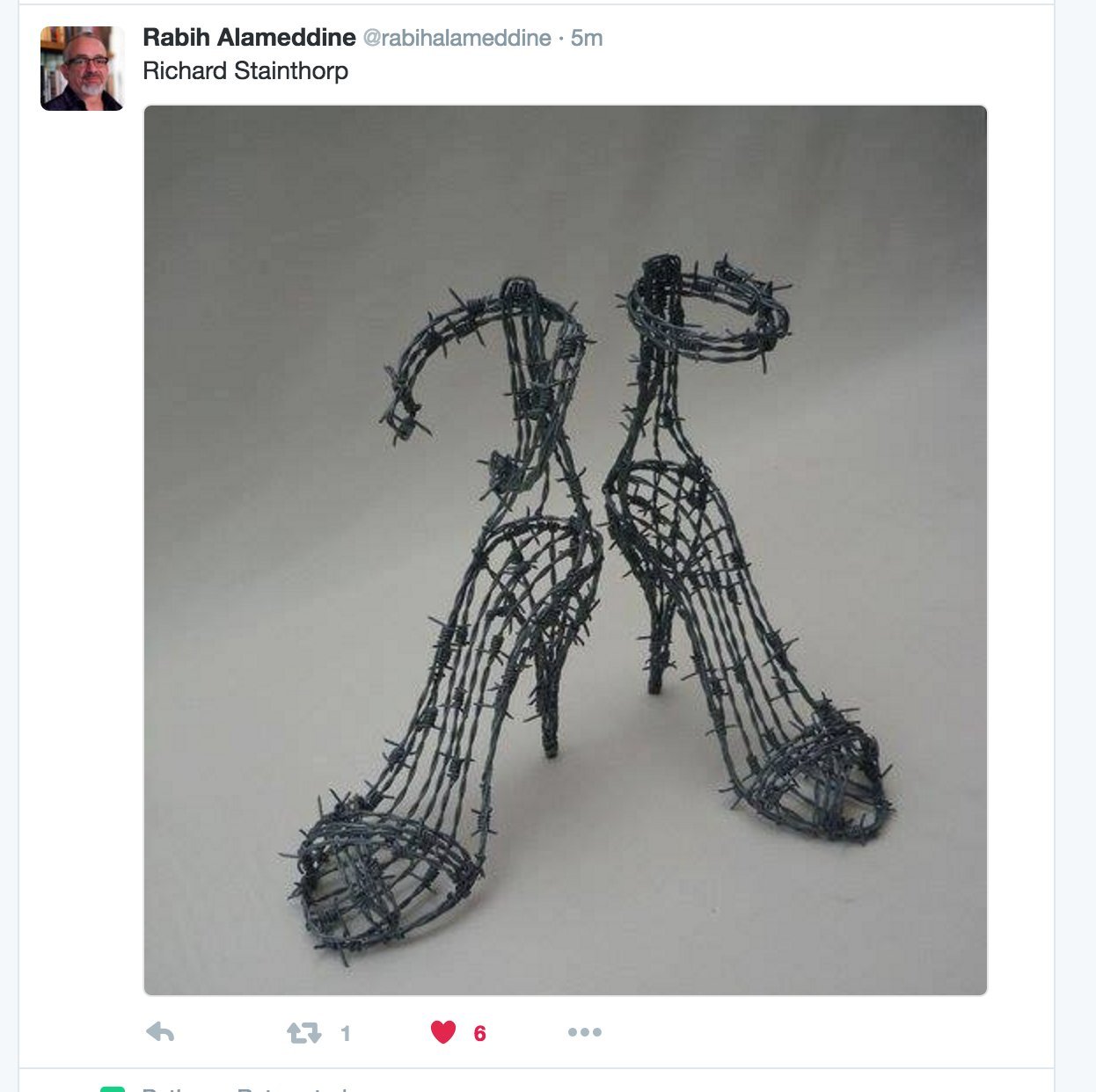
Richard Stainthorp's wire sculpture (hat tip to Rabih Alameddine) makes the pain of very high heels visceral: Ouch!
High heels are almost compulsory in fashion photographs, even so high heels that nobody could run in them should a saber-tooth tiger attack. The reason is that they make women's legs look longer and tilt their butts to an inviting angle (for saber-tooth tigers?).
Many items of clothing which are intended to signal female gender hurt*. Think of girdles which American women wore until fairly recently, think of Victorian corsets, think of those high-heeled shoes, think of dresses as tight as fish skin or belts pulled so small that the stomach commits suicide. All those are intended to showcase female beauty.
From the other end, modesty clothes (to hide female beauty), long dresses, niqabs or face veils, abayas or long cloaks, hurt in a different way. Abayas are stifling in hot climates, their bagginess means that they can catch on things which can result in accidents, and burqas, say, make women likely to stumble because they restrict vision . Hearing is harder through several layers of fabric, too. And in the colonial America women's long dresses could catch fire in the kitchens.
What both the "revealing" and the "covering" female-coded clothing share is that they make it much harder for someone to be physically active. A woman or a girl cannot run in them, she cannot play soccer in them, she cannot climb a tree in them. Even knee-length dresses make that tree climbing impossible, if anyone can look up that dress.
Is it female passivity that these gender-coded clothes are intended to promote**?
Never mind. No laws currently require American women and girls to wear girdles or high-heeled shoes or abayas, and it can be fun to take a little bit of pain when dressing up for a wild party.
But not all women on this earth are in an equally free position when it comes to their clothing. Both Iran and Saudi Arabia have laws which stipulate that all women inside their country's borders must wear the government's approved version of Islamic dress, including women who are not Muslims.
And then there's this recent British case:
A receptionist claims she was sent home from work at a corporate finance company after refusing to wear high heels.Thorp found out that nothing in the British laws stops firms from requiring that their female workers wear high heels***. I wonder if a British firm could demand that its male workers wear, say, codpieces? They don't seem to have the health risks that high heels do, after all. And I think they would look great!
Nicola Thorp, 27, from Hackney in east London, arrived on her first day at PwC in December in flat shoes but says she was told she had to wear shoes with a “2in to 4in heel”.
Thorp, who was employed as a temporary worker by PwC’s outsourced reception firm Portico, said she was laughed at when she said the demand was discriminatory and sent home without pay after refusing to go out and buy a pair of heels.
-------------------------
Please support this blog. It's the fund-raising week and I promise I won't spend the money on clothing.
* This tends not to be the case for clothing intended to show that someone is male, though men's business uniform (suit, tie, clunky dark shoes etc.) might be more restricting today than the equivalent women's business uniform (unless high heels are required).
That is an exception to the rule. In my opinion the reason is that the male business suit has not changed for roughly a century. When it was first created it was considerably more comfortable than female clothing of the era. But in the West women's clothes have changed a lot during those hundred years, while men's business suits have not.
** And if so, was it always the case? In the medieval era European women and men dressed more alike than they did for several centuries afterwards, with both sexes wearing tunic-type outfits. Women's tunics were longer than men's tunics, but close enough in style so that medieval wills sometimes leave clothing to individuals who are not the same sex as the person who made the will. I believe that it was the available technology and the great expense of cloth that caused this similarity. Gender was signaled by head-dresses and jewelry, not by most clothing.
It is only recently that the everyday clothing of the sexes has once again become pretty similar.
*** She launched a petition to change this.
Thursday, August 18, 2016
Life Is Complicated. A Re-Posting.
Originally from here.
Sometimes I despair of people's desire for very simple solutions to complicated problems. Life is complicated, human behavior is complicated and the causes for many phenomena are myriad and interacting. Yet what most people want are the kinds of explanations which can be made into television soundbites or which can be understood immediately by a person who has no training in the field.
Hence the popularity of, say, evolutionary psychology where my guesses about the past are as good as your guesses about the past, and neither one of us needs actual data from that imaginary past! We can just make up simple explanations. That's partly why those theories apply to so many. Why they apply to misogynists goes without saying.
Take that Search For Simple Answers to politics and you get Ron Paul believing in some weird god of free markets who will take care of everything for him. He's not the only politician or public person who loves Simple-But-Wrong-Answers, and they are not all on the right side of the political aisle. But that search for simplicity appears to be almost universal. And very wrong.
I've been following the obesity debates and the same thing is going on there: The Search For One Cause. It's much more likely that the causes are many and that they, once again, interact, though I'm willing to bet quite a lot that the most important part of that puzzle is some change in the practices of the food industry, sometime before 1980s. Other causes do, however, also exist. But the change in extreme obesity levels, in particular, was too fast to be caused purely by lifestyle changes and the shape of obesity itself looks to me to have changed as well. Fat deposits on the sides, even in an otherwise thin person, for instance.
The obesity debate is also interesting in revealing that unpleasant moralizing side of Americans (and probably people in general). If only we all had enough willpower we'd all be slim and supple! This turns the focus to purely individual solutions, purely individual failings and leaves the societal changes and frameworks unaffected. Never mind that the food industry advertises soft drinks all the time! Never mind that exercise has been cut in schools, that fears of pederasts make middle-class parents keep their children indoors and that the environment really is too dangerous for poor children to play outside. Never mind that healthy food is expensive and bad food is cheap. It's all about willpower and even that is assumed to be something you can acquire if you are good enough.
OK, that aside was more like a rant. It's a hot day here at Snakepit Inc..
The Search For Simple Answers often has false duality built into it. If the choices for an explanation are apples or bananas we tend to accept the initial setup and vote for either apples or bananas. But what if the cause is in both? Or in neither? Public political debates are usually set up in those falsely dualistic terms and any attempt to explain that things are more complicated becomes inaudible. For some weird reason.
Then take the reductio ad absurdum. This is a common trick in political debates: All liberals want to live off the government so that only conservatives end up working hard and paying all taxes. All feminists want to kill unborn babies.
Substitute your own reverse argument for that one. Then note how common such arguments are in political squabbling. There's no good way of responding to those arguments, by the way, not because they were true (they are not) but because the debate would deteriorate into addressing an absurd argument. Their point is not to present facts but to express loathing or hatred of the political opposition, and they work for that purpose.
The soundbite mode of public conversation makes things much worse, much more focused on short emotional comments. Think of Twitter or television programs. Television, in particular, may warp our understanding more than it aids it, given the short amount of time one has for presenting complex issues. The one with the funniest soundbite wins!
Wednesday, August 17, 2016
Why The Republican Alternative to ACA Would Fail
The Republicans presented their alternative to "Obamacare" (the Affordable Care Act or ACA) in June. That would be the system they are going to install once ACA is properly destroyed, stomped on and sent to the trash bins of history.
There's lots I could write about that alternative, too fluffy to be truly viewed as an alternative realistic proposal. But in this post I want to focus on one basic belief the conservatives will not let go:
If we only give consumers more choice and greater incentives to learn about prices then competition will drive the costs of health care down and the quality of health care up.
Here's the same statement from the Republican manifesto:
Unleashing the power of choice and competition is the best way to lower health care costs and improve quality. One way to immediately empower Americans and put them in the driver’s seat of their health care decisions is to expand consumer-driven health care. Consumer-driven health care allows individuals and families to control their utilization of health care by providing incentives to shop around. This ultimately lowers costs and increases quality.
The problem with that statement is that it is largely false, or that at least it is false in evaluating the bulk of health care expenditure. Greater consumer choice can lower costs when it comes to getting dental cleanings and check-ups, new eyeglasses and certain other simple-to-understand basic services essentially healthy people consume. But most of health care consumption is not of that sort, and consumer choice will not result in lower costs or higher quality.
For more detail on my counter-argument, the following earlier posts are useful:
This one and this one explain why health care markets are inherently not competitive markets, and this one (ignore the pre-ACA stuff and scroll down to the where-when-who-why part) gives more information about the characteristics of health care costs.
Finally, note that the Republican statement I quote also has that little bit about "providing incentives to shop around." What might those incentives be?
My guess is that they want people to pay more out of pocket and to rely more on their own savings for health care spending. But that, of course, means that health care would become less affordable to many individuals, especially those without high incomes.
That fits, in a way, given the Republican drive to abolish the Affordable Care Act.
Tuesday, August 16, 2016
For Your Toolkit 2.: The Challenge: Prove That Discrimination in Labor Markets Exists
This is the second post* in the toolkit series which tries to equip you with a few tools that might come handy in debates with people who don't believe in things such as labor market discrimination:
SleeZee Lyers in the comments to my earlier post on the gender gap in wages asks this question:
Regarding hidden discrimination, I would think that in the 50 years since the Equal Pay Act of 1963, that if such hidden sex associated wage discrimination as you hypothesize existed, that you would be able to find testimony to that effect from retired managers, retired executives, retired HR employees.
Surely someone must know and be ready to talk!
...
Occam's Razor isn't the be all and end all, but given a choice of personal choice / no discrimination or discrimination hidden by thousands for 50 years, I'd say the burden is on you to demonstrate that discimation.
This post is my answer to that Occam's Razor argument, though I wish to preface it with the fact that I believe the earnings differences reflect many reasons: Choice based on societal expectations about what is appropriate for women and men, gendered differences in family responsibilities, gendered preferences (whether innate or societally molded or both) and discrimination of various types. Thus, there is no reason to go for just one explanation, such as choice.
To return to the main point: That the burden is on me to demonstrate that gender discrimination exists in the labor markets:
First, there are fields of studies which do exactly that. The audit studies are one group. These consist of using trained actors, in this case men and women, to go out and apply for jobs in some industry. The actors are coached to say all the same things and they are provided with equally good resumes. The studies usually randomize the order in which they visit the firms and do other stuff to guarantee that the results make sense. The studies then measure call-back rates and other measures to see whether the female and male job applicants, otherwise the same, are treated the same.
The classic study in this field is a 1990s study about server job applications in Philadelphia restaurants. It demonstrates some discrimination against female applicants to server jobs at that time and in that place.
The other important example of studies which have demonstrated the impact of gender discrimination is the classical orchestra study. Musicians audit to get employed by orchestras. A simple change in auditing rule: introducing a screen so that the evaluators cannot observe the appearance of a musician but only his or her musical talent increased the probability that a female musician would be hired by an orchestra.
A further group of studies which can be used to study possible discrimination in hiring are the correspondence studies where various evaluators are asked to judge an application. Some evaluators get the application with a female name, others get the exactly same application with a male name. Given that the actual application is the same for both names, in the absence of any discrimination we would expect the average evaluations of the candidates to be the same.
This is sometimes the case in such studies, but not always. A recent study in this field shows that science faculty evaluated fictional female applicants to a laboratory manager position more severely than the fictional male applicant. In other words, being called "John" rather than "Jane" caused the same application to be treated less harshly and also resulted in higher estimated salary offer.
Both male and female evaluators treated "Jane" worse than "John," by the way. Thus, what these studies find is probably a societal and unconscious gender bias, not some kind of explicit discrimination by either men or women. Other studies in this field have also found that female evaluators are usually no less discriminatory than male evaluators.
Correspondence studies about gender do not always show discrimination just against women in gender studies. What seems to matter here is whether a job is regarded as somehow "belonging" to men or somehow "belonging to women." Women are judged more harshly in traditionally male-dominated occupations (such as science and in writing plays), men are judged more harshly (in at least some studies) in traditionally female-dominated occupations (such as secretarial work).
Most of this appears to be something the evaluators are unaware of. In other words, they are not explicitly singling out applicants with female or male names.
But note that whatever the causes for this might be, the likely effect this tendency has is to keep occupations more gender-segregated: Men are more likely to be hired in traditionally male occupations and more likely to be offered a higher starting salary, whereas the reverse applies to women in traditionally female occupations. That the latter occupations pay much less is, however, important to remember in this context, because the benefits the applicants accrue from being treated as "typical" for their occupations are smaller for women than for men, on average.
Second, the existence of discrimination can also be measured from court cases which decide for the plaintiff in gender discrimination cases. Such cases have appeared in the years since the 1960s and are too numerous to list here. A few examples: The AT&T case, the Price-Waterhouse v. Hopkins case and the Lily Ledbetter v. Goodyear Tire&Rubber Co case.
It is more difficult to study the existence of any possible gender discrimination in long-term labor contracts, because we cannot force actors to keep on acting roles over time and because it is much harder to control for individual differences in skills etc. under that setting. The multiple regression techniques which studies us are a way around that. If we could establish and measure all the variables which are non-discriminatory but which affect earnings, we could create studies where whatever gender difference we have been unable to account for after controlling for all those other variables would clearly be due to men and women being treated differently just on the basis of their gender. But in reality there are always variables we don't have data about. This means that the unexplained residual even in good studies could be an overestimate of discrimination.
At the same time, some of the variables which are included in the "neutral" category could themselves have a partially discriminatory background. For instance, in my earlier post I noted that if women don't get promoted into certain jobs then the fact that they are not in that job category terribly often might not be a "neutral" part of the explanation. That would require that occupations are simply chosen in the same way by both men and women.
This post is most likely a partial one. It probably should include a discussion of the different concepts of discrimination (including institutional discrimination etc.), but I think I have written enough for the time being.
------
* Originally from here.
Monday, August 15, 2016
John Tierney And His Woman Trouble Through The Ages
INTRODUCTION*
John Tierney is a right-wing libertarian science writer at the New York Times. Wikipedia describes him as follows:
Say hello to Mr. Tierney:
I read him a lot during his Op-Ed page years, less after those. To me he presented a different angle from that reflected in the above quote: He seemed to be a man who had never found an anti-uppity-woman study that didn't desperately need wider dissemination.
But it's always possible that I just happened to notice those columns by our John which worked against my beliefs, right? It could have been that Tierney's writing over his career was much more balanced and impartial.
It could have been, but it wasn't. Rather, Tierney used the space he was given to work against anything that just might allow women to be uppity. The way he linked "science" to this was by lavish use of one sub-branch of evolutionary psychology, the kind I call EP or Evolutionary Psychology, the kind which is in favor in cocktail party debates about gender, the kind which ignores all cultural influences on human beings and which often results in JustSo stories about human evolution (1).
Over time, the percentage of Tierney's columns which were on the topic of what's-wrong-with-uppity women or on the topic of gender-equality-is-scientifically-proven-to-be-impossible is far too high to happen by accident, and neither is it a random drawing from the gender studies which were published in any particular year (2). No. Johnnie just wanted to share with all the New York Times readers his views on women and so he picked those studies which support the same views.
Why would this matter? After all, everybody knows that Tierney writes opinions, not facts. He's like his brother-in-ideas, David Brooks, or like his sister-in-the-hatred-of-uppity-women, Maureen Dowd. Just what the New York Times thinks us women might find fascinating on those kinds of opinions, right?
I wrote this post to answer those questions (which I asked myself, in a deep-and-heated political debate!):
First, it is salutary and enlightening to see what Tierney has written about us womenfolk over the last decade or so, in one place, in short lists, with the basic contents highlighted. History brought to life! Facts gleaned from the dreck and pure noise of actual time passing, dinners, work, other articles and politics intervening! Just pure Tierney, bright as transparent glass! And it is great to see whom Tierney uses as experts on the "woman question." People like Christina Hoff Sommers and Roy Baumeister.
Second, it shows you how the culture around us will affect us, will affect the information we hold, the ideas we agree with and our general beliefs about what others believe. Sometimes those cultural effects are orchestrated, and hearing the orchestra and who is conducting it (Tierney! New York Times paying for the performances!) is an interesting and fun phenomenon.
Third, putting together the work of one influential science writer in one influential place tells us something about the way various voices are given microphones at newspapers, something about the way "the balancing" of Democrats and Republicans and libertarians etc. in the stables of writers works out in practice, and what it's possible consequences might be.
I decided to write this post now for no particular current-events related reasons, but because I want to clean up my never-posted archives, to tidy up everything, to tie up all the loose ends, and while doing that I found research I had started into Tierney's career (3). It seemed too good to waste, even though the research is not complete and doesn't pretend to reflect on the whole career of John Tierney (4). So I'm tossing it out by first tossing it here.
Before we move to Tierney's work itself, I want to stress this:
There's nothing wrong with Tierney covering certain opinions and studies which support those particular opinions. What's wrong, in the context of opinion writing in science, is ignoring other studies which don't support those opinions, over-using certain experts and not using others at all, and, in general, giving the impression that the studies one covers are somehow the consensus of all researchers in a particular field.
TIERNEY BY THE YEAR OF PUBLICATION
John Tierney is a right-wing libertarian science writer at the New York Times. Wikipedia describes him as follows:
In 2005 and 2006, he was a columnist on the Times Op-Ed page, before which he wrote a column about New York, "The Big City", that ran in the New York Times Magazine and the Metro section from 1994 to 2002.
Tierney identifies himself as a libertarian and has become increasingly identified with libertarianism. His columns have been critical of rent stabilization, the war on drugs, Amtrak and compulsory recycling. His 1996 article "Recycling Is Garbage" broke the New York Times Magazine's hate mail record.[2]
Joseph J. Romm has written that Tierney is one of the "influential but misinformed" skeptics who have helped prevent the U.S. from taking action on climate change. In his 2007 book, Hell and High Water, Romm cites, and claims to refute, what he calls Tierney's "misinformation".[3]
Say hello to Mr. Tierney:
I read him a lot during his Op-Ed page years, less after those. To me he presented a different angle from that reflected in the above quote: He seemed to be a man who had never found an anti-uppity-woman study that didn't desperately need wider dissemination.
But it's always possible that I just happened to notice those columns by our John which worked against my beliefs, right? It could have been that Tierney's writing over his career was much more balanced and impartial.
It could have been, but it wasn't. Rather, Tierney used the space he was given to work against anything that just might allow women to be uppity. The way he linked "science" to this was by lavish use of one sub-branch of evolutionary psychology, the kind I call EP or Evolutionary Psychology, the kind which is in favor in cocktail party debates about gender, the kind which ignores all cultural influences on human beings and which often results in JustSo stories about human evolution (1).
Over time, the percentage of Tierney's columns which were on the topic of what's-wrong-with-uppity women or on the topic of gender-equality-is-scientifically-proven-to-be-impossible is far too high to happen by accident, and neither is it a random drawing from the gender studies which were published in any particular year (2). No. Johnnie just wanted to share with all the New York Times readers his views on women and so he picked those studies which support the same views.
Why would this matter? After all, everybody knows that Tierney writes opinions, not facts. He's like his brother-in-ideas, David Brooks, or like his sister-in-the-hatred-of-uppity-women, Maureen Dowd. Just what the New York Times thinks us women might find fascinating on those kinds of opinions, right?
I wrote this post to answer those questions (which I asked myself, in a deep-and-heated political debate!):
First, it is salutary and enlightening to see what Tierney has written about us womenfolk over the last decade or so, in one place, in short lists, with the basic contents highlighted. History brought to life! Facts gleaned from the dreck and pure noise of actual time passing, dinners, work, other articles and politics intervening! Just pure Tierney, bright as transparent glass! And it is great to see whom Tierney uses as experts on the "woman question." People like Christina Hoff Sommers and Roy Baumeister.
Second, it shows you how the culture around us will affect us, will affect the information we hold, the ideas we agree with and our general beliefs about what others believe. Sometimes those cultural effects are orchestrated, and hearing the orchestra and who is conducting it (Tierney! New York Times paying for the performances!) is an interesting and fun phenomenon.
Third, putting together the work of one influential science writer in one influential place tells us something about the way various voices are given microphones at newspapers, something about the way "the balancing" of Democrats and Republicans and libertarians etc. in the stables of writers works out in practice, and what it's possible consequences might be.
I decided to write this post now for no particular current-events related reasons, but because I want to clean up my never-posted archives, to tidy up everything, to tie up all the loose ends, and while doing that I found research I had started into Tierney's career (3). It seemed too good to waste, even though the research is not complete and doesn't pretend to reflect on the whole career of John Tierney (4). So I'm tossing it out by first tossing it here.
Before we move to Tierney's work itself, I want to stress this:
There's nothing wrong with Tierney covering certain opinions and studies which support those particular opinions. What's wrong, in the context of opinion writing in science, is ignoring other studies which don't support those opinions, over-using certain experts and not using others at all, and, in general, giving the impression that the studies one covers are somehow the consensus of all researchers in a particular field.
TIERNEY BY THE YEAR OF PUBLICATION
Subscribe to:
Posts (Atom)